ECOSYSTEMIC PSYCHOLOGY
PYC4808
Assignment 2
ANALYSIS
2025
Perfectionist Notes
PRIVATE TUTOR FOR HONOURS IN PSYCHOLOGY
helping you achieve your best results
Document Contains:
Evidence for the answers FROM THE TEXTBOOK
, Property of Perfectionist Notes
Plagiarism/distribution/selling/illegal use of these notes will be prosecuted
Question 1
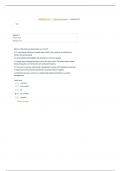
A student is falling dismally in her class. Her teacher is concerned about her
performance, and she refers her to a school psychologist. The school psychologist is not
interested in the cause of her low performance but rather how the student holistically
interacts with her academics and the school system and vice versa.
Which statement describes the cybernetic principle the school psychologist is
using?
a. School performance is related to genetics; the learner is performing badly because of
a genetic predisposition associated with a lack of intelligence.
b. People should be understood holistically in their own context, looking at mutual
connection and influence. Therefore, a psychologist could look at how the school
environment, learners, school curriculum, teachers and the learners engage with one
another and impact one another.
c. People usually grow and mature in the environments they are placed in, to maintain
stability, to allow one to function and adjust to environmental changes. Therefore, the
school psychologist must recognize how the learner integrates into the school system
and adapts to change.
d. People should consider how past behaviours can interact with the present. Therefore,
the school psychologist must look at the previous interactions of the learner, the school
environment, the school curriculum, teachers, and how they navigate them.
Additional Notes:
“The school psychologist is not interested in the cause of her low performance”
This directly correlates to Recursion in the textbook: “We are not interested in the cause of
a particular behavior or situation.” (Becvar & Becvar, 2014, pp. 69)
What are the principles of FOC?
➢ Recursion
➢ Feedback
➢ Morphogenesis/Morphostasis
➢ Rules and Boundaries
➢ Openness/closedness
➢ Entropy/Negentropy
➢ Equifinality/equipotentiality
PYC4808
Assignment 2
ANALYSIS
2025
Perfectionist Notes
PRIVATE TUTOR FOR HONOURS IN PSYCHOLOGY
helping you achieve your best results
Document Contains:
Evidence for the answers FROM THE TEXTBOOK
, Property of Perfectionist Notes
Plagiarism/distribution/selling/illegal use of these notes will be prosecuted
Question 1
A student is falling dismally in her class. Her teacher is concerned about her
performance, and she refers her to a school psychologist. The school psychologist is not
interested in the cause of her low performance but rather how the student holistically
interacts with her academics and the school system and vice versa.
Which statement describes the cybernetic principle the school psychologist is
using?
a. School performance is related to genetics; the learner is performing badly because of
a genetic predisposition associated with a lack of intelligence.
b. People should be understood holistically in their own context, looking at mutual
connection and influence. Therefore, a psychologist could look at how the school
environment, learners, school curriculum, teachers and the learners engage with one
another and impact one another.
c. People usually grow and mature in the environments they are placed in, to maintain
stability, to allow one to function and adjust to environmental changes. Therefore, the
school psychologist must recognize how the learner integrates into the school system
and adapts to change.
d. People should consider how past behaviours can interact with the present. Therefore,
the school psychologist must look at the previous interactions of the learner, the school
environment, the school curriculum, teachers, and how they navigate them.
Additional Notes:
“The school psychologist is not interested in the cause of her low performance”
This directly correlates to Recursion in the textbook: “We are not interested in the cause of
a particular behavior or situation.” (Becvar & Becvar, 2014, pp. 69)
What are the principles of FOC?
➢ Recursion
➢ Feedback
➢ Morphogenesis/Morphostasis
➢ Rules and Boundaries
➢ Openness/closedness
➢ Entropy/Negentropy
➢ Equifinality/equipotentiality