Respiration-2
2
Section 1: Structure and Function of the lung
1.1. Overview and Function
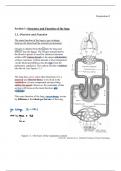
The main function of the lung is gas exchange
between the blood and the external environment.
Oxygen is inhaled from the& air into the lung and
diffuses into the blood. The oxygen transported by
=
the blood to tissues is used for chemical reactions
-
within cells; carbon dioxide is the major end-product
of those reactions. Carbon dioxide is also transported
via the blood and diffuses into the lung from the
pulmonary capillaries. The carbon dioxide is exhaled
into the air. (see figure 1.1.)
The lung does serve some other functions; it is a
reservoir and filter for blood, it involved in the
metabolism of some compounds and providing
airflow for speech. However, the remainder of this
section will focus on the main function; gas
exchange.
This main function of the lung, gas exchange, occurs
by diffusion at the blood-gas barrier of the lung.
(On + 802)
gas exchange
occurs
by diffusion at BGB
Fis law :
Figure 1.1. Overview of the respiratory system
(From W.J. Germann & C.L. Stanfield: Principles of Human Physiology)
, Respiration-3
3
1.1.1. Diffusion of gases
In general, the rate of diffusion of gas across a tissue sheet is described by Fick's law of dif-
fusion. This law states that the rate of gas transport across a tissue sheet is proportional to the
area of the sheet, a diffusion constant, and the difference in partial pressure, and is inversely
proportional to the thickness.
Fick’s Law: Vgas = (constant * (P1-P2))*A/T
where, Vgas = Volume of gas transferred per unit time
(P1-P2) = difference in partial pressures (see section 1.1.2)
A = Area of tissue sheet
T = Thickness of the tissue sheet
Constant = the diffusion constant => size of Moleck Ugus diffconst =
as
sorbing o
factors>
2
↑2 M W
solubility" Vgas *
.
The diffusion constant is proportional to the gas solubility but inversely proportional to the
square root of its molecular weight. In other words, the larger the molecule is the slower
diffusion occurs and the more soluble the molecule is in the tissue the faster diffusion occurs
As schematically shown in figure 1.1, based on Fick’s law it can be predicted that diffusion will
be fast when there is a large pressure gradient, a large surface area for diffusion and a thin
surface. In contrast, diffusion is slow when the pressure gradient is small, the surface area is
small and the tissue is relatively thick.
Thus, for efficient gas exchange in the lung by diffusion, the blood-gas barrier needs to be very
thin and have a large surface area.
Fast Diffusion
Slow Diffusion
O2 O2
O2 O2 O2 O2
O2 O2 O 2 O2
O2 O2 O2 O O2
O2 O2 O2 2
O 2 O2
Small pressure gradient
Large pressure gradient Small area
Large area Thick interface
Thin interface
Figure 1.2. Based on Fick’s law, diffusion occurs rapidly when there is a large pressure
gradient, a thin wall and a large surface area.
2
Section 1: Structure and Function of the lung
1.1. Overview and Function
The main function of the lung is gas exchange
between the blood and the external environment.
Oxygen is inhaled from the& air into the lung and
diffuses into the blood. The oxygen transported by
=
the blood to tissues is used for chemical reactions
-
within cells; carbon dioxide is the major end-product
of those reactions. Carbon dioxide is also transported
via the blood and diffuses into the lung from the
pulmonary capillaries. The carbon dioxide is exhaled
into the air. (see figure 1.1.)
The lung does serve some other functions; it is a
reservoir and filter for blood, it involved in the
metabolism of some compounds and providing
airflow for speech. However, the remainder of this
section will focus on the main function; gas
exchange.
This main function of the lung, gas exchange, occurs
by diffusion at the blood-gas barrier of the lung.
(On + 802)
gas exchange
occurs
by diffusion at BGB
Fis law :
Figure 1.1. Overview of the respiratory system
(From W.J. Germann & C.L. Stanfield: Principles of Human Physiology)
, Respiration-3
3
1.1.1. Diffusion of gases
In general, the rate of diffusion of gas across a tissue sheet is described by Fick's law of dif-
fusion. This law states that the rate of gas transport across a tissue sheet is proportional to the
area of the sheet, a diffusion constant, and the difference in partial pressure, and is inversely
proportional to the thickness.
Fick’s Law: Vgas = (constant * (P1-P2))*A/T
where, Vgas = Volume of gas transferred per unit time
(P1-P2) = difference in partial pressures (see section 1.1.2)
A = Area of tissue sheet
T = Thickness of the tissue sheet
Constant = the diffusion constant => size of Moleck Ugus diffconst =
as
sorbing o
factors>
2
↑2 M W
solubility" Vgas *
.
The diffusion constant is proportional to the gas solubility but inversely proportional to the
square root of its molecular weight. In other words, the larger the molecule is the slower
diffusion occurs and the more soluble the molecule is in the tissue the faster diffusion occurs
As schematically shown in figure 1.1, based on Fick’s law it can be predicted that diffusion will
be fast when there is a large pressure gradient, a large surface area for diffusion and a thin
surface. In contrast, diffusion is slow when the pressure gradient is small, the surface area is
small and the tissue is relatively thick.
Thus, for efficient gas exchange in the lung by diffusion, the blood-gas barrier needs to be very
thin and have a large surface area.
Fast Diffusion
Slow Diffusion
O2 O2
O2 O2 O2 O2
O2 O2 O 2 O2
O2 O2 O2 O O2
O2 O2 O2 2
O 2 O2
Small pressure gradient
Large pressure gradient Small area
Large area Thick interface
Thin interface
Figure 1.2. Based on Fick’s law, diffusion occurs rapidly when there is a large pressure
gradient, a thin wall and a large surface area.