ECON 333 Lesson 2 Review
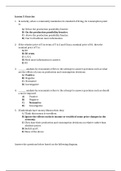
ECON 333 Lesson 2 Review Lesson 2: Exercise 1. In autarky, when a community maximizes its standard of living, its consumption point is: A) Below the production possibility frontier. B) On the production possibility frontier. C) Above the production possibility frontier. D) Can’t tell without more information. 2. If the relative price of S in terms of T is 2 and S has a nominal price of $1, then the nominal price of T is: A) $2. B) 50 cents. C) 1/2 S. D) Need more information to answer. E) $3 3. ________ analysis by economists refers to the attempt to answer questions such as what are the effects of a tax on production and consumption decisions. A) Positive B) Negative C) Normative D) Investigative 4. ________ analysis by economists refers to the attempt to answer questions such as should a tax be imposed. A) Positive B) Negative C) Normative D) Investigative 5. If individuals have money illusion then they: A) Think that money is worthless. B) Ignore the effects on their income or wealth of some price changes in the economy. C) They base their production and consumption decisions on relative rather than absolute prices. D) Both B and C. E) None of the above. Answer the questions below based on the following diagram. 6. The relative price of T (in terms of S) is: A) 2. B) 1/2. C) 500. D) 1000. E) None of the above. 7. If the relative price of S were to increase, then the budget constraint would: A) Shift out in a parallel fashion. B) Shift in in a parallel fashion. C) Become steeper. D) Become flatter. Answer the question below based on the following diagram. 8. Which of the following is true? A) The relative price of S is higher at G than at D. B) The relative price of T is higher at C than at F. C) A move from D to C would raise community satisfaction. D) Two of the above are true. 9. In autarky equilibrium, the relative price is given by the slope of the production possibility frontier at point A) D. B) E. C) F. D) G E) Can't answer without more information. 10. Suppose that country A produces two goods under conditions of constant opportunity costs. Given its resources, the maximum C that it can make is 400 units, and the opportunity cost of making T is 2 units of C given up. What is the maximum amount of T that country A can produce? A) 800 T B) 200 T C) 2 T D) 1/2 T 11. If the relative price of Chemicals in terms of Textiles is 4 and Chemicals have a nominal price of $1, then the nominal price of Textiles is A) $4. B) 1/4 of a Chemical. C) C) 3 Chemicals D) 25 cents. 12. A country produces two goods, raisins and peanuts. The market price of peanuts is $8 per pound and the market price of raisins is $4 per pound. What is the relative price of peanuts? A) $2 B) $8 C) 2 pounds of raisins D) ½ of a pound of raisins 13. If a country has a straight line downward sloping production possibilities frontier, then production is said to be subject to A) first increasing and then decreasing opportunity costs. B) decreasing opportunity costs. C) constant opportunity costs. D) increasing opportunity 14. Answer the questions below based on the following diagram. Refer to the figure above. The opportunity cost of 1 additional S is A) 1000 S given up. B) 500 T given up. C) 2 T given up. D) 1/2 T given up. E) None of the above. 15. An indifference curve A) is a bundles of goods that each yield the same level of satisfaction to an individual consumer. B) is a bundles of goods such that the consumer is indifferent between each good in every bundle. C) is a bundles of goods such that each good in every bundle yields equal satisfaction. D) All of the above are correct. E) None of the above. 16. In autarky, when a community maximizes its standard of living, its consumption point is A) below the production possibility frontier. B) on the production possibility frontier. C) can't tell without more information. D) above the production possibility frontier. 17. The slope of a country's PPF reflects A) the opportunity cost of the good on the horizontal axis measured in terms of money prices. B) the opportunity cost of the product on the horizontal axis measured in terms of the product on the vertical axis. C) the opportunity cost of the product on the vertical axis measured in terms of the product on the horizontal axis. D) Both A and B are correct. 18. Tastes of individuals are represented by A) the production possibility frontier. B) the price line. C) the indifference curve. D) the production function. E) the budget constraint. 19. Answer the question below based on the following diagram. Refer to the figure above. In autarky, the economy would be in general equilibrium at point A) E B) I C) F D) D 20. Refer to the figure above in 19. If tastes were to change so that S became more preferred relative to T, then, in autarky, production and consumption would move from their initial equilibrium to a point such as A) F B) D C) E D) H E) S More exercise! 1. Consider a country facing a constant opportunity cost PPF. This country makes two goods, S and T. The maximum amount of S that this country could produce is 45, and the maximum amount of T that this country could produce is 15. a) Draw a graph showing PPF line. Make sure you label everything. Place good S on the x-axis. b) The relative price of T (in terms of S) is___________. c) The opportunity cost of 1 additional S is__________. d) According to your answer in b) and c), interpret your result. 2. A country produces 2 goods: C and T. Assume this country is at point “A” on its increasing opportunity cost PPF where the slope of the PPF is flatter (more horizontal) than the slope of the CIC touching that same point. a. TRUE or FALSE? The standard of living would rise if the country moved away from production point “A”, down along the PPF to another point called “B”. Demonstrate GRAPHICALLY using the axes shown below. Place Textiles on the vertical axis of your graph and Chemicals on the horizontal axis. Make sure you label the axes, the PPF, the CICs, point A and point B. Briefly explain your result 3. The economy has 800 units of capital (K) and 800 units of labor (L) and makes yogurt and cheese. The production technology to make 1 unit of: Yogurt: requires 2K or 1L Cheese: require 1K or 2L a) What are the intercepts? Illustrate this on a graph (place yogurt on the vertical axis) b) What is the output bundle if we divide K and L evenly between yogurt and cheese? c) What happens to total output if we use only L to make yogurt and only K to make cheese? d) Show your answer to part c) with a graph (place yogurt on the vertical axis)
Escuela, estudio y materia
- Institución
- Penn State University
- Grado
- ECON 333 Lesson 2 Review
Información del documento
- Subido en
- 21 de septiembre de 2020
- Número de páginas
- 9
- Escrito en
- 2020/2021
- Tipo
- Examen
- Contiene
- Preguntas y respuestas
Temas
-
econ 333 lesson 2 review

Documento también disponible en un lote