Child Dev 001 Notes
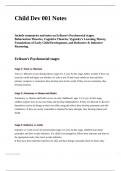
Include summaries and notes on Erikson’s Psychosocial stages,
Behaviorism Theories, Cognitive Theories, Vygotsky’s Learning Theory,
Foundations of Early Child Development, and Deductive & Inductive
Reasoning.
Erikson’s Psychosocial stages
Stage 1: Trust vs. Mistrust
Trust vs. Mistrust occurs during infancy (ages 0-1.5 yrs). At this stage, babies wonder if they can
trust the world and figure out whether it’s safe or not. If their basic needs are met and their
primary caregiver is consistent, they develop trust in the world. If they are not consistent, they
develop mistrust.
Stage 2: Autonomy vs Shame and Doubt
Autonomy vs. Shame and Doubt occurs in early childhood ( ages 1.5-3 yrs). At this stage,
toddlers explore how to use your body and develop independence. If they are allowed to discover
themselves and to do things on their own (like using the toilet), they develop autonomy and self-
confidence. If they are overly controlled or shamed for their attempts, they develop shame and
doubt.
Stage 3: Initiative vs. Guilt.
Initiative vs. Guilt occurs for preschoolers (ages 3-5 yrs). In this stage, children learn basic
principles and how to take initiative. If a child is encouraged to follow their interests and learn to
do appropriate tasks, they learn to take initiative.
If they have been told their interests are silly and have things constantly done for them, they
Child Dev 001 Notes 1
, develop guilt and entitlement:
Stage 4: Industry vs Inferiority
Industry vs. Inferiority occurs during the elementary school years (ages 5-12 yrs). At this stage,
children are focused on learning and mastering new academic and social skills. If they are
encouraged and feel competent in their efforts, they develop industry, a sense of being capable
and productive. However, if they face constant criticism or feel like they don't measure up, they
can develop feelings of inferiority.
Stage 5: Identity vs. Role Confusion
Identity vs. Role Confusion occurs for adolescences (ages 12-18 yrs).This stage is a critical
period where teenagers search for their sense of self. They explore different roles, beliefs, and
values to answer the question, "Who am I?" Successfully navigating this exploration leads them
to develop a strong sense of identity. If they struggle to define themselves or are pressured into
roles that don't fit who they are, they may experience role confusion, feeling uncertain about
their place in the world.
Stage 6: Intimacy vs. Isolation
Intimacy vs. Isolation occurs during early adulthood (ages 18-40 yrs ). Individuals, having
formed a sense of self, are ready to form deep, meaningful relationships. Success in this stage
means developing intimacy, which involves forming close, loving bonds with others, whether in
friendships or romantic relationships. If they are unable to form these connections, they may
experience isolation and loneliness.
Stage 7: Generativity vs. Stagnation
Generativity vs. Stagnation spans middle adulthood (ages 40-65 yrs). This stage focuses on
contributing to the next generation or society as a whole. Generativity means finding ways to
give back, raise children, mentor others, or be productive in one's work and community. If
individuals don't find ways to contribute, they can experience stagnation, feeling unproductive,
uninvolved, and self-absorbed.
Child Dev 001 Notes 2
Include summaries and notes on Erikson’s Psychosocial stages,
Behaviorism Theories, Cognitive Theories, Vygotsky’s Learning Theory,
Foundations of Early Child Development, and Deductive & Inductive
Reasoning.
Erikson’s Psychosocial stages
Stage 1: Trust vs. Mistrust
Trust vs. Mistrust occurs during infancy (ages 0-1.5 yrs). At this stage, babies wonder if they can
trust the world and figure out whether it’s safe or not. If their basic needs are met and their
primary caregiver is consistent, they develop trust in the world. If they are not consistent, they
develop mistrust.
Stage 2: Autonomy vs Shame and Doubt
Autonomy vs. Shame and Doubt occurs in early childhood ( ages 1.5-3 yrs). At this stage,
toddlers explore how to use your body and develop independence. If they are allowed to discover
themselves and to do things on their own (like using the toilet), they develop autonomy and self-
confidence. If they are overly controlled or shamed for their attempts, they develop shame and
doubt.
Stage 3: Initiative vs. Guilt.
Initiative vs. Guilt occurs for preschoolers (ages 3-5 yrs). In this stage, children learn basic
principles and how to take initiative. If a child is encouraged to follow their interests and learn to
do appropriate tasks, they learn to take initiative.
If they have been told their interests are silly and have things constantly done for them, they
Child Dev 001 Notes 1
, develop guilt and entitlement:
Stage 4: Industry vs Inferiority
Industry vs. Inferiority occurs during the elementary school years (ages 5-12 yrs). At this stage,
children are focused on learning and mastering new academic and social skills. If they are
encouraged and feel competent in their efforts, they develop industry, a sense of being capable
and productive. However, if they face constant criticism or feel like they don't measure up, they
can develop feelings of inferiority.
Stage 5: Identity vs. Role Confusion
Identity vs. Role Confusion occurs for adolescences (ages 12-18 yrs).This stage is a critical
period where teenagers search for their sense of self. They explore different roles, beliefs, and
values to answer the question, "Who am I?" Successfully navigating this exploration leads them
to develop a strong sense of identity. If they struggle to define themselves or are pressured into
roles that don't fit who they are, they may experience role confusion, feeling uncertain about
their place in the world.
Stage 6: Intimacy vs. Isolation
Intimacy vs. Isolation occurs during early adulthood (ages 18-40 yrs ). Individuals, having
formed a sense of self, are ready to form deep, meaningful relationships. Success in this stage
means developing intimacy, which involves forming close, loving bonds with others, whether in
friendships or romantic relationships. If they are unable to form these connections, they may
experience isolation and loneliness.
Stage 7: Generativity vs. Stagnation
Generativity vs. Stagnation spans middle adulthood (ages 40-65 yrs). This stage focuses on
contributing to the next generation or society as a whole. Generativity means finding ways to
give back, raise children, mentor others, or be productive in one's work and community. If
individuals don't find ways to contribute, they can experience stagnation, feeling unproductive,
uninvolved, and self-absorbed.
Child Dev 001 Notes 2