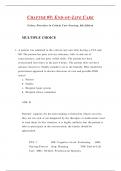
C HAPTER 09: E ND - OF -L IFE C ARE
Urden: Priorities in Critical Care Nursing, 8th Edition
MULTIPLE CHOICE
1. A patient was admitted to the critical care unit after having a CVA and
MI. The patient ha s poor activit y tolerance, falls in and out of
consciousness, and has poor verbal skills. The patient has been
resuscitated four times in the past 6 hours. The patient does not have
advance directives. Famil y members are at the bedside. Who should the
practitioner approach to discuss decisions of care and possible DNR
status?
a. Patient
b. Famil y
c. Hospital legal system
d. Hospital ethics committee
ANS: B
Patients’ capacit y for decision making is limited by illness severit y;
they are too sick or are hampered by the therapies or medications used
to treat them. In this situation, it is highly unlikel y that the patient is
able to participate in the conversation, the famil y should be
approached.
PTS: 1 DIF: Cognitive Level: Evaluating OBJ:
Nursing Process Step: Planning TOP: End-of-Life
Care MSC: NC LEX: Psychosocial Integrit y
, 2. Hospice care is an option that should be considered, especially in end -
stage illness. Hospice care can help families with which issue(s)?
a. Organ and tissue donations
b. Symptom management and fa mil y support
c. Procurement of advance directives and living wills
d. Legal and voluntary euthanasia
ANS: B
Health professionals can assist patients and families by providing
information about the hospice benefit, particularl y regarding the
aggressive symptom management and famil y support. Organ donations
must follow Social Securit y Act Section 1138 regarding written
protocols for identification of potential organ donors and notification
of organ recovery agencies. Advance directives can be taken care of at
the hospital or legal firm. Euthanasia generall y not offered through
hospice.
PTS: 1 DIF: Cognitive Level: Understanding OBJ: Nursing
Process Step: Planning TOP: End-of-Life Care MSC:
NCLEX: Psychosocial Integrit y
3. In caring for a patient receiving pal liative care, antiemetics are used in
the treatment of what problem?
a. Dyspnea
b. Nausea and vomiting
c. Anxiet y
d. Edema
Urden: Priorities in Critical Care Nursing, 8th Edition
MULTIPLE CHOICE
1. A patient was admitted to the critical care unit after having a CVA and
MI. The patient ha s poor activit y tolerance, falls in and out of
consciousness, and has poor verbal skills. The patient has been
resuscitated four times in the past 6 hours. The patient does not have
advance directives. Famil y members are at the bedside. Who should the
practitioner approach to discuss decisions of care and possible DNR
status?
a. Patient
b. Famil y
c. Hospital legal system
d. Hospital ethics committee
ANS: B
Patients’ capacit y for decision making is limited by illness severit y;
they are too sick or are hampered by the therapies or medications used
to treat them. In this situation, it is highly unlikel y that the patient is
able to participate in the conversation, the famil y should be
approached.
PTS: 1 DIF: Cognitive Level: Evaluating OBJ:
Nursing Process Step: Planning TOP: End-of-Life
Care MSC: NC LEX: Psychosocial Integrit y
, 2. Hospice care is an option that should be considered, especially in end -
stage illness. Hospice care can help families with which issue(s)?
a. Organ and tissue donations
b. Symptom management and fa mil y support
c. Procurement of advance directives and living wills
d. Legal and voluntary euthanasia
ANS: B
Health professionals can assist patients and families by providing
information about the hospice benefit, particularl y regarding the
aggressive symptom management and famil y support. Organ donations
must follow Social Securit y Act Section 1138 regarding written
protocols for identification of potential organ donors and notification
of organ recovery agencies. Advance directives can be taken care of at
the hospital or legal firm. Euthanasia generall y not offered through
hospice.
PTS: 1 DIF: Cognitive Level: Understanding OBJ: Nursing
Process Step: Planning TOP: End-of-Life Care MSC:
NCLEX: Psychosocial Integrit y
3. In caring for a patient receiving pal liative care, antiemetics are used in
the treatment of what problem?
a. Dyspnea
b. Nausea and vomiting
c. Anxiet y
d. Edema