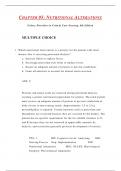
C HAPTER 05: N UTRITIONAL A LTERATIONS
Urden: Priorities in Critical Care Nursing, 8th Edition
MULTIPLE CHOICE
1. Which nutritional intervention is a priority for the patient with renal
disease who is receiving peritoneal dial ysis?
a. Increase fluids to replace losses.
b. Encourage potassium -rich foods to replace losses.
c. Ensure an adequate amount of protein to prevent catabolism.
d. Limit all nutrients to account for altered renal excretion.
ANS: C
Proteins and amino acids are removed during peritoneal dial ysis,
creating a greater nutritional requirement for protein. The renal patient
must receive an adequate amount of protein to prevent catabo lism of
body tissues to meet energy needs. Approximatel y 1.5 to 2.0 g
protein/kg/day is required. Certain nutrients such as potassium and
phosphorus are restricted because they are excreted by the kidney. The
patient has no specific requirement for the fat -soluble vitamins A, E,
and K because they are not removed in appreciable amounts by
dial ysis, and restriction generall y prevents development of toxicit y.
PTS: 1 DIF: Cognitive Level: Anal yzing OBJ:
Nursing Process Step: Implementation TOP:
Nutritional Alterations MSC: NC LEX: Physiological
Integrit y: Physiological Adaptation
, 2. The patient management plan for an intubated patient at risk for
aspiration should include which intervention?
a. Administer intermittent enteral feedings.
b. Add thickening agents to the tube feeding solution.
c. Suction the patient hourl y.
d. Elevate the head of the bed at least 45 degrees.
ANS: D
To reduce the risk of pulmonary aspiration during enteral tube feeding,
keep the patient’s head elevated at least 45 degrees during feedings,
unless contraindicated; keep the cuff of the artificial airway inflated
during feeding, if possible; monitor the patient for increasing
abdominal distention; and check tube placement before each feeding (if
intermittent) or at least every 4 to 8 hours if feed ings are continuous.
PTS: 1 DIF: Cognitive Level: Anal yzing OBJ: Nursing
Process Step: Implementation TOP: Nutritional
Alterations MSC: NC LEX: Physiological Integrit y:
Reduction of Risk Potential
3. A patient is admitted with severe malnutrition. A cent ral venous catheter
is placed in the right subclavian vein and TPN is started. For which
complication should the patient be evaluated immediatel y after insertion
of the catheter?
a. Pneumothorax
b. Hypogl ycemia
c. Central venous thrombosis
d. Pulmonary aspiration
Urden: Priorities in Critical Care Nursing, 8th Edition
MULTIPLE CHOICE
1. Which nutritional intervention is a priority for the patient with renal
disease who is receiving peritoneal dial ysis?
a. Increase fluids to replace losses.
b. Encourage potassium -rich foods to replace losses.
c. Ensure an adequate amount of protein to prevent catabolism.
d. Limit all nutrients to account for altered renal excretion.
ANS: C
Proteins and amino acids are removed during peritoneal dial ysis,
creating a greater nutritional requirement for protein. The renal patient
must receive an adequate amount of protein to prevent catabo lism of
body tissues to meet energy needs. Approximatel y 1.5 to 2.0 g
protein/kg/day is required. Certain nutrients such as potassium and
phosphorus are restricted because they are excreted by the kidney. The
patient has no specific requirement for the fat -soluble vitamins A, E,
and K because they are not removed in appreciable amounts by
dial ysis, and restriction generall y prevents development of toxicit y.
PTS: 1 DIF: Cognitive Level: Anal yzing OBJ:
Nursing Process Step: Implementation TOP:
Nutritional Alterations MSC: NC LEX: Physiological
Integrit y: Physiological Adaptation
, 2. The patient management plan for an intubated patient at risk for
aspiration should include which intervention?
a. Administer intermittent enteral feedings.
b. Add thickening agents to the tube feeding solution.
c. Suction the patient hourl y.
d. Elevate the head of the bed at least 45 degrees.
ANS: D
To reduce the risk of pulmonary aspiration during enteral tube feeding,
keep the patient’s head elevated at least 45 degrees during feedings,
unless contraindicated; keep the cuff of the artificial airway inflated
during feeding, if possible; monitor the patient for increasing
abdominal distention; and check tube placement before each feeding (if
intermittent) or at least every 4 to 8 hours if feed ings are continuous.
PTS: 1 DIF: Cognitive Level: Anal yzing OBJ: Nursing
Process Step: Implementation TOP: Nutritional
Alterations MSC: NC LEX: Physiological Integrit y:
Reduction of Risk Potential
3. A patient is admitted with severe malnutrition. A cent ral venous catheter
is placed in the right subclavian vein and TPN is started. For which
complication should the patient be evaluated immediatel y after insertion
of the catheter?
a. Pneumothorax
b. Hypogl ycemia
c. Central venous thrombosis
d. Pulmonary aspiration