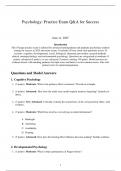
Psychology: Practice Exam Q&A for Success
June 11, 2025
Introduction
This 10-page practice exam is tailored for advanced undergraduate and graduate psychology students
aiming for success in 2025 university exams. It includes 50 new exam-style questions across 10
sections: cognitive, developmental, social, biological, abnormal, personality, research methods,
clinical, neuropsychology, and environmental psychology. Questions are categorized as moderate (3
points), advanced (5 points), or very advanced (7 points), totaling 130 points. Model answers are
evidence-based, with marking guidance for high scores and hints to avoid common errors. Pair with
primary texts for optimal preparation.
Questions and Model Answers
1. Cognitive Psychology
1. (3 points) Moderate: What is the primacy effect in memory? Provide an example.
2. (5 points) Advanced: How does the multi-store model explain memory forgetting? Include evi-
dence.
3. (7 points) Very Advanced: Critically evaluate the neural basis of the serial position effect, with
evidence.
4. (3 points) Moderate: Which bias involves over-relying on initial information?
A. Hindsight
B. Anchoring
C. Availability
D. Framing
5. (5 points) Advanced: How does the framing effect influence decision-making? Include evidence.
2. Developmental Psychology
1. (3 points) Moderate: What is object permanence in Piagets theory?
1
, 2. (5 points) Advanced: How does attachment theory explain social development? Include evi-
dence.
3. (7 points) Very Advanced: Critically evaluate attachment theorys cross-cultural applicability,
with evidence.
4. (3 points) Moderate: What is Kohlbergs preconventional morality?
5. (5 points) Advanced: How does Kohlbergs theory differ from Gilligans ethics of care?
3. Social Psychology
1. (3 points) Moderate: What is deindividuation? Provide an example.
2. (5 points) Advanced: How does cognitive dissonance theory explain attitude change? Include
evidence.
3. (7 points) Very Advanced: Critically evaluate cognitive dissonance in digital behavior, with evi-
dence.
4. (3 points) Moderate: What is the fundamental attribution error?
A. Ignoring situational factors
B. Overemphasizing group norms
C. Seeking external validation
D. Underestimating personal traits
5. (5 points) Advanced: How does realistic conflict theory explain intergroup tension?
4. Biological Psychology
1. (3 points) Moderate: What is the role of the thalamus in sensory processing?
2. (5 points) Advanced: How does serotonin influence mood regulation? Include evidence.
3. (7 points) Very Advanced: Critically evaluate serotonins role in anxiety disorders, with evidence.
4. (3 points) Moderate: Which brain region regulates hunger?
A. Hypothalamus
B. Amygdala
Page 2
June 11, 2025
Introduction
This 10-page practice exam is tailored for advanced undergraduate and graduate psychology students
aiming for success in 2025 university exams. It includes 50 new exam-style questions across 10
sections: cognitive, developmental, social, biological, abnormal, personality, research methods,
clinical, neuropsychology, and environmental psychology. Questions are categorized as moderate (3
points), advanced (5 points), or very advanced (7 points), totaling 130 points. Model answers are
evidence-based, with marking guidance for high scores and hints to avoid common errors. Pair with
primary texts for optimal preparation.
Questions and Model Answers
1. Cognitive Psychology
1. (3 points) Moderate: What is the primacy effect in memory? Provide an example.
2. (5 points) Advanced: How does the multi-store model explain memory forgetting? Include evi-
dence.
3. (7 points) Very Advanced: Critically evaluate the neural basis of the serial position effect, with
evidence.
4. (3 points) Moderate: Which bias involves over-relying on initial information?
A. Hindsight
B. Anchoring
C. Availability
D. Framing
5. (5 points) Advanced: How does the framing effect influence decision-making? Include evidence.
2. Developmental Psychology
1. (3 points) Moderate: What is object permanence in Piagets theory?
1
, 2. (5 points) Advanced: How does attachment theory explain social development? Include evi-
dence.
3. (7 points) Very Advanced: Critically evaluate attachment theorys cross-cultural applicability,
with evidence.
4. (3 points) Moderate: What is Kohlbergs preconventional morality?
5. (5 points) Advanced: How does Kohlbergs theory differ from Gilligans ethics of care?
3. Social Psychology
1. (3 points) Moderate: What is deindividuation? Provide an example.
2. (5 points) Advanced: How does cognitive dissonance theory explain attitude change? Include
evidence.
3. (7 points) Very Advanced: Critically evaluate cognitive dissonance in digital behavior, with evi-
dence.
4. (3 points) Moderate: What is the fundamental attribution error?
A. Ignoring situational factors
B. Overemphasizing group norms
C. Seeking external validation
D. Underestimating personal traits
5. (5 points) Advanced: How does realistic conflict theory explain intergroup tension?
4. Biological Psychology
1. (3 points) Moderate: What is the role of the thalamus in sensory processing?
2. (5 points) Advanced: How does serotonin influence mood regulation? Include evidence.
3. (7 points) Very Advanced: Critically evaluate serotonins role in anxiety disorders, with evidence.
4. (3 points) Moderate: Which brain region regulates hunger?
A. Hypothalamus
B. Amygdala
Page 2