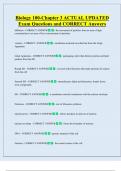
Biology 100-Chapter 3 ACTUAL UPDATED
Exam Questions and CORRECT Answers
diffusion - CORRECT ANSWER - the movement of particles from an area of high
concentration to an area of low concentration of particles
vesicles - CORRECT ANSWER - membrane enclosed sacs that bud from the Golgi
Apparatus
Golgi Apparatus - CORRECT ANSWER - packaging center that directs proteins and lipid
product from the ER
Rough ER - CORRECT ANSWER - covered with ribosomes that make proteins for export
from the cell
Smooth ER - CORRECT ANSWER - manufactures lipids and hormones, breaks down
toxic compounds
ER - CORRECT ANSWER - a membrane network continuous with the nuclear envelope
Nucleous - CORRECT ANSWER - site of ribosome synthesis
nuclear pores - CORRECT ANSWER - allows products in and out of nucleus
nuclear envelope - CORRECT ANSWER - forms the boundary of nucleus
DNA - CORRECT ANSWER - genetic material of the cell
Nucleus - CORRECT ANSWER - the control center of the cell
, phospholipid bilayer - CORRECT ANSWER - cell membranes are composed of
a:_______________
-transport regulation and cell protection
phospholipids - CORRECT ANSWER - organic molecules with a hydrophilic head and
hydrophobic tail
fluid mosaic - CORRECT ANSWER - describes your cell membrane, allows for
movement(fluid), multiple components(mosaic)
animals
plants
fungi - CORRECT ANSWER - examples of eukaryotes
unicellular bacteria - CORRECT ANSWER - example of prokaryote
centrosomes - CORRECT ANSWER - organize microtubules, contain 2 centrioles
microtubules - CORRECT ANSWER - aid in cell division, form a "trackway" for
organelles to move along the inside of a cell
intermediate filaments - CORRECT ANSWER - help maintain cell shape and bind cells
together
microfilaments - CORRECT ANSWER - thinnest component of cytoskeleton, provide
strength for cell, attach cells to one another
(ex: actin found in muscle cells)
Exam Questions and CORRECT Answers
diffusion - CORRECT ANSWER - the movement of particles from an area of high
concentration to an area of low concentration of particles
vesicles - CORRECT ANSWER - membrane enclosed sacs that bud from the Golgi
Apparatus
Golgi Apparatus - CORRECT ANSWER - packaging center that directs proteins and lipid
product from the ER
Rough ER - CORRECT ANSWER - covered with ribosomes that make proteins for export
from the cell
Smooth ER - CORRECT ANSWER - manufactures lipids and hormones, breaks down
toxic compounds
ER - CORRECT ANSWER - a membrane network continuous with the nuclear envelope
Nucleous - CORRECT ANSWER - site of ribosome synthesis
nuclear pores - CORRECT ANSWER - allows products in and out of nucleus
nuclear envelope - CORRECT ANSWER - forms the boundary of nucleus
DNA - CORRECT ANSWER - genetic material of the cell
Nucleus - CORRECT ANSWER - the control center of the cell
, phospholipid bilayer - CORRECT ANSWER - cell membranes are composed of
a:_______________
-transport regulation and cell protection
phospholipids - CORRECT ANSWER - organic molecules with a hydrophilic head and
hydrophobic tail
fluid mosaic - CORRECT ANSWER - describes your cell membrane, allows for
movement(fluid), multiple components(mosaic)
animals
plants
fungi - CORRECT ANSWER - examples of eukaryotes
unicellular bacteria - CORRECT ANSWER - example of prokaryote
centrosomes - CORRECT ANSWER - organize microtubules, contain 2 centrioles
microtubules - CORRECT ANSWER - aid in cell division, form a "trackway" for
organelles to move along the inside of a cell
intermediate filaments - CORRECT ANSWER - help maintain cell shape and bind cells
together
microfilaments - CORRECT ANSWER - thinnest component of cytoskeleton, provide
strength for cell, attach cells to one another
(ex: actin found in muscle cells)