WGU D659 Task 1: Feedback on Student Understanding & Mursion Reflection
Task 1 : Providing Feedback
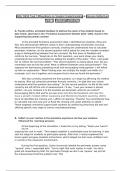
A. Provide written, actionable feedback to address the needs of two students based on
data trends observed in the "Formative Assessment Student Data" table, found in the
Supporting Documents section
In the provided formative assessment data, I identified two students, Mina and
Will, who demonstrate different needs in their understanding of perimeter and area.
Mina answered the first question correctly, showing she understands how to calculate
perimeter. However, on the second question which asked for area her mistake revealed
a gap in distinguishing between the two concepts. My first piece of feedback will
reinforce her success: “Great job on the first question, your work shows you clearly
understand how to find perimeter by adding the lengths of the sides.” Then, I will guide
her to rethink the second problem: “This second question is asking about area. Do you
remember how we find the area? What is different between area and perimeter?” This
supports her learning by prompting recall and encouraging metacognition. I will follow
up with an explanation: “When finding area, we multiply the length and width of a
rectangle. Let’s try it together and compare that to how we found the perimeter.”
Will also correctly answered the first question, so I begin by affirming his method
by saying “Nice job using the perimeter formula correctly, I’m glad that you clearly
understood what the question was asking.” On the second question, he did all the math
correctly but left off the unit of measurement. I’ll say: “I see your answer is almost
perfect, can you compare it to the example we discussed, what do you notice?”
Encouraging Will to find and fix his own error self-directed feedback will help him
have a growth mindset (WGU, Assessing and Monitoring Student Learning, 2025).
Once he identifies the missing unit, I affirm his learning: “Exactly! You remembered how
to calculate area and now you’ve fixed the missing unit, great attention to detail.”
These targeted comments support both students by reinforcing what they did well and
offering specific next steps to correct misunderstandings.
B. Reflect on your reaction to the simulation experience and how your emotions
influenced the learning process.
At the beginning of the simulation, I broke the ice by asking, “Raise your hand if
you’re
enjoying this unit in math.” This helped establish a comfortable tone for learning. It also
sets the stage for students to participate openly. After that, I clearly explained the
lesson goals and gave students instructions, which helped me feel more confident and
in control of the classroom environment.
During the first question, Carlos incorrectly labeled his perimeter answer using
“square” units. I responded with, “You’re right that units matter in math. You did a
great job remembering that! For perimeter though we don’t use ‘square’, we just list
the measurement that the problem has” This
Task 1 : Providing Feedback
A. Provide written, actionable feedback to address the needs of two students based on
data trends observed in the "Formative Assessment Student Data" table, found in the
Supporting Documents section
In the provided formative assessment data, I identified two students, Mina and
Will, who demonstrate different needs in their understanding of perimeter and area.
Mina answered the first question correctly, showing she understands how to calculate
perimeter. However, on the second question which asked for area her mistake revealed
a gap in distinguishing between the two concepts. My first piece of feedback will
reinforce her success: “Great job on the first question, your work shows you clearly
understand how to find perimeter by adding the lengths of the sides.” Then, I will guide
her to rethink the second problem: “This second question is asking about area. Do you
remember how we find the area? What is different between area and perimeter?” This
supports her learning by prompting recall and encouraging metacognition. I will follow
up with an explanation: “When finding area, we multiply the length and width of a
rectangle. Let’s try it together and compare that to how we found the perimeter.”
Will also correctly answered the first question, so I begin by affirming his method
by saying “Nice job using the perimeter formula correctly, I’m glad that you clearly
understood what the question was asking.” On the second question, he did all the math
correctly but left off the unit of measurement. I’ll say: “I see your answer is almost
perfect, can you compare it to the example we discussed, what do you notice?”
Encouraging Will to find and fix his own error self-directed feedback will help him
have a growth mindset (WGU, Assessing and Monitoring Student Learning, 2025).
Once he identifies the missing unit, I affirm his learning: “Exactly! You remembered how
to calculate area and now you’ve fixed the missing unit, great attention to detail.”
These targeted comments support both students by reinforcing what they did well and
offering specific next steps to correct misunderstandings.
B. Reflect on your reaction to the simulation experience and how your emotions
influenced the learning process.
At the beginning of the simulation, I broke the ice by asking, “Raise your hand if
you’re
enjoying this unit in math.” This helped establish a comfortable tone for learning. It also
sets the stage for students to participate openly. After that, I clearly explained the
lesson goals and gave students instructions, which helped me feel more confident and
in control of the classroom environment.
During the first question, Carlos incorrectly labeled his perimeter answer using
“square” units. I responded with, “You’re right that units matter in math. You did a
great job remembering that! For perimeter though we don’t use ‘square’, we just list
the measurement that the problem has” This