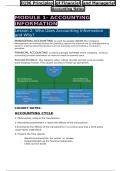
D196 Principles of Financial and Managerial
Accounting Notes
MODULE 1- ACCOUNTING
INFORMATION
Lesson 2: Who Uses Accounting Information
and Why?
MANAGERIAL ACCOUNTING is used by people INSIDE the company.
Management accounting focuses on providing reports for internal use by management to
assist in making operating decisions and in planning and controlling a company’s
activities.
FINANCIAL ACCOUNTING is used by people OUTSIDE of the company. Financial
accounting provides information to meet the needs of external users.
Societal Gridlock: this happens when critical records are lost such as simple
book keeping records. This causes society to freeze up operations.
COHORT NOTES:
ACCOUNTING CYCLE
1: Meticulously analyze the transactions
2: Record/document/make a report the effects of the transactions
3:Summarize the effects of the transactions in a concise way that a third party
could easily understand
4: Prepare the final reports
- Adjust/correct/reconcile the entries as needed
- Prepared/polish up the financial statements
- Close out the books
, D196 Principles of Financial and Managerial
Accounting Notes
THE BASIC ACCOUNTING EQUATION
ASSETS = LIABILITIES + OWNERS’ EQUITY
Definitions
- Assets: resources ($$$, people, things)
- Liabilities: any financing the funds resources to be repaid
- Owners’ Equity: This is the money invested into the business that does
NOT need to be repaid but represents ownership. “I own 51% of this
company! Don’t fuck with me fellas!”-Joan Crawford
- Revenues: any money coming in from sales The amount of assets
created through the sale of goods and services
- Expenses: costs of business
- Dividends: something we pay to investors
Equity types
- Owners’ Equity is for sole proprietor businesses.
- Partner’s Equity is for ‘partnership’ categorized business.
- Stockholders’ Equity is for businesses listed as Corporations.
The rule here is THE ASSET MUST EQUAL THE LIABILITIES PLUS EQUITY
If it doesn’t, we got
issues…
The balance sheet will show all of this.
CHART OF ACCOUNTS
This chart always has a name and a
number/ID. It goes in financial statement
order :assets first
, D196 Principles of Financial and Managerial
Accounting Notes
.
Equity is increased with money IN and decreased with money
OUT For example:
Increase: let’s say I own Sparky’s Sparkles Doggy Daycare and Spa. We receive
an investment into our company via cash and equipment. Cash $90,000.00 as
well as a brand new truckload of new luxury kennels worth about $33,000.00.
Add those 2 together ($123,000.00) and my EQUITY has now increased by that
amount.
Decrease: now we need to buy all new furniture for our waiting room, staff lounge,
and training/conference room. This will be about $7,000.00 and we barrow that
from our Business Line of Credit. This will fall into the Notes Payable category
under Liabilities and will go against our equity. Also the value of the furniture will go
into assets so it will show in our balance sheet twice.
If we bill a customer and they pay it in full. Say $320.00 that amount would go
under Accounts Rec. and Revenue.
Now we use credit for a $3,000 purchase. I pay that in full so that amount that was
in liabilities is now gone but also is the corresponding cash.
Expenses decrease equity. Expenses increase when we pay for business needs.
When someone pays us our cash increases but under accounts receivable it
shows a decrease or deletion because that A.R. is fulfilled.
THE 3 GENERAL-PURPOSE FINANCIAL STATEMENTS
The three general-purpose financial statements are the:
GENERAL-PURPOSE DEFINITION
FINANCIAL STATEMENT
TYPE
BALANCE SHEET A sheet that reports/shows the
resources of a company (the
assets), the company’s
obligations (the liabilities), and
the owners’ equity, which
represents the difference
between what is owned
, D196 Principles of Financial and Managerial
Accounting Notes
(assets) and what is owed
(liabilities).
INCOME STATEMENT A statement that reports/shows
the amount of net income
earned by the company during
a period of
time.
STATEMENT OF CASH FLOWS A statement that reports/shows
the amount of cash collected and
paid out by the company in the
following
three types of activities:
operating, investing, and
financing,
The financial statements are used by interested external
parties such as investors, creditors, competitors, and the
government as well as internal parties such as management,
suppliers and customers, and employees.
Lesson 3: Important Influences on Accounting
LESSON OBJECTIVE : Describe how accounting is influenced by external
accounting bodies.
ANSWER:
Accounting is directly influenced by external accounting bodies such as the
Financial Accounting Standards Board (FASB), International Accounting Standards
Board (IASB), and Securities and Exchange Commission (SEC). These
organizations set standards and regulations that govern how financial
information is recorded, reported, and disclosed by companies.
Overall, external accounting bodies play a crucial role in shaping accounting
practices and ensuring the accuracy and reliability of financial information for
investors, stakeholders, and regulators. Compliance with these standards is
essential for companies to uphold transparency, credibility, and accountability in
their financial reporting.
ACCOUNTING ENVIRONMENT
Within What Kind of Environment Does Accounting Operate?
There are three elements to this. The accounting organizations, the
ethics and the ethical standards that accountants are expected and
required to abide by, and technology and how does that impact
accounting.
How does each of the following relate to the accounting environment:
Organizations: That’s the main subject, the org. is the thing we are doing
Accounting Notes
MODULE 1- ACCOUNTING
INFORMATION
Lesson 2: Who Uses Accounting Information
and Why?
MANAGERIAL ACCOUNTING is used by people INSIDE the company.
Management accounting focuses on providing reports for internal use by management to
assist in making operating decisions and in planning and controlling a company’s
activities.
FINANCIAL ACCOUNTING is used by people OUTSIDE of the company. Financial
accounting provides information to meet the needs of external users.
Societal Gridlock: this happens when critical records are lost such as simple
book keeping records. This causes society to freeze up operations.
COHORT NOTES:
ACCOUNTING CYCLE
1: Meticulously analyze the transactions
2: Record/document/make a report the effects of the transactions
3:Summarize the effects of the transactions in a concise way that a third party
could easily understand
4: Prepare the final reports
- Adjust/correct/reconcile the entries as needed
- Prepared/polish up the financial statements
- Close out the books
, D196 Principles of Financial and Managerial
Accounting Notes
THE BASIC ACCOUNTING EQUATION
ASSETS = LIABILITIES + OWNERS’ EQUITY
Definitions
- Assets: resources ($$$, people, things)
- Liabilities: any financing the funds resources to be repaid
- Owners’ Equity: This is the money invested into the business that does
NOT need to be repaid but represents ownership. “I own 51% of this
company! Don’t fuck with me fellas!”-Joan Crawford
- Revenues: any money coming in from sales The amount of assets
created through the sale of goods and services
- Expenses: costs of business
- Dividends: something we pay to investors
Equity types
- Owners’ Equity is for sole proprietor businesses.
- Partner’s Equity is for ‘partnership’ categorized business.
- Stockholders’ Equity is for businesses listed as Corporations.
The rule here is THE ASSET MUST EQUAL THE LIABILITIES PLUS EQUITY
If it doesn’t, we got
issues…
The balance sheet will show all of this.
CHART OF ACCOUNTS
This chart always has a name and a
number/ID. It goes in financial statement
order :assets first
, D196 Principles of Financial and Managerial
Accounting Notes
.
Equity is increased with money IN and decreased with money
OUT For example:
Increase: let’s say I own Sparky’s Sparkles Doggy Daycare and Spa. We receive
an investment into our company via cash and equipment. Cash $90,000.00 as
well as a brand new truckload of new luxury kennels worth about $33,000.00.
Add those 2 together ($123,000.00) and my EQUITY has now increased by that
amount.
Decrease: now we need to buy all new furniture for our waiting room, staff lounge,
and training/conference room. This will be about $7,000.00 and we barrow that
from our Business Line of Credit. This will fall into the Notes Payable category
under Liabilities and will go against our equity. Also the value of the furniture will go
into assets so it will show in our balance sheet twice.
If we bill a customer and they pay it in full. Say $320.00 that amount would go
under Accounts Rec. and Revenue.
Now we use credit for a $3,000 purchase. I pay that in full so that amount that was
in liabilities is now gone but also is the corresponding cash.
Expenses decrease equity. Expenses increase when we pay for business needs.
When someone pays us our cash increases but under accounts receivable it
shows a decrease or deletion because that A.R. is fulfilled.
THE 3 GENERAL-PURPOSE FINANCIAL STATEMENTS
The three general-purpose financial statements are the:
GENERAL-PURPOSE DEFINITION
FINANCIAL STATEMENT
TYPE
BALANCE SHEET A sheet that reports/shows the
resources of a company (the
assets), the company’s
obligations (the liabilities), and
the owners’ equity, which
represents the difference
between what is owned
, D196 Principles of Financial and Managerial
Accounting Notes
(assets) and what is owed
(liabilities).
INCOME STATEMENT A statement that reports/shows
the amount of net income
earned by the company during
a period of
time.
STATEMENT OF CASH FLOWS A statement that reports/shows
the amount of cash collected and
paid out by the company in the
following
three types of activities:
operating, investing, and
financing,
The financial statements are used by interested external
parties such as investors, creditors, competitors, and the
government as well as internal parties such as management,
suppliers and customers, and employees.
Lesson 3: Important Influences on Accounting
LESSON OBJECTIVE : Describe how accounting is influenced by external
accounting bodies.
ANSWER:
Accounting is directly influenced by external accounting bodies such as the
Financial Accounting Standards Board (FASB), International Accounting Standards
Board (IASB), and Securities and Exchange Commission (SEC). These
organizations set standards and regulations that govern how financial
information is recorded, reported, and disclosed by companies.
Overall, external accounting bodies play a crucial role in shaping accounting
practices and ensuring the accuracy and reliability of financial information for
investors, stakeholders, and regulators. Compliance with these standards is
essential for companies to uphold transparency, credibility, and accountability in
their financial reporting.
ACCOUNTING ENVIRONMENT
Within What Kind of Environment Does Accounting Operate?
There are three elements to this. The accounting organizations, the
ethics and the ethical standards that accountants are expected and
required to abide by, and technology and how does that impact
accounting.
How does each of the following relate to the accounting environment:
Organizations: That’s the main subject, the org. is the thing we are doing