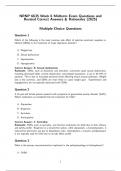
NRNP 6635 Week 6 Midterm Exam Questions and
Revised Correct Answers & Rationales (2025)
Multiple-Choice Questions
Question 1
Which of the following is the most common side effect of selective serotonin reuptake in-
hibitors (SSRIs) in the treatment of major depressive disorder?
A. Weight loss
B. Sexual dysfunction
C. Hypertension
D. Hypoglycemia
Correct Answer: B. Sexual dysfunction
Rationale: SSRIs, such as fluoxetine and sertraline, commonly cause sexual dysfunction,
including decreased libido, erectile dysfunction, and delayed ejaculation, in up to 30–70% of
patients. This is due to increased serotonin levels affecting sexual arousal pathways. Weight
loss is less common, and SSRIs are more likely to cause weight gain. Hypertension and
hypoglycemia are not typically associated with SSRIs.
Question 2
A 32-year-old female patient presents with symptoms of generalized anxiety disorder (GAD).
Which medication is considered first-line treatment for GAD?
A. Alprazolam
B. Buspirone
C. Sertraline
D. Amitriptyline
Correct Answer: C. Sertraline
Rationale: SSRIs, such as sertraline, are first-line treatments for GAD due to their efficacy
and safety profile. Buspirone is a second-line option, while alprazolam, a benzodiazepine, is
reserved for short-term use due to dependency risks. Amitriptyline, a tricyclic antidepressant,
is not typically used for GAD due to its side effect profile.
Question 3
What is the primary neurotransmitter implicated in the pathophysiology of schizophrenia?
A. GABA
1
, B. Dopamine
C. Serotonin
D. Acetylcholine
Correct Answer: B. Dopamine
Rationale: The dopamine hypothesis of schizophrenia suggests that dysregulation of dopamine,
particularly in the mesolimbic pathway, contributes to positive symptoms like hallucinations
and delusions. While serotonin and GABA play roles in schizophrenia, dopamine is the primary
neurotransmitter implicated.
Question 4
A patient with bipolar I disorder is prescribed lithium. Which laboratory test must be moni-
tored regularly to ensure safe use?
A. Complete blood count (CBC)
B. Thyroid function tests
C. Liver function tests
D. Lipid panel
Correct Answer: B. Thyroid function tests
Rationale: Lithium can cause hypothyroidism in up to 20% of patients, necessitating regular
monitoring of thyroid function tests (e.g., TSH, T4). While CBC and renal function tests are
also monitored, thyroid function is critical due to lithium’s direct impact on the thyroid gland.
Question 5
Which assessment tool is most appropriate for evaluating the severity of depression in an adult
patient?
A. Mini-Mental State Examination (MMSE)
B. Patient Health Questionnaire-9 (PHQ-9)
C. Generalized Anxiety Disorder-7 (GAD-7)
D. Montreal Cognitive Assessment (MoCA)
Correct Answer: B. Patient Health Questionnaire-9 (PHQ-9)
Rationale: The PHQ-9 is a validated tool specifically designed to assess the severity of
depression in adults based on DSM-5 criteria. The MMSE and MoCA evaluate cognitive
function, while the GAD-7 is used for anxiety.
Question 6
A patient with obsessive-compulsive disorder (OCD) is prescribed clomipramine. What is the
primary mechanism of action of this medication?
2
, A. Dopamine receptor antagonist
B. Serotonin reuptake inhibition
C. GABA receptor agonist
D. Norepinephrine reuptake inhibition
Correct Answer: B. Serotonin reuptake inhibition
Rationale: Clomipramine, a tricyclic antidepressant, primarily inhibits serotonin reuptake,
making it effective for OCD, which is driven by serotonin dysregulation. It also affects nore-
pinephrine but is less selective for it.
Question 7
Which of the following is a hallmark symptom of post-traumatic stress disorder (PTSD)?
A. Euphoria
B. Intrusive memories
C. Grandiosity
D. Anhedonia
Correct Answer: B. Intrusive memories
Rationale: Intrusive memories, such as flashbacks or nightmares, are a core symptom of
PTSD per DSM-5 criteria. Euphoria and grandiosity are associated with mania, while anhe-
donia is more typical of depression.
Question 8
A 45-year-old male patient with schizophrenia is prescribed risperidone. What is a potential
side effect that requires monitoring?
A. Hypothyroidism
B. Extrapyramidal symptoms
C. Hypoglycemia
D. Bradycardia
Correct Answer: B. Extrapyramidal symptoms
Rationale: Risperidone, a second-generation antipsychotic, can cause extrapyramidal symp-
toms (EPS) such as parkinsonism or dystonia due to dopamine D2 receptor blockade. Hy-
pothyroidism, hypoglycemia, and bradycardia are not commonly associated with risperidone.
Question 9
Which of the following medications requires a baseline electrocardiogram (ECG) before initi-
ation due to the risk of QT prolongation?
3
Revised Correct Answers & Rationales (2025)
Multiple-Choice Questions
Question 1
Which of the following is the most common side effect of selective serotonin reuptake in-
hibitors (SSRIs) in the treatment of major depressive disorder?
A. Weight loss
B. Sexual dysfunction
C. Hypertension
D. Hypoglycemia
Correct Answer: B. Sexual dysfunction
Rationale: SSRIs, such as fluoxetine and sertraline, commonly cause sexual dysfunction,
including decreased libido, erectile dysfunction, and delayed ejaculation, in up to 30–70% of
patients. This is due to increased serotonin levels affecting sexual arousal pathways. Weight
loss is less common, and SSRIs are more likely to cause weight gain. Hypertension and
hypoglycemia are not typically associated with SSRIs.
Question 2
A 32-year-old female patient presents with symptoms of generalized anxiety disorder (GAD).
Which medication is considered first-line treatment for GAD?
A. Alprazolam
B. Buspirone
C. Sertraline
D. Amitriptyline
Correct Answer: C. Sertraline
Rationale: SSRIs, such as sertraline, are first-line treatments for GAD due to their efficacy
and safety profile. Buspirone is a second-line option, while alprazolam, a benzodiazepine, is
reserved for short-term use due to dependency risks. Amitriptyline, a tricyclic antidepressant,
is not typically used for GAD due to its side effect profile.
Question 3
What is the primary neurotransmitter implicated in the pathophysiology of schizophrenia?
A. GABA
1
, B. Dopamine
C. Serotonin
D. Acetylcholine
Correct Answer: B. Dopamine
Rationale: The dopamine hypothesis of schizophrenia suggests that dysregulation of dopamine,
particularly in the mesolimbic pathway, contributes to positive symptoms like hallucinations
and delusions. While serotonin and GABA play roles in schizophrenia, dopamine is the primary
neurotransmitter implicated.
Question 4
A patient with bipolar I disorder is prescribed lithium. Which laboratory test must be moni-
tored regularly to ensure safe use?
A. Complete blood count (CBC)
B. Thyroid function tests
C. Liver function tests
D. Lipid panel
Correct Answer: B. Thyroid function tests
Rationale: Lithium can cause hypothyroidism in up to 20% of patients, necessitating regular
monitoring of thyroid function tests (e.g., TSH, T4). While CBC and renal function tests are
also monitored, thyroid function is critical due to lithium’s direct impact on the thyroid gland.
Question 5
Which assessment tool is most appropriate for evaluating the severity of depression in an adult
patient?
A. Mini-Mental State Examination (MMSE)
B. Patient Health Questionnaire-9 (PHQ-9)
C. Generalized Anxiety Disorder-7 (GAD-7)
D. Montreal Cognitive Assessment (MoCA)
Correct Answer: B. Patient Health Questionnaire-9 (PHQ-9)
Rationale: The PHQ-9 is a validated tool specifically designed to assess the severity of
depression in adults based on DSM-5 criteria. The MMSE and MoCA evaluate cognitive
function, while the GAD-7 is used for anxiety.
Question 6
A patient with obsessive-compulsive disorder (OCD) is prescribed clomipramine. What is the
primary mechanism of action of this medication?
2
, A. Dopamine receptor antagonist
B. Serotonin reuptake inhibition
C. GABA receptor agonist
D. Norepinephrine reuptake inhibition
Correct Answer: B. Serotonin reuptake inhibition
Rationale: Clomipramine, a tricyclic antidepressant, primarily inhibits serotonin reuptake,
making it effective for OCD, which is driven by serotonin dysregulation. It also affects nore-
pinephrine but is less selective for it.
Question 7
Which of the following is a hallmark symptom of post-traumatic stress disorder (PTSD)?
A. Euphoria
B. Intrusive memories
C. Grandiosity
D. Anhedonia
Correct Answer: B. Intrusive memories
Rationale: Intrusive memories, such as flashbacks or nightmares, are a core symptom of
PTSD per DSM-5 criteria. Euphoria and grandiosity are associated with mania, while anhe-
donia is more typical of depression.
Question 8
A 45-year-old male patient with schizophrenia is prescribed risperidone. What is a potential
side effect that requires monitoring?
A. Hypothyroidism
B. Extrapyramidal symptoms
C. Hypoglycemia
D. Bradycardia
Correct Answer: B. Extrapyramidal symptoms
Rationale: Risperidone, a second-generation antipsychotic, can cause extrapyramidal symp-
toms (EPS) such as parkinsonism or dystonia due to dopamine D2 receptor blockade. Hy-
pothyroidism, hypoglycemia, and bradycardia are not commonly associated with risperidone.
Question 9
Which of the following medications requires a baseline electrocardiogram (ECG) before initi-
ation due to the risk of QT prolongation?
3