W32 ggd gg65
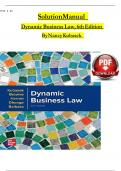
SolutionManual
g
Dynamic Business Law, 6th Edition
gg gg gg gg
By Nancy Kubasek
gg gg
,Chapter gg1 gg- ggAn ggIntroduction ggto ggDynamic ggBusiness ggLaw
CHAPTER gg OVERVIEW
Chapter g g One g g lays g g the g g foundation g g for g g the g g textbook. g g Make g g sure g g you g g look
g g on g g the g g publisher‘s g g web g g site g g for g g information ggabout gghow gg business gglaw ggintersects
gg with ggthe gg six gg functional gg areas gg of gg business. gg The gg ggauthors g g encourage ggstudents ggto
gg―connect gg to ggthe ggcore,‖ ggand ggremember ggthe ggways ggin ggwhich gglaw ggintersects ggwith ggother
ggareas g g of g g study, g g including g g corporate g g management, g g production g g and
g g transportation, g g marketing, g g research g g and g g development, ggaccounting ggand ggfinance,
ggand gghuman ggresource gg management.
This g g manual g g supports g g the g g ―connecting g g to g g the g g core‖ g g theme g g by g g giving g g ideas
g g for g g assignments g g that g g encourage g g students ggto g g integrate g g their g g business g g law
g g knowledge g g with g g knowledge g g they g g are g g acquiring g g from g g their g g other g g business
g g classes. g g The g g manual gg also gg encourages g g professors g g to g g improve g g their g g teaching g g skills.
gg Finally, g g the g g manual g g suggests ggteaching ggideas ggfor ggboth ggbeginning ggand ggexperienced
ggteachers.
LEARNING g g OBJECTIVES
After ggreading ggthis ggchapter, ggstudents ggwill ggbe ggable ggto:
1-1 Define ggbusiness gglaw.
1-2 Relate ggthe ggfunctional ggareas ggof ggbusiness ggto ggthe ggrelevant
areas ggof ggbusiness gglaw1- g g 3 ggRecall gg the ggpurposes ggof gglaw.
gg
1-4 Distinguish ggamong ggtypes ggof gglaw.
1-5 Differentiate ggbetween ggsources ggof ggthe gglaw.
1-6 Identify ggthe ggvarious ggschools ggof ggjurisprudence.
LECTURE gg NOTES g g WITH g g DEFINITIONS
In ggthe ggnews… Teaching gg tip: ggFor ggeach ggchapter, ggconsider ggasking ggstudents gg to ggrelate
ggcurrent gg news g g items ggto ggmaterial ggfrom ggthe ggchapter.
In g g addition g g to g g ideas g g students g g come g g up g g with g g on g g their g g own,
g g consider g g weaving g g in g g news ggstories ggprovided ggby ggthe ggMcGraw ggHill.
For ggChapter ggOne, ggMcGraw ggHill ggoffers ggthe ggfollowing ggstories:
―Smoking ggBan: ggTobacco ggTyrants: ggGone ggToo ggFar? ggMany ggStates
gg Are ggPutting g g Stronger ggRestrictions gg on ggWhere ggYou ggCan ggSmoke‖
Have ggstates gggone ggtoo ggfar ggin ggbanning ggsmoking?
, Whose g g interests g g are g g state g g legislatures g g looking
g g out g g for g g in g g banning g g smoking?
―College ggOfficer ggDealings ggWith ggLenders ggScrutinized.‖
Should ggregulators ggtake gga ggmore ggcareful gglook ggat ggcollege
ggofficers?
1-1 g g Define Why
Business created
law
g g gg ggchanges
g g consists g in
g g of gg ggthe
g the ways ggcollege
g gggenforceable officers
rules
g g gg g g ofgginteract
g g business g g law. with lenders?
g g conduct g g that g g govern g g commercial ggrelationships.
gg gg
1-2 ggRelate ggthe Business gglaw ggapplies ggto ggthe ggsix ggfunctional ggareas ggof ggbusiness:
g g functional Corporate ggmanagement
gg areas ggof
Production ggand ggtransportation
g g business ggto
ggthe g g relevant
Marketing
ggareas ggof Research ggand ggdevelopment
g g business gglaw. Accounting ggand ggfinance
Human ggresource ggmanagement
1-3 ggRecall Providing ggorder
gg the Serving ggas ggan ggalternative ggto ggfighting
g g purposes ggof
Facilitating gga ggsense ggthat ggchange ggis ggpossible
gglaw.
Encouraging ggsocial ggjustice
Guaranteeing ggpersonal ggfreedoms
Serving ggas gga ggmoral ggguide
1-4 ggDistinguish One ggway ggto ggclassify gglaw:
g g among ggtypes Private gglaw gginvolves ggdisputes ggbetween ggprivate ggindividuals ggor
ggof gglaw. gggroups.
Public g g law g g involves g g disputes g g between g g private g g individuals
g g or g g groups g g and g g their g g government.
A ggsecond ggway ggto ggclassify gglaw:
Civil gglaw gginvolves ggthe ggrights gg and ggresponsibilities gginvolved ggin
ggrelationshipsbetween g g persons ggand ggbetween ggpersons gg and ggtheir
gggovernment.
Criminal gglaw gg involves gg incidents ggin ggwhich gg someone gg commits g g an
gg act ggagainst g g the g g public ggas gga ggunit.
1-5 Teaching
Sources gg of tip:
g g gg g g Ask gg
business students
g glaw gg are:g g to g g give g g an g g example g g of g g a
gg Differentiate g g fact g g situation g g that g g led g g to g g both ggcriminal ggand ggcivil gg lawsuits,
1. Constitutions
g g between gge.g., ggthe ggO.J. ggSimpson ggtrials.
Constitutional g g law g g refers g g to g g the g g general g g limits g g and g g powers
ggsources ggof
g g of g g governments g g as g g stated ggin ggtheir ggwritten ggconstitutions.
g g the gglaw.
2. Statutes ggor gglegislative ggactions
3. Cases
Case g g law g g (or g g common g g law) g g is g g the g g collection g g of g g legal
g g interpretations g g made g g by g g judges.
Stare ggdecisis ggmeans ggcourts ggare ggrelying ggon ggprecedent.
Teaching g g tip: g g The g g first g g time g g your g g students g g encounter g g an
g g appellate g g case g g in g g the
, readings, ggshow ggthem ggwhat ggstare ggdecisis gglooks gglike ggin ggthe ggcontext
ggof gga ggreal ggcase.
4. Administrative gglaw
Administrative g g law g g is g g the g g collection g g of g g rules g g and
g g decisions g g made g g by g g administrative ggagencies.
5. Treaties
A g g treaty g g is g g a gg ggbinding g g agreement g g between g g two
g g states g g or g g international g g organizations.
6. gg g g Executive ggorders
An ggexecutive gg order ggis gg a ggdirective ggthat ggcomes gg from ggthe gg president
1-6 ggIdentify gg or ggstategovernor.
Schools gg of ggjurisprudence ggare ggcommon ggguides ggto gglegal gginterpretation.
ggthe g g various Natural g g law—certain g g ethical g g laws g g and g g principles g g are
ggschools ggof gg morally gg right g g and
g g jurisprudence.
―above‖ ggthe gglaws ggdevised ggby gghumans.
Legal g g Positivism—assumes g g the g g legitimate g g political
g g authority g g deserves g g our ggobedience ggwhen ggit ggissues gga
ggrule.
Identification ggwith ggthe ggVulnerable—emphasis gg on ggfairness
gg and gglooking g g out ggfor ggthose ggwith ggthe ggleast ggpower.
Historical ggSchool/Tradition—emphasis ggon ggthe gguse ggof ggstare
ggdecisis.
Legal ggRealism—judges ggconsider ggsocial ggand ggeconomic
ggconditions.
Cost-benefit ggAnalysis—make gg calculations gg to ggmaximize
Global ggand At g g this g g point g g in g g the g g textbook, g g students g g should g g merely
ggthe gg ratio gg of g g benefits gg to ggcosts.
g g Comparative g g have g g an g g awareness g g that g g globalization g g has g g affected g g the
ggLaw g scope g ggof
Teaching
g g g gbusiness
g tip: g Considerg g law.
g g usingg g Consequently,
g g ―The g g Case g g gwe
g of gggghighlight
the g g the
g gdefinitions
gg Speluncean ggto
g ggg the ggfollowing
Explorers g g (linkgggkey ggterms
g below) gg that
ggto ggwill
ggmake ggthe come
gg gggg ggup
schools gglater
gg of
in the book:
ggjurisprudence ggcome ggalive.
gg gg gg
Trade, g g i.e. g g the g g exchange g g of g g goods g g or g g services, g g on g g a
g g global g g scale g g has g g ledto g g the g g creation g g of g g trade
g g agreements g g that g g serve gg as g g de g g facto g g rules g g governing ggthe
g g global gg business gg environment.
Appendix ggon Comparative
Critical g g thinking gggglaw—the
includes ggggthe fieldg gggapplication
of gglaw ggthat ggstudies
g g of g g and
g g evaluative
ggCritical ggcompares
g g standards g g to ggg laws ggin g g different
g assess ggcountries.
the g g quality g g or g g the g g reasoning g g being
g g Thinking ggand g g offered g g to g g support g g the g g conclusion. g g Critical g g thinkers g g will ggfollow
g g Business ggthis ggpattern ggof ggcareful gg thinking ggwhen ggthey ggread gg ggan ggargument:
1. Find ggthe ggfacts.
2. Look ggfor ggthe ggissue.
3. Identify ggthe ggjudge‘s ggreasons ggand ggconclusion.
4. Locate ggin ggthe ggdecision ggthe ggrules ggof gglaw ggthat gggovern ggthe ggjudge‘s
ggreasoning.
5. Apply ggcritical ggthinking ggto ggthe ggreasoning. ggEvaluate ggthe ggreasoning.
Look ggfor ggpotential ggambiguity.
Consider ggthe ggstrength ggof gganalogies.
SolutionManual
g
Dynamic Business Law, 6th Edition
gg gg gg gg
By Nancy Kubasek
gg gg
,Chapter gg1 gg- ggAn ggIntroduction ggto ggDynamic ggBusiness ggLaw
CHAPTER gg OVERVIEW
Chapter g g One g g lays g g the g g foundation g g for g g the g g textbook. g g Make g g sure g g you g g look
g g on g g the g g publisher‘s g g web g g site g g for g g information ggabout gghow gg business gglaw ggintersects
gg with ggthe gg six gg functional gg areas gg of gg business. gg The gg ggauthors g g encourage ggstudents ggto
gg―connect gg to ggthe ggcore,‖ ggand ggremember ggthe ggways ggin ggwhich gglaw ggintersects ggwith ggother
ggareas g g of g g study, g g including g g corporate g g management, g g production g g and
g g transportation, g g marketing, g g research g g and g g development, ggaccounting ggand ggfinance,
ggand gghuman ggresource gg management.
This g g manual g g supports g g the g g ―connecting g g to g g the g g core‖ g g theme g g by g g giving g g ideas
g g for g g assignments g g that g g encourage g g students ggto g g integrate g g their g g business g g law
g g knowledge g g with g g knowledge g g they g g are g g acquiring g g from g g their g g other g g business
g g classes. g g The g g manual gg also gg encourages g g professors g g to g g improve g g their g g teaching g g skills.
gg Finally, g g the g g manual g g suggests ggteaching ggideas ggfor ggboth ggbeginning ggand ggexperienced
ggteachers.
LEARNING g g OBJECTIVES
After ggreading ggthis ggchapter, ggstudents ggwill ggbe ggable ggto:
1-1 Define ggbusiness gglaw.
1-2 Relate ggthe ggfunctional ggareas ggof ggbusiness ggto ggthe ggrelevant
areas ggof ggbusiness gglaw1- g g 3 ggRecall gg the ggpurposes ggof gglaw.
gg
1-4 Distinguish ggamong ggtypes ggof gglaw.
1-5 Differentiate ggbetween ggsources ggof ggthe gglaw.
1-6 Identify ggthe ggvarious ggschools ggof ggjurisprudence.
LECTURE gg NOTES g g WITH g g DEFINITIONS
In ggthe ggnews… Teaching gg tip: ggFor ggeach ggchapter, ggconsider ggasking ggstudents gg to ggrelate
ggcurrent gg news g g items ggto ggmaterial ggfrom ggthe ggchapter.
In g g addition g g to g g ideas g g students g g come g g up g g with g g on g g their g g own,
g g consider g g weaving g g in g g news ggstories ggprovided ggby ggthe ggMcGraw ggHill.
For ggChapter ggOne, ggMcGraw ggHill ggoffers ggthe ggfollowing ggstories:
―Smoking ggBan: ggTobacco ggTyrants: ggGone ggToo ggFar? ggMany ggStates
gg Are ggPutting g g Stronger ggRestrictions gg on ggWhere ggYou ggCan ggSmoke‖
Have ggstates gggone ggtoo ggfar ggin ggbanning ggsmoking?
, Whose g g interests g g are g g state g g legislatures g g looking
g g out g g for g g in g g banning g g smoking?
―College ggOfficer ggDealings ggWith ggLenders ggScrutinized.‖
Should ggregulators ggtake gga ggmore ggcareful gglook ggat ggcollege
ggofficers?
1-1 g g Define Why
Business created
law
g g gg ggchanges
g g consists g in
g g of gg ggthe
g the ways ggcollege
g gggenforceable officers
rules
g g gg g g ofgginteract
g g business g g law. with lenders?
g g conduct g g that g g govern g g commercial ggrelationships.
gg gg
1-2 ggRelate ggthe Business gglaw ggapplies ggto ggthe ggsix ggfunctional ggareas ggof ggbusiness:
g g functional Corporate ggmanagement
gg areas ggof
Production ggand ggtransportation
g g business ggto
ggthe g g relevant
Marketing
ggareas ggof Research ggand ggdevelopment
g g business gglaw. Accounting ggand ggfinance
Human ggresource ggmanagement
1-3 ggRecall Providing ggorder
gg the Serving ggas ggan ggalternative ggto ggfighting
g g purposes ggof
Facilitating gga ggsense ggthat ggchange ggis ggpossible
gglaw.
Encouraging ggsocial ggjustice
Guaranteeing ggpersonal ggfreedoms
Serving ggas gga ggmoral ggguide
1-4 ggDistinguish One ggway ggto ggclassify gglaw:
g g among ggtypes Private gglaw gginvolves ggdisputes ggbetween ggprivate ggindividuals ggor
ggof gglaw. gggroups.
Public g g law g g involves g g disputes g g between g g private g g individuals
g g or g g groups g g and g g their g g government.
A ggsecond ggway ggto ggclassify gglaw:
Civil gglaw gginvolves ggthe ggrights gg and ggresponsibilities gginvolved ggin
ggrelationshipsbetween g g persons ggand ggbetween ggpersons gg and ggtheir
gggovernment.
Criminal gglaw gg involves gg incidents ggin ggwhich gg someone gg commits g g an
gg act ggagainst g g the g g public ggas gga ggunit.
1-5 Teaching
Sources gg of tip:
g g gg g g Ask gg
business students
g glaw gg are:g g to g g give g g an g g example g g of g g a
gg Differentiate g g fact g g situation g g that g g led g g to g g both ggcriminal ggand ggcivil gg lawsuits,
1. Constitutions
g g between gge.g., ggthe ggO.J. ggSimpson ggtrials.
Constitutional g g law g g refers g g to g g the g g general g g limits g g and g g powers
ggsources ggof
g g of g g governments g g as g g stated ggin ggtheir ggwritten ggconstitutions.
g g the gglaw.
2. Statutes ggor gglegislative ggactions
3. Cases
Case g g law g g (or g g common g g law) g g is g g the g g collection g g of g g legal
g g interpretations g g made g g by g g judges.
Stare ggdecisis ggmeans ggcourts ggare ggrelying ggon ggprecedent.
Teaching g g tip: g g The g g first g g time g g your g g students g g encounter g g an
g g appellate g g case g g in g g the
, readings, ggshow ggthem ggwhat ggstare ggdecisis gglooks gglike ggin ggthe ggcontext
ggof gga ggreal ggcase.
4. Administrative gglaw
Administrative g g law g g is g g the g g collection g g of g g rules g g and
g g decisions g g made g g by g g administrative ggagencies.
5. Treaties
A g g treaty g g is g g a gg ggbinding g g agreement g g between g g two
g g states g g or g g international g g organizations.
6. gg g g Executive ggorders
An ggexecutive gg order ggis gg a ggdirective ggthat ggcomes gg from ggthe gg president
1-6 ggIdentify gg or ggstategovernor.
Schools gg of ggjurisprudence ggare ggcommon ggguides ggto gglegal gginterpretation.
ggthe g g various Natural g g law—certain g g ethical g g laws g g and g g principles g g are
ggschools ggof gg morally gg right g g and
g g jurisprudence.
―above‖ ggthe gglaws ggdevised ggby gghumans.
Legal g g Positivism—assumes g g the g g legitimate g g political
g g authority g g deserves g g our ggobedience ggwhen ggit ggissues gga
ggrule.
Identification ggwith ggthe ggVulnerable—emphasis gg on ggfairness
gg and gglooking g g out ggfor ggthose ggwith ggthe ggleast ggpower.
Historical ggSchool/Tradition—emphasis ggon ggthe gguse ggof ggstare
ggdecisis.
Legal ggRealism—judges ggconsider ggsocial ggand ggeconomic
ggconditions.
Cost-benefit ggAnalysis—make gg calculations gg to ggmaximize
Global ggand At g g this g g point g g in g g the g g textbook, g g students g g should g g merely
ggthe gg ratio gg of g g benefits gg to ggcosts.
g g Comparative g g have g g an g g awareness g g that g g globalization g g has g g affected g g the
ggLaw g scope g ggof
Teaching
g g g gbusiness
g tip: g Considerg g law.
g g usingg g Consequently,
g g ―The g g Case g g gwe
g of gggghighlight
the g g the
g gdefinitions
gg Speluncean ggto
g ggg the ggfollowing
Explorers g g (linkgggkey ggterms
g below) gg that
ggto ggwill
ggmake ggthe come
gg gggg ggup
schools gglater
gg of
in the book:
ggjurisprudence ggcome ggalive.
gg gg gg
Trade, g g i.e. g g the g g exchange g g of g g goods g g or g g services, g g on g g a
g g global g g scale g g has g g ledto g g the g g creation g g of g g trade
g g agreements g g that g g serve gg as g g de g g facto g g rules g g governing ggthe
g g global gg business gg environment.
Appendix ggon Comparative
Critical g g thinking gggglaw—the
includes ggggthe fieldg gggapplication
of gglaw ggthat ggstudies
g g of g g and
g g evaluative
ggCritical ggcompares
g g standards g g to ggg laws ggin g g different
g assess ggcountries.
the g g quality g g or g g the g g reasoning g g being
g g Thinking ggand g g offered g g to g g support g g the g g conclusion. g g Critical g g thinkers g g will ggfollow
g g Business ggthis ggpattern ggof ggcareful gg thinking ggwhen ggthey ggread gg ggan ggargument:
1. Find ggthe ggfacts.
2. Look ggfor ggthe ggissue.
3. Identify ggthe ggjudge‘s ggreasons ggand ggconclusion.
4. Locate ggin ggthe ggdecision ggthe ggrules ggof gglaw ggthat gggovern ggthe ggjudge‘s
ggreasoning.
5. Apply ggcritical ggthinking ggto ggthe ggreasoning. ggEvaluate ggthe ggreasoning.
Look ggfor ggpotential ggambiguity.
Consider ggthe ggstrength ggof gganalogies.