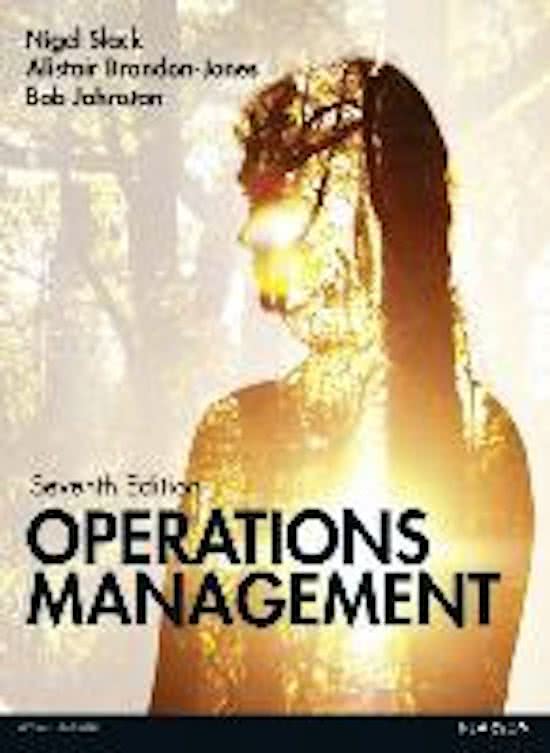
Operations Management
● Authors: Nigel Slack, Alistair Brandon-Jones, Nicola Burgess
● Latest Edition: 10th Edition (2020)
● Publisher: Pearson
● ISBN: 9781292295145
Summary:
"Operations Management" offers a comprehensive examination of the principles and
practices involved in managing operations within organizations. The book covers topics such
as process design, capacity planning, supply chain management, and quality control. The
authors integrate theoretical concepts with real-world applications, providing case studies
and examples from various industries. The 10th edition includes updated content reflecting
the latest trends and challenges in operations management.
Chapter 1: Operations Management
🔹 What is Operations Management?
Operations management (OM) is about designing, managing, and improving processes
to produce goods and services. It lies at the heart of every organization because every
organization produces something — products, services, or both.
🔹 The Role of Operations in an Organization
Operations interact with:
● Marketing (which identifies customer needs)
● Product/service development (which designs offerings)
● Finance (which tracks performance and budgets)
Together, they deliver value to customers and achieve business goals.
🔹 Input–Transformation–Output Model
This model describes any operation as a process that transforms inputs into outputs:
,Inputs→Transformation Process→Outputs
Inputs: Materials, information, customers
Transformations: Physical changes (manufacturing), location (transport), physiological
(healthcare), informational (IT), psychological (entertainment)
Outputs: Finished goods or services
🔹 The 4 D’s of Operations Management (Framework)
1. Directing – Setting overall strategic goals of operations
2. Designing – Structuring the operations processes and resources
3. Delivering – Planning and controlling operations to match demand
4. Developing – Improving operations over time through innovation
🔹 The Operations Function
It involves:
● Managing resources (people, equipment, tech, etc.)
● Designing and improving processes
● Ensuring efficiency and effectiveness
● Delivering consistent quality
🔹 Operations in Different Sectors
Sector Example
Manufacturing Automobile production
Services Healthcare, retail, banking
Public sector Government, education, policing
🔹 Operations and Strategy
● Operations must align with the overall business strategy.
● It can be a competitive weapon by enabling better quality, speed, flexibility, or cost.
🔹 Operations and Value
,Operations create value through:
● Reducing costs
● Increasing responsiveness
● Improving quality
● Innovating offerings
📝 Key Terms:
● Operations Management – Managing processes that transform inputs into outputs
● Process – A set of activities with a defined input and output
● Value – The benefit received by customers compared to cost
● Efficiency – Getting the most output from the least input
● Effectiveness – Meeting customer requirements
Chapter 2: Operations Performance
🔹 Overview:
This chapter explores how operations performance affects both customers and the internal
functioning of an organization. It introduces five key performance objectives, and how
they align with business strategy and stakeholder expectations.
🔹 The Five Performance Objectives
Operations performance is traditionally measured using five objectives. These are:
Objective What it means Example Benefit
Quality Doing things right, meeting Fewer complaints, better
customer expectations reputation
Speed Doing things fast, Faster delivery, improved
minimizing time between customer satisfaction
request & delivery
Dependability Doing things on time, Consistent service, reliability
keeping promises
, Flexibility Ability to change Responds quickly to
(product/service, mix, changes in demand
volume, delivery)
Cost Doing things cheaply, Lower prices, higher
efficient use of resources profitability
These objectives often involve trade-offs. For example, increasing flexibility might reduce
speed or increase cost.
🔹 Operations Performance and Stakeholders
Operations impact different stakeholders in different ways:
● Customers – want quality, speed, dependability, flexibility
● Employees – seek safe, rewarding work environments
● Investors – care about cost efficiency and return on investment
● Society – looks for sustainable and responsible operations
🔹 Internal vs External Effects of Operations Performance
● External effects: How well operations meet market and customer needs
● Internal effects: How efficient operations are in using (cost, capacity, utilization)
🔹 Polar Representation (Radar Chart)
This tool visually compares performance objectives, showing strengths and weaknesses.
Useful for understanding trade-offs and strategic positioning.
🔹 The Triple Bottom Line (TBL)
A modern view of performance includes:
1. Economic – profitability, efficiency
2. Environmental – sustainability, waste reduction
3. Social – employee welfare, community impact
This ties into the idea of Responsible Operations Management.
● Authors: Nigel Slack, Alistair Brandon-Jones, Nicola Burgess
● Latest Edition: 10th Edition (2020)
● Publisher: Pearson
● ISBN: 9781292295145
Summary:
"Operations Management" offers a comprehensive examination of the principles and
practices involved in managing operations within organizations. The book covers topics such
as process design, capacity planning, supply chain management, and quality control. The
authors integrate theoretical concepts with real-world applications, providing case studies
and examples from various industries. The 10th edition includes updated content reflecting
the latest trends and challenges in operations management.
Chapter 1: Operations Management
🔹 What is Operations Management?
Operations management (OM) is about designing, managing, and improving processes
to produce goods and services. It lies at the heart of every organization because every
organization produces something — products, services, or both.
🔹 The Role of Operations in an Organization
Operations interact with:
● Marketing (which identifies customer needs)
● Product/service development (which designs offerings)
● Finance (which tracks performance and budgets)
Together, they deliver value to customers and achieve business goals.
🔹 Input–Transformation–Output Model
This model describes any operation as a process that transforms inputs into outputs:
,Inputs→Transformation Process→Outputs
Inputs: Materials, information, customers
Transformations: Physical changes (manufacturing), location (transport), physiological
(healthcare), informational (IT), psychological (entertainment)
Outputs: Finished goods or services
🔹 The 4 D’s of Operations Management (Framework)
1. Directing – Setting overall strategic goals of operations
2. Designing – Structuring the operations processes and resources
3. Delivering – Planning and controlling operations to match demand
4. Developing – Improving operations over time through innovation
🔹 The Operations Function
It involves:
● Managing resources (people, equipment, tech, etc.)
● Designing and improving processes
● Ensuring efficiency and effectiveness
● Delivering consistent quality
🔹 Operations in Different Sectors
Sector Example
Manufacturing Automobile production
Services Healthcare, retail, banking
Public sector Government, education, policing
🔹 Operations and Strategy
● Operations must align with the overall business strategy.
● It can be a competitive weapon by enabling better quality, speed, flexibility, or cost.
🔹 Operations and Value
,Operations create value through:
● Reducing costs
● Increasing responsiveness
● Improving quality
● Innovating offerings
📝 Key Terms:
● Operations Management – Managing processes that transform inputs into outputs
● Process – A set of activities with a defined input and output
● Value – The benefit received by customers compared to cost
● Efficiency – Getting the most output from the least input
● Effectiveness – Meeting customer requirements
Chapter 2: Operations Performance
🔹 Overview:
This chapter explores how operations performance affects both customers and the internal
functioning of an organization. It introduces five key performance objectives, and how
they align with business strategy and stakeholder expectations.
🔹 The Five Performance Objectives
Operations performance is traditionally measured using five objectives. These are:
Objective What it means Example Benefit
Quality Doing things right, meeting Fewer complaints, better
customer expectations reputation
Speed Doing things fast, Faster delivery, improved
minimizing time between customer satisfaction
request & delivery
Dependability Doing things on time, Consistent service, reliability
keeping promises
, Flexibility Ability to change Responds quickly to
(product/service, mix, changes in demand
volume, delivery)
Cost Doing things cheaply, Lower prices, higher
efficient use of resources profitability
These objectives often involve trade-offs. For example, increasing flexibility might reduce
speed or increase cost.
🔹 Operations Performance and Stakeholders
Operations impact different stakeholders in different ways:
● Customers – want quality, speed, dependability, flexibility
● Employees – seek safe, rewarding work environments
● Investors – care about cost efficiency and return on investment
● Society – looks for sustainable and responsible operations
🔹 Internal vs External Effects of Operations Performance
● External effects: How well operations meet market and customer needs
● Internal effects: How efficient operations are in using (cost, capacity, utilization)
🔹 Polar Representation (Radar Chart)
This tool visually compares performance objectives, showing strengths and weaknesses.
Useful for understanding trade-offs and strategic positioning.
🔹 The Triple Bottom Line (TBL)
A modern view of performance includes:
1. Economic – profitability, efficiency
2. Environmental – sustainability, waste reduction
3. Social – employee welfare, community impact
This ties into the idea of Responsible Operations Management.