Chapter 3: Properties of substances,
based on their structure
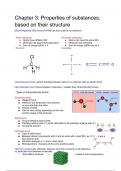
Electronegativity (EN): force on which an atom pulls on its electrons
Polar molecules Non-polar molecules
● Atoms have different EN ● Atoms can have the same EN
● Molecule has assymmetry geometry ● Molecule has symmetry
● Sum of charge (∆EN) ≠ 0 ● Sum of charge (∆EN) can be 0
Example Examples
Intramolecular forces: atomic bonding between atoms in a molecule with an atomic bond
Intermolecular bond: forces between molecules (, weaker than intramolecular forces)
- Types of intermolecular bonds
Dispersion force
■ Weakest force
■ Electrons are temporary more present
on one side than the other
■ Always present
■ Can be very strong depending on the size
and the shape of the molecule
Dipole force
■ Occurs between polar bonds
■ Partially positive side (δ+) will be attracted by the partially negative side (δ-)
■ Constantly present
Hydrogen bond
■ Type of polar bond
■ Between atomic compounds with H and an atom with a high EN ( ex. O, F, …) and a
free electron pair
■ Attraction between δ+ H and δ- other atom
■ Strongest force ( because of the extra electron pairs)
Interionic compounds: attraction between ions that is present in all directions,
no particular bond between molecules
- Solid lattice structure → ( solids at room temperature )
based on their structure
Electronegativity (EN): force on which an atom pulls on its electrons
Polar molecules Non-polar molecules
● Atoms have different EN ● Atoms can have the same EN
● Molecule has assymmetry geometry ● Molecule has symmetry
● Sum of charge (∆EN) ≠ 0 ● Sum of charge (∆EN) can be 0
Example Examples
Intramolecular forces: atomic bonding between atoms in a molecule with an atomic bond
Intermolecular bond: forces between molecules (, weaker than intramolecular forces)
- Types of intermolecular bonds
Dispersion force
■ Weakest force
■ Electrons are temporary more present
on one side than the other
■ Always present
■ Can be very strong depending on the size
and the shape of the molecule
Dipole force
■ Occurs between polar bonds
■ Partially positive side (δ+) will be attracted by the partially negative side (δ-)
■ Constantly present
Hydrogen bond
■ Type of polar bond
■ Between atomic compounds with H and an atom with a high EN ( ex. O, F, …) and a
free electron pair
■ Attraction between δ+ H and δ- other atom
■ Strongest force ( because of the extra electron pairs)
Interionic compounds: attraction between ions that is present in all directions,
no particular bond between molecules
- Solid lattice structure → ( solids at room temperature )