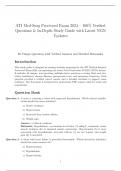
ATI Med-Surg Proctored Exam 2024 – 100% Verified
Questions & In-Depth Study Guide with Latest NGN
Updates
80 Unique Questions with Verified Answers and Detailed Rationales
Introduction
This study guide is designed for nursing students preparing for the ATI Medical-Surgical
Proctored Exam 2024, incorporating the latest Next Generation NCLEX (NGN) format.
It includes 80 unique, non-repeating multiple-choice questions covering fluid and elec-
trolyte imbalances, chronic illnesses, perioperative care, and emergency situations. Each
question provides a verified correct answer and a detailed rationale to support exam
readiness. The document is formatted for professional PDF output, ideal for study and
remediation.
Question Bank
Question 1: A nurse is assessing a client with suspected hypokalemia. Which clinical manifes-
tation should the nurse prioritize?
a) Muscle weakness
b) Hypertension
c) Increased deep tendon reflexes
d) Weight gain
Answer: a) Muscle weakness
Rationale: Hypokalemia, a potassium level below 3.5 mEq/L, commonly causes
muscle weakness due to impaired muscle contraction. Hypertension (b) is more
associated with hyperkalemia, increased reflexes (c) are not typical, and weight
gain (d) is unrelated.
Question 2: A client with heart failure is prescribed furosemide. Which electrolyte imbalance
should the nurse monitor for?
a) Hypernatremia
b) Hypokalemia
c) Hypercalcemia
1
, d) Hypermagnesemia
Answer: b) Hypokalemia
Rationale: Furosemide, a loop diuretic, increases potassium excretion, leading to
hypokalemia. Hypernatremia (a), hypercalcemia (c), and hypermagnesemia (d) are
not typically caused by furosemide.
Question 3: A nurse is caring for a client with diabetic ketoacidosis (DKA). Which finding
indicates the condition is resolving?
a) Blood glucose of 300 mg/dL
b) Serum bicarbonate of 18 mEq/L
c) Kussmaul respirations
d) pH of 7.25
Answer: b) Serum bicarbonate of 18 mEq/L
Rationale: A serum bicarbonate level approaching normal (15–18 mEq/L) in-
dicates resolution of the metabolic acidosis in DKA. High glucose (a), Kussmaul
respirations (c), and low pH (d) suggest ongoing DKA.
Question 4: A client is postoperative day 1 after abdominal surgery. Which assessment finding
requires immediate action?
a) Serous drainage on the dressing
b) Pain at the incision site
c) Absent bowel sounds
d) Fever of 102°F
Answer: d) Fever of 102°F
Rationale: A fever of 102°F may indicate infection, a serious postoperative com-
plication requiring immediate intervention. Serous drainage (a) and pain (b) are
expected, and absent bowel sounds (c) are common early post-surgery.
Question 5: A nurse is caring for a client with chronic obstructive pulmonary disease (COPD).
Which oxygen delivery method is most appropriate?
a) Simple face mask at 10 L/min
b) Nasal cannula at 2 L/min
c) Non-rebreather mask at 15 L/min
d) Venturi mask at 40
Answer: b) Nasal cannula at 2 L/min
Rationale: Clients with COPD require low-flow oxygen (e.g., nasal cannula at
1–2 L/min) to maintain oxygen saturation without suppressing the hypoxic drive.
High-flow options (a, c, d) may cause CO2 retention.
Question 6: A client with a new tracheostomy is at risk for airway obstruction. Which nursing
action is the priority?
2
, a) Administering pain medication
b) Suctioning the tracheostomy
c) Changing the tracheostomy ties
d) Providing humidified oxygen
Answer: b) Suctioning the tracheostomy
Rationale: Suctioning clears secretions to maintain airway patency, the priority for
tracheostomy care. Pain management (a), tie changes (c), and humidified oxygen
(d) are secondary.
Question 7: A nurse is assessing a client with suspected hypernatremia. Which symptom should
the nurse expect?
a) Bradycardia
b) Confusion
c) Hypotension
d) Muscle cramps
Answer: b) Confusion
Rationale: Hypernatremia (sodium >145 mEq/L) causes neurological symptoms
like confusion due to cellular dehydration. Bradycardia (a), hypotension (c), and
muscle cramps (d) are more associated with hyponatremia.
Question 8: A client with a history of heart failure reports dyspnea and weight gain. Which
action should the nurse take first?
a) Administer oxygen
b) Assess lung sounds
c) Check daily weight records
d) Notify the provider
Answer: b) Assess lung sounds
Rationale: Dyspnea and weight gain suggest fluid overload in heart failure. As-
sessing lung sounds for crackles confirms pulmonary edema, guiding further action.
Oxygen (a), weight records (c), and notification (d) follow assessment.
Question 9: A nurse is preparing a client for a colonoscopy. Which instruction should the nurse
provide?
a) Eat a high-fiber meal the night before
b) Consume only clear liquids for 24 hours prior
c) Take a laxative 2 hours before the procedure
d) Avoid drinking water on the procedure day
Answer: b) Consume only clear liquids for 24 hours prior
Rationale: Clear liquids for 24 hours ensure a clean colon for visualization. High-
3
Questions & In-Depth Study Guide with Latest NGN
Updates
80 Unique Questions with Verified Answers and Detailed Rationales
Introduction
This study guide is designed for nursing students preparing for the ATI Medical-Surgical
Proctored Exam 2024, incorporating the latest Next Generation NCLEX (NGN) format.
It includes 80 unique, non-repeating multiple-choice questions covering fluid and elec-
trolyte imbalances, chronic illnesses, perioperative care, and emergency situations. Each
question provides a verified correct answer and a detailed rationale to support exam
readiness. The document is formatted for professional PDF output, ideal for study and
remediation.
Question Bank
Question 1: A nurse is assessing a client with suspected hypokalemia. Which clinical manifes-
tation should the nurse prioritize?
a) Muscle weakness
b) Hypertension
c) Increased deep tendon reflexes
d) Weight gain
Answer: a) Muscle weakness
Rationale: Hypokalemia, a potassium level below 3.5 mEq/L, commonly causes
muscle weakness due to impaired muscle contraction. Hypertension (b) is more
associated with hyperkalemia, increased reflexes (c) are not typical, and weight
gain (d) is unrelated.
Question 2: A client with heart failure is prescribed furosemide. Which electrolyte imbalance
should the nurse monitor for?
a) Hypernatremia
b) Hypokalemia
c) Hypercalcemia
1
, d) Hypermagnesemia
Answer: b) Hypokalemia
Rationale: Furosemide, a loop diuretic, increases potassium excretion, leading to
hypokalemia. Hypernatremia (a), hypercalcemia (c), and hypermagnesemia (d) are
not typically caused by furosemide.
Question 3: A nurse is caring for a client with diabetic ketoacidosis (DKA). Which finding
indicates the condition is resolving?
a) Blood glucose of 300 mg/dL
b) Serum bicarbonate of 18 mEq/L
c) Kussmaul respirations
d) pH of 7.25
Answer: b) Serum bicarbonate of 18 mEq/L
Rationale: A serum bicarbonate level approaching normal (15–18 mEq/L) in-
dicates resolution of the metabolic acidosis in DKA. High glucose (a), Kussmaul
respirations (c), and low pH (d) suggest ongoing DKA.
Question 4: A client is postoperative day 1 after abdominal surgery. Which assessment finding
requires immediate action?
a) Serous drainage on the dressing
b) Pain at the incision site
c) Absent bowel sounds
d) Fever of 102°F
Answer: d) Fever of 102°F
Rationale: A fever of 102°F may indicate infection, a serious postoperative com-
plication requiring immediate intervention. Serous drainage (a) and pain (b) are
expected, and absent bowel sounds (c) are common early post-surgery.
Question 5: A nurse is caring for a client with chronic obstructive pulmonary disease (COPD).
Which oxygen delivery method is most appropriate?
a) Simple face mask at 10 L/min
b) Nasal cannula at 2 L/min
c) Non-rebreather mask at 15 L/min
d) Venturi mask at 40
Answer: b) Nasal cannula at 2 L/min
Rationale: Clients with COPD require low-flow oxygen (e.g., nasal cannula at
1–2 L/min) to maintain oxygen saturation without suppressing the hypoxic drive.
High-flow options (a, c, d) may cause CO2 retention.
Question 6: A client with a new tracheostomy is at risk for airway obstruction. Which nursing
action is the priority?
2
, a) Administering pain medication
b) Suctioning the tracheostomy
c) Changing the tracheostomy ties
d) Providing humidified oxygen
Answer: b) Suctioning the tracheostomy
Rationale: Suctioning clears secretions to maintain airway patency, the priority for
tracheostomy care. Pain management (a), tie changes (c), and humidified oxygen
(d) are secondary.
Question 7: A nurse is assessing a client with suspected hypernatremia. Which symptom should
the nurse expect?
a) Bradycardia
b) Confusion
c) Hypotension
d) Muscle cramps
Answer: b) Confusion
Rationale: Hypernatremia (sodium >145 mEq/L) causes neurological symptoms
like confusion due to cellular dehydration. Bradycardia (a), hypotension (c), and
muscle cramps (d) are more associated with hyponatremia.
Question 8: A client with a history of heart failure reports dyspnea and weight gain. Which
action should the nurse take first?
a) Administer oxygen
b) Assess lung sounds
c) Check daily weight records
d) Notify the provider
Answer: b) Assess lung sounds
Rationale: Dyspnea and weight gain suggest fluid overload in heart failure. As-
sessing lung sounds for crackles confirms pulmonary edema, guiding further action.
Oxygen (a), weight records (c), and notification (d) follow assessment.
Question 9: A nurse is preparing a client for a colonoscopy. Which instruction should the nurse
provide?
a) Eat a high-fiber meal the night before
b) Consume only clear liquids for 24 hours prior
c) Take a laxative 2 hours before the procedure
d) Avoid drinking water on the procedure day
Answer: b) Consume only clear liquids for 24 hours prior
Rationale: Clear liquids for 24 hours ensure a clean colon for visualization. High-
3