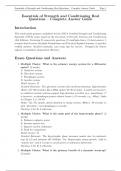
Essentials of Strength and Conditioning Real Questions – Complete Answer Guide Page 1
Essentials of Strength and Conditioning Real
Questions – Complete Answer Guide
Introduction
This study guide prepares candidates for the NSCA Certified Strength and Conditioning
Specialist (CSCS) exam, based on the Essentials of Strength Training and Conditioning
(4th Edition). Featuring 35 exam-style questions (15 multiple-choice, 15 short-answer, 5
scenario-based) across Scientific Foundations and Practical/Applied domains, it provides
verified answers, detailed rationales, and exam tips for success. Designed for Stuvia
upload, it maximizes preparation efficiency.
Exam Questions and Answers
1. Multiple Choice: What is the primary energy system for a 200-meter
sprint? [2 marks]
A. Oxidative system
B. Glycolytic system
C. Phosphagen system
D. Aerobic system
Model Answer: B
Detailed Rationale: The glycolytic system fuels moderate-duration, high-intensity
efforts ( 30–120 seconds), like a 200m sprint ( 20–30 seconds). A and D are incorrect,
as oxidative/aerobic systems support long-duration activities (e.g., marathons). C
is incorrect, as phosphagen powers shorter bursts (<15 seconds, e.g., 100m). Links
to Chapter 3, p. 68–69.
Helper Tip: For sprints, match duration to energy system. 200m is 30 seconds, so
pick “glycolytic,” not phosphagen or aerobic.
Marking: 2 for B; 0 otherwise.
2. Multiple Choice: What is the main goal of the hypertrophy phase? [2
marks]
A. Enhance explosive power
B. Increase muscle size
C. Improve aerobic endurance
D. Peak for competition
Model Answer: B
Detailed Rationale: The hypertrophy phase increases muscle size via moderate
reps (6–12) and intensity (65–85Helper Tip: Hypertrophy means growth. Link to
“muscle size” and 6–12 reps to avoid power or endurance distractors.
Marking: 2 for B; 0 otherwise.
3. Multiple Choice: What is the primary benefit of a dynamic warm-up?
[2 marks]
, Essentials of Strength and Conditioning Real Questions – Complete Answer Guide Page 2
A. Build maximal strength
B. Increase mobility and reduce injury
C. Enhance anaerobic power
D. Improve long-term flexibility
Model Answer: B
Detailed Rationale: Dynamic warm-ups (e.g., leg swings) increase joint mobility and
prepare muscles, reducing injury risk. A is incorrect, as strength requires resistance
training. C is incorrect, as power is trained via plyometrics. D is incorrect, as
flexibility gains come from static stretching. Links to Chapter 16, p. 361–362.
Helper Tip: Dynamic warm-ups are active. Link to “mobility” or “injury” to avoid
strength or flexibility traps.
Marking: 2 for B; 0 otherwise.
4. Multiple Choice: What does the vertical jump test measure? [2 marks]
A. Aerobic capacity
B. Lower-body power
C. Upper-body strength
D. Core stability
Model Answer: B
Detailed Rationale: The vertical jump tests lower-body power (force x velocity)
via explosive leg action. A is incorrect, as aerobic capacity is tested by runs (e.g.,
1.5-mile). C is incorrect, as upper-body strength uses bench press. D is incorrect,
as core stability is assessed via planks. Links to Chapter 13, p. 286–287.
Helper Tip: Vertical jump is explosive. Link to “lower-body power” to avoid en-
durance or core distractors.
Marking: 2 for B; 0 otherwise.
5. Multiple Choice: What is scoliosis? [2 marks]
A. Inward lumbar curvature
B. Outward thoracic curvature
C. Lateral spinal curvature
D. Flat spinal alignment
Model Answer: C
Detailed Rationale: Scoliosis is lateral (side-to-side) spinal curvature. A is incorrect,
as inward lumbar curvature is lordosis. B is incorrect, as outward thoracic curvature
is kyphosis. D is incorrect, as flat alignment isn’t a curvature issue. Links to
Chapter 14, p. 317.
Helper Tip: Scoliosis is side-to-side. Link to “lateral” and “spine” to avoid kyphosis
or lordosis traps.
Marking: 2 for C; 0 otherwise.
6. Multiple Choice: What is the role of the Valsalva maneuver in lifting?
[2 marks]
A. Increase heart rate
B. Stabilize spine via pressure
C. Enhance flexibility
Essentials of Strength and Conditioning Real
Questions – Complete Answer Guide
Introduction
This study guide prepares candidates for the NSCA Certified Strength and Conditioning
Specialist (CSCS) exam, based on the Essentials of Strength Training and Conditioning
(4th Edition). Featuring 35 exam-style questions (15 multiple-choice, 15 short-answer, 5
scenario-based) across Scientific Foundations and Practical/Applied domains, it provides
verified answers, detailed rationales, and exam tips for success. Designed for Stuvia
upload, it maximizes preparation efficiency.
Exam Questions and Answers
1. Multiple Choice: What is the primary energy system for a 200-meter
sprint? [2 marks]
A. Oxidative system
B. Glycolytic system
C. Phosphagen system
D. Aerobic system
Model Answer: B
Detailed Rationale: The glycolytic system fuels moderate-duration, high-intensity
efforts ( 30–120 seconds), like a 200m sprint ( 20–30 seconds). A and D are incorrect,
as oxidative/aerobic systems support long-duration activities (e.g., marathons). C
is incorrect, as phosphagen powers shorter bursts (<15 seconds, e.g., 100m). Links
to Chapter 3, p. 68–69.
Helper Tip: For sprints, match duration to energy system. 200m is 30 seconds, so
pick “glycolytic,” not phosphagen or aerobic.
Marking: 2 for B; 0 otherwise.
2. Multiple Choice: What is the main goal of the hypertrophy phase? [2
marks]
A. Enhance explosive power
B. Increase muscle size
C. Improve aerobic endurance
D. Peak for competition
Model Answer: B
Detailed Rationale: The hypertrophy phase increases muscle size via moderate
reps (6–12) and intensity (65–85Helper Tip: Hypertrophy means growth. Link to
“muscle size” and 6–12 reps to avoid power or endurance distractors.
Marking: 2 for B; 0 otherwise.
3. Multiple Choice: What is the primary benefit of a dynamic warm-up?
[2 marks]
, Essentials of Strength and Conditioning Real Questions – Complete Answer Guide Page 2
A. Build maximal strength
B. Increase mobility and reduce injury
C. Enhance anaerobic power
D. Improve long-term flexibility
Model Answer: B
Detailed Rationale: Dynamic warm-ups (e.g., leg swings) increase joint mobility and
prepare muscles, reducing injury risk. A is incorrect, as strength requires resistance
training. C is incorrect, as power is trained via plyometrics. D is incorrect, as
flexibility gains come from static stretching. Links to Chapter 16, p. 361–362.
Helper Tip: Dynamic warm-ups are active. Link to “mobility” or “injury” to avoid
strength or flexibility traps.
Marking: 2 for B; 0 otherwise.
4. Multiple Choice: What does the vertical jump test measure? [2 marks]
A. Aerobic capacity
B. Lower-body power
C. Upper-body strength
D. Core stability
Model Answer: B
Detailed Rationale: The vertical jump tests lower-body power (force x velocity)
via explosive leg action. A is incorrect, as aerobic capacity is tested by runs (e.g.,
1.5-mile). C is incorrect, as upper-body strength uses bench press. D is incorrect,
as core stability is assessed via planks. Links to Chapter 13, p. 286–287.
Helper Tip: Vertical jump is explosive. Link to “lower-body power” to avoid en-
durance or core distractors.
Marking: 2 for B; 0 otherwise.
5. Multiple Choice: What is scoliosis? [2 marks]
A. Inward lumbar curvature
B. Outward thoracic curvature
C. Lateral spinal curvature
D. Flat spinal alignment
Model Answer: C
Detailed Rationale: Scoliosis is lateral (side-to-side) spinal curvature. A is incorrect,
as inward lumbar curvature is lordosis. B is incorrect, as outward thoracic curvature
is kyphosis. D is incorrect, as flat alignment isn’t a curvature issue. Links to
Chapter 14, p. 317.
Helper Tip: Scoliosis is side-to-side. Link to “lateral” and “spine” to avoid kyphosis
or lordosis traps.
Marking: 2 for C; 0 otherwise.
6. Multiple Choice: What is the role of the Valsalva maneuver in lifting?
[2 marks]
A. Increase heart rate
B. Stabilize spine via pressure
C. Enhance flexibility