1
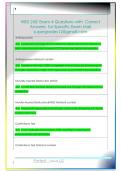
HIEU 242 exam 3 Questions with Correct
Answers for Specific Exam Mail
Versailles treaty
Ans: Agreement between the allied and central powers. It was the primary
treaty produced by the Paris Peace Conference at the end of WWI. Took
place in the Hall of Mirrors in the Palace of Versailles and was signed in june
28, 1919
War guilt clause
Ans: Put on Germany. They were forced to accept complete responsibility
for WWI and required to make reparation payments. Took place as a part of
the versailles treaty. Happened after the end of WWI in 1919.
League of Nations
Ans: Involved GB, France, Japan and Italy. Was the first intergovernmental
organization established to promote international cooperation and to
achieve international peace and security. Came after WWI in 1920.
Weimar Republic
Ans: Given to the German government. The established government after
their loss in WWI. Lasted between 1918-1933, the beginning of Nazi Germany.
Stab-in-the-back legend
Pretest - Stuvia US
, 2
Ans: Hitler's idea that domestic enemies were blamed for the defeat in WWII.
The war wasn't lost on the battlefield but instead within internally. By domestic
enemies such as the Jews, left wing parities, and liberals. After 1918
Kellogg-Briand Pact
Ans: Signed by France, US, UK, Ireland, Canada, etcc. Agreement to outlaw
war and have peace. Signed on August 27, 1928 in Paris.
Benito Mussolini
Ans: Fascist dictator of Italy (1922-1943). He led Italy to conquer Ethiopia
(1935), joined Germany in the Axis pact (1936), and allied Italy with Germany
in World War II. He was overthrown in 1943 when the Allies invaded Italy.
Blackshirts
Ans: Members of Italian fascists before WWII. It was led by Mussolini. Helped
solidify Mussolini's control
March on Rome
Ans: A strike "led" by Mussolini in October 1922 (who was no where to be
found during this March) in which 30,000 or so Blackshirts marched to Rome
and Mussolini was legally put into power
Totalitarianism
Ans: Term coined by Mussolini in the early 1920s to characterize the fascist
state of Italy. It is a system of government that is centralized and dictatorial
and requires complete subservience to the state.
Pretest - Stuvia US
HIEU 242 exam 3 Questions with Correct
Answers for Specific Exam Mail
Versailles treaty
Ans: Agreement between the allied and central powers. It was the primary
treaty produced by the Paris Peace Conference at the end of WWI. Took
place in the Hall of Mirrors in the Palace of Versailles and was signed in june
28, 1919
War guilt clause
Ans: Put on Germany. They were forced to accept complete responsibility
for WWI and required to make reparation payments. Took place as a part of
the versailles treaty. Happened after the end of WWI in 1919.
League of Nations
Ans: Involved GB, France, Japan and Italy. Was the first intergovernmental
organization established to promote international cooperation and to
achieve international peace and security. Came after WWI in 1920.
Weimar Republic
Ans: Given to the German government. The established government after
their loss in WWI. Lasted between 1918-1933, the beginning of Nazi Germany.
Stab-in-the-back legend
Pretest - Stuvia US
, 2
Ans: Hitler's idea that domestic enemies were blamed for the defeat in WWII.
The war wasn't lost on the battlefield but instead within internally. By domestic
enemies such as the Jews, left wing parities, and liberals. After 1918
Kellogg-Briand Pact
Ans: Signed by France, US, UK, Ireland, Canada, etcc. Agreement to outlaw
war and have peace. Signed on August 27, 1928 in Paris.
Benito Mussolini
Ans: Fascist dictator of Italy (1922-1943). He led Italy to conquer Ethiopia
(1935), joined Germany in the Axis pact (1936), and allied Italy with Germany
in World War II. He was overthrown in 1943 when the Allies invaded Italy.
Blackshirts
Ans: Members of Italian fascists before WWII. It was led by Mussolini. Helped
solidify Mussolini's control
March on Rome
Ans: A strike "led" by Mussolini in October 1922 (who was no where to be
found during this March) in which 30,000 or so Blackshirts marched to Rome
and Mussolini was legally put into power
Totalitarianism
Ans: Term coined by Mussolini in the early 1920s to characterize the fascist
state of Italy. It is a system of government that is centralized and dictatorial
and requires complete subservience to the state.
Pretest - Stuvia US