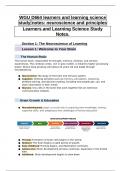
WGU D664 learners and learning science
study notes: neuroscience and principles
Learners and Learning Science Study
Notes.
🎓 Section 1: The Neuroscience of Learning
📚 Lesson 1: Welcome to Your Brain
🧠 The Human Brain
The human brain, responsible for thought, memory, emotion, and sensory
experiences. The cerebral cortex, rich in grey matter, is linked to higher processing
power. Brains keep growing until about 25 years old and adapt through
neuroplasticity.
● Neuroscience: the study of the brain and nervous system.
● Cognition: thinking activities such as memory, perception, reasoning,
problem-solving, and decision-making, including how people get, use, and
store information in their minds.
● Neurons: tiny cells in the brain that work together like an extensive
communication network.
🧠 Brain Growth & Education
● Neurodevelopment: plays a crucial role in acquiring new knowledge, honing
cognitive skills, and adapting to the challenges of formal education
● Prenatal: Formation of brain cells begins in the womb.
● Newborn: The brain begins a rapid period of growth.
● Early Childhood: Pruning begins, and Myelination continues.
● Adolescence: Brain development process continues, especially in the frontal
lobe.
● Adulthood: Brain development begins to slow down.
, 🧠 Brain Development & Learning
● Brainstem: part of the brain that connects to the spinal cord; oversees
important jobs like keeping the heart beating regularly, controlling
breathing, managing blood flow, and controlling automatic actions like
sneezing and swallowing
● limbic System: deep in the brain, it is like an emotional control center
helping handle feelings like happiness, fear, and sadness
● Cerebellum: located at the back of the head, the "little brain" helps
control voluntary muscle movements, posture, and balance
● Cerebrum: the front part of the brain responsible for controlling movement,
body temperature, and thinking skills like speaking, problem-solving, and
decision-making; it also handles sensory tasks like seeing, hearing, and
feeling touch
● Prefrontal Cortex: plays a crucial role in decision-making, impulse
control, and emotional regulation.
● Functional Magnetic Resonance Imaging (fMRI): Used for mapping brain
activity by measuring changes in blood flow and oxygenation levels
associated with neuronal activity
study notes: neuroscience and principles
Learners and Learning Science Study
Notes.
🎓 Section 1: The Neuroscience of Learning
📚 Lesson 1: Welcome to Your Brain
🧠 The Human Brain
The human brain, responsible for thought, memory, emotion, and sensory
experiences. The cerebral cortex, rich in grey matter, is linked to higher processing
power. Brains keep growing until about 25 years old and adapt through
neuroplasticity.
● Neuroscience: the study of the brain and nervous system.
● Cognition: thinking activities such as memory, perception, reasoning,
problem-solving, and decision-making, including how people get, use, and
store information in their minds.
● Neurons: tiny cells in the brain that work together like an extensive
communication network.
🧠 Brain Growth & Education
● Neurodevelopment: plays a crucial role in acquiring new knowledge, honing
cognitive skills, and adapting to the challenges of formal education
● Prenatal: Formation of brain cells begins in the womb.
● Newborn: The brain begins a rapid period of growth.
● Early Childhood: Pruning begins, and Myelination continues.
● Adolescence: Brain development process continues, especially in the frontal
lobe.
● Adulthood: Brain development begins to slow down.
, 🧠 Brain Development & Learning
● Brainstem: part of the brain that connects to the spinal cord; oversees
important jobs like keeping the heart beating regularly, controlling
breathing, managing blood flow, and controlling automatic actions like
sneezing and swallowing
● limbic System: deep in the brain, it is like an emotional control center
helping handle feelings like happiness, fear, and sadness
● Cerebellum: located at the back of the head, the "little brain" helps
control voluntary muscle movements, posture, and balance
● Cerebrum: the front part of the brain responsible for controlling movement,
body temperature, and thinking skills like speaking, problem-solving, and
decision-making; it also handles sensory tasks like seeing, hearing, and
feeling touch
● Prefrontal Cortex: plays a crucial role in decision-making, impulse
control, and emotional regulation.
● Functional Magnetic Resonance Imaging (fMRI): Used for mapping brain
activity by measuring changes in blood flow and oxygenation levels
associated with neuronal activity