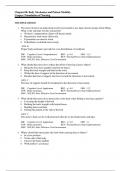
Chapter 08: Body Mechanics and Patient Mobility
Cooper: Foundation of Nursing
MULTIPLE CHOICE
1. The nurse instructs an unlicensed assistive personnel to use large muscle groups when lifting.
What is the rationale for this instruction?
a. Workers’ compensation claims will be prevented.
b. Big muscles work more effectively.
c. It guarantees no muscle strain.
d. It distributes workload more evenly.
ANS: D
Proper body mechanics provide for even distribution of workload.
DIF: Cognitive Level: Comprehension REF: p. 161 OBJ: 1 | 2
TOP: Body mechanics KEY: Nursing Process Step: Implementation
MSC: NCLEX: Safe, Effective Care Environment
2. What should the nurse do to reduce the effort of moving a heavy object?
a. Bring the feet close together and flex the knees.
b. Keep the back straight and bend at the waist.
c. Widen the base of support in the direction of movement.
d. Broaden the base of support and twist toward the direction of movement.
ANS: C
The base of support should be broadened in the direction of movement.
DIF: Cognitive Level: Application REF: p. 161 OBJ: 1 | 2
TOP: Body mechanics KEY: Nursing Process Step: Implementation
MSC: NCLEX: Safe, Effective Care Environment
3. What should the nurse do to protect his or her back when lifting or moving a patient?
a. Lowering the height of the bed
b. Holding the back straight with locked knees
c. Bending knees and hips
d. Getting the patient to the side of the bed
ANS: C
The nurse’s back can be well protected when he or she bends knees and hips.
DIF: Cognitive Level: Application REF: p. 161 OBJ: 11
TOP: Body mechanics KEY: Nursing Process Step: Implementation
MSC: NCLEX: Safe, Effective Care Environment
4. Where should the nurse place the load when carrying heavy objects?
a. In a low position
b. To the side of the body
c. Close to the body midline
d. With another’s assistance
, ANS: C
The nurse should carry objects close to the midline of the body.
DIF: Cognitive Level: Comprehension REF: p. 163 OBJ: 11
TOP: Body mechanics KEY: Nursing Process Step: Implementation
MSC: NCLEX: Safe, Effective Care Environment
5. The nurse is educating a patient on ways to regain the ability to perform ADLs and maintain
normal physiologic activities. What will the nurse relay as a requirement?
a. Strength
b. Wellness
c. Alertness
d. Mobility
ANS: D
The purpose of mobility is completing ADLs and maintaining physiologic activities.
DIF: Cognitive Level: Comprehension REF: p. 167 OBJ: 4
TOP: Mobility KEY: Nursing Process Step: Assessment
MSC: NCLEX: Physiological Integrity
6. The nurse counsels the immobilized patient in regard to prevention of muscle atrophy and
contractures. What will the nurse be sure to include when counseling this patient?
a. The need for additional calcium
b. The need for additional protein
c. The need for some type of exercise
d. The need for a special protective bed
ANS: C
The immobilized patient must receive some type of exercise to prevent atrophy and
contractures.
DIF: Cognitive Level: Application REF: p. 171 OBJ: 6
TOP: Immobility KEY: Nursing Process Step: Implementation
MSC: NCLEX: Physiological Integrity
7. What is the term for range of motion (ROM) when it is performed by the patient?
a. Assisted
b. Passive
c. Active
d. Coordinated
ANS: C
ROM performed actively by the patient is designated as active ROM.
DIF: Cognitive Level: Knowledge REF: p. 183 OBJ: 9
TOP: Range of motion (ROM) KEY: Nursing Process Step: Implementation
MSC: NCLEX: Physiological Integrity
8. The nurse is performing passive range of motion (ROM) for the patient. How will the nurse
move the joint through ROM?
a. The fullest extent.
Cooper: Foundation of Nursing
MULTIPLE CHOICE
1. The nurse instructs an unlicensed assistive personnel to use large muscle groups when lifting.
What is the rationale for this instruction?
a. Workers’ compensation claims will be prevented.
b. Big muscles work more effectively.
c. It guarantees no muscle strain.
d. It distributes workload more evenly.
ANS: D
Proper body mechanics provide for even distribution of workload.
DIF: Cognitive Level: Comprehension REF: p. 161 OBJ: 1 | 2
TOP: Body mechanics KEY: Nursing Process Step: Implementation
MSC: NCLEX: Safe, Effective Care Environment
2. What should the nurse do to reduce the effort of moving a heavy object?
a. Bring the feet close together and flex the knees.
b. Keep the back straight and bend at the waist.
c. Widen the base of support in the direction of movement.
d. Broaden the base of support and twist toward the direction of movement.
ANS: C
The base of support should be broadened in the direction of movement.
DIF: Cognitive Level: Application REF: p. 161 OBJ: 1 | 2
TOP: Body mechanics KEY: Nursing Process Step: Implementation
MSC: NCLEX: Safe, Effective Care Environment
3. What should the nurse do to protect his or her back when lifting or moving a patient?
a. Lowering the height of the bed
b. Holding the back straight with locked knees
c. Bending knees and hips
d. Getting the patient to the side of the bed
ANS: C
The nurse’s back can be well protected when he or she bends knees and hips.
DIF: Cognitive Level: Application REF: p. 161 OBJ: 11
TOP: Body mechanics KEY: Nursing Process Step: Implementation
MSC: NCLEX: Safe, Effective Care Environment
4. Where should the nurse place the load when carrying heavy objects?
a. In a low position
b. To the side of the body
c. Close to the body midline
d. With another’s assistance
, ANS: C
The nurse should carry objects close to the midline of the body.
DIF: Cognitive Level: Comprehension REF: p. 163 OBJ: 11
TOP: Body mechanics KEY: Nursing Process Step: Implementation
MSC: NCLEX: Safe, Effective Care Environment
5. The nurse is educating a patient on ways to regain the ability to perform ADLs and maintain
normal physiologic activities. What will the nurse relay as a requirement?
a. Strength
b. Wellness
c. Alertness
d. Mobility
ANS: D
The purpose of mobility is completing ADLs and maintaining physiologic activities.
DIF: Cognitive Level: Comprehension REF: p. 167 OBJ: 4
TOP: Mobility KEY: Nursing Process Step: Assessment
MSC: NCLEX: Physiological Integrity
6. The nurse counsels the immobilized patient in regard to prevention of muscle atrophy and
contractures. What will the nurse be sure to include when counseling this patient?
a. The need for additional calcium
b. The need for additional protein
c. The need for some type of exercise
d. The need for a special protective bed
ANS: C
The immobilized patient must receive some type of exercise to prevent atrophy and
contractures.
DIF: Cognitive Level: Application REF: p. 171 OBJ: 6
TOP: Immobility KEY: Nursing Process Step: Implementation
MSC: NCLEX: Physiological Integrity
7. What is the term for range of motion (ROM) when it is performed by the patient?
a. Assisted
b. Passive
c. Active
d. Coordinated
ANS: C
ROM performed actively by the patient is designated as active ROM.
DIF: Cognitive Level: Knowledge REF: p. 183 OBJ: 9
TOP: Range of motion (ROM) KEY: Nursing Process Step: Implementation
MSC: NCLEX: Physiological Integrity
8. The nurse is performing passive range of motion (ROM) for the patient. How will the nurse
move the joint through ROM?
a. The fullest extent.