CCRN Exam V1 (Latest Update
) Questions with Verified
Answers | Grade A | 100% Correct
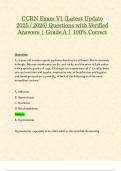
Question:
A 77-year-old woman reports explosive diarrhea for 48 hours. She is extremely
lethargic. Mucous membranes are dry and sticky, and the urine is dark amber
with a specific gravity of 1.035. Vital signs are temperature 38.2° C orally; heart
rate 130 beats/min and regular; respiratory rate 26 breaths/min and regular;
and blood pressure 90/74 mm Hg. Which of the following is of the most
immediate concern?
A. Infection
B. Hypovolemia
C. Nutrition
D. Skin breakdown
Answer:
B. Hypovolemia
Hypovolemia, especially in an older adult, is the most life threatening
,Question:
What is the priority of management in respiratory acidosis?
A. Improve alveolar ventilation by treating the cause of hypoventilation.
B. Buffer the acid with sodium bicarbonate.
C. Improve oxygenation by administering oxygen.
D. Decrease anxiety to increase PaCO2 level.
Answer:
A. Improve alveolar ventilation by treating the cause of hypoventilation.
Question:
Which of the following describes the pulse pressure of a patient with aortic
regurgitation?
A. 30 to 40 mm Hg
B. Less than 30 mm Hg
C. More than 40 mm Hg
D. Varies with phase of respiratory cycle
Answer:
C. More than 40 mm Hg
Aortic regurgitation causes a wide pulse pressure and water-hammer pulse,
which is a rapid upstroke and downstroke and shortened peak.
,Question:
Which of the following is not a way that carbon dioxide is transported in the
body?
A. Dissolved in plasma
B. Attached to hemoglobin
C. As bicarbonate
D. As hydrogen ions
Answer:
D. as hydrogen ions
Hydrogen ions are single element ions. They cannot carry anything
Question:
Which of the following may affect adversely the ability of pulmonary artery
occlusive pressure (PAOP) to reflect preload?
A. Measuring the PAOP at the end of inspiration
B. Changes in the patient's afterload
C. Changes in the compliance of the patient's ventricle
D. Loss of blood rather than fluid
Answer:
C. Changes in the compliance of the patient's ventricle
, Preload is a volume concept, but we routinely use atrial pressure to evaluate
preload. The logical conclusion is that volume and pressure are directly and
proportionally related. Although this may be true in a normally compliant
ventricle, there will be a disproportionate increase in pressure with an
increase in volume in a noncompliant ventricle. Remember that compliance is
the change in pressure for a given change in volume. Use of volumetric
parameters measured with a right ejection fraction catheter would allow
measurement of volumes as a reflection of preload.
Question:
Which of the following would not be associated with a false-positive result for
an acute myocardial infarction using the total creatine kinase (CK)?
A. Hypothyroidism
B. Hemorrhagic stroke
C. Cardioversion
D. Ulcerative colitis
Answer:
D. Ulcerative colitis
CK may be elevated by chronic alcoholism, cardioversion, strokes,
hypothyroidism, intramuscular injections, skeletal muscle injury, and trauma.
) Questions with Verified
Answers | Grade A | 100% Correct
Question:
A 77-year-old woman reports explosive diarrhea for 48 hours. She is extremely
lethargic. Mucous membranes are dry and sticky, and the urine is dark amber
with a specific gravity of 1.035. Vital signs are temperature 38.2° C orally; heart
rate 130 beats/min and regular; respiratory rate 26 breaths/min and regular;
and blood pressure 90/74 mm Hg. Which of the following is of the most
immediate concern?
A. Infection
B. Hypovolemia
C. Nutrition
D. Skin breakdown
Answer:
B. Hypovolemia
Hypovolemia, especially in an older adult, is the most life threatening
,Question:
What is the priority of management in respiratory acidosis?
A. Improve alveolar ventilation by treating the cause of hypoventilation.
B. Buffer the acid with sodium bicarbonate.
C. Improve oxygenation by administering oxygen.
D. Decrease anxiety to increase PaCO2 level.
Answer:
A. Improve alveolar ventilation by treating the cause of hypoventilation.
Question:
Which of the following describes the pulse pressure of a patient with aortic
regurgitation?
A. 30 to 40 mm Hg
B. Less than 30 mm Hg
C. More than 40 mm Hg
D. Varies with phase of respiratory cycle
Answer:
C. More than 40 mm Hg
Aortic regurgitation causes a wide pulse pressure and water-hammer pulse,
which is a rapid upstroke and downstroke and shortened peak.
,Question:
Which of the following is not a way that carbon dioxide is transported in the
body?
A. Dissolved in plasma
B. Attached to hemoglobin
C. As bicarbonate
D. As hydrogen ions
Answer:
D. as hydrogen ions
Hydrogen ions are single element ions. They cannot carry anything
Question:
Which of the following may affect adversely the ability of pulmonary artery
occlusive pressure (PAOP) to reflect preload?
A. Measuring the PAOP at the end of inspiration
B. Changes in the patient's afterload
C. Changes in the compliance of the patient's ventricle
D. Loss of blood rather than fluid
Answer:
C. Changes in the compliance of the patient's ventricle
, Preload is a volume concept, but we routinely use atrial pressure to evaluate
preload. The logical conclusion is that volume and pressure are directly and
proportionally related. Although this may be true in a normally compliant
ventricle, there will be a disproportionate increase in pressure with an
increase in volume in a noncompliant ventricle. Remember that compliance is
the change in pressure for a given change in volume. Use of volumetric
parameters measured with a right ejection fraction catheter would allow
measurement of volumes as a reflection of preload.
Question:
Which of the following would not be associated with a false-positive result for
an acute myocardial infarction using the total creatine kinase (CK)?
A. Hypothyroidism
B. Hemorrhagic stroke
C. Cardioversion
D. Ulcerative colitis
Answer:
D. Ulcerative colitis
CK may be elevated by chronic alcoholism, cardioversion, strokes,
hypothyroidism, intramuscular injections, skeletal muscle injury, and trauma.