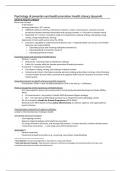
Psychology of prevention and health promotion: Health Literacy (lesson4)
WHAT IS HEALTH LITERACY
Not a new concept
- To be literate1
- Increased attention: 20th century
• UNESCO: ability to identify, understand, interpret, create, communicate, compute and use
printed and written materials associated with varying contexts => !!!function in modern world
• Expanded: 21st century: includes a range of competences (reading, writing, calculating, using
money, using smartphones, driving)
- Application to the health sector since the 1970s
• Evolution: capability to understand what doctors say => expanded (take care of your own health/
take your own responsibility)
o Expanding scope and meaning (rijkwijdte & betekenis)
o Expanding body of scientific research
o Expanding political interest
Expanding scope and meaning of health literacy
- Medical public
• Medical HL: individual skills in healthcare settings
• Public HL: broader skills for disease prevention & health promotion
- Functional interactive & critical
• Functional: reading, writing, calculating in medical context
• Interactive & critical: information seeking, decision making and problem solving, critical thinking,
communication & social skills, personal and cognitive skills that are necessary to function in the
health system
Expanding research on Health Literacy (scientific research)
- First articles: 1970s now: 20.000 publications (70% in the last 5y, >1.000/year)
Political recognition of the importance of Health literacy
- UN: Views Health Literacy (HL) as essential for achieving Sustainable Development Goals (SDGs).
- WHO:
• HL improvement = key priority in Health 2020 (European Region strategy)
• HL = 1 of 3 priorities at 9th Global Conference on Health Promotion (Shanghai, 2016)
- EU: HL included in Health for Growth Programme (2014–2020).
- National level: WHO report reviews policy effectiveness at national, regional, and organizational
levels in Europe
THE EVOLVING CONCEPT OF HEALTH LITERACY
Linked to informed decision making in health:
INFORMED DECISION MAKING2
- ≠ just signing consent;
- Requires ongoing dialogue with healthcare providers
Cf. being involved in decisions, with enough information ( doctor decides, minister decides about
compulsory vaccination, …); your body, your (informed) decision
Applicable to
- Medical treatment
- Prevention & health promotion (e.g., screening, vaccination, breastfeeding)
1
To be literate= being ‘knowledgeable or educated in a particular field(s).
2
Informed decision making= make decisions based on sufficient knowledge of potential benefits and risks, and
consistent with personal values and preferences.
WHAT IS HEALTH LITERACY
Not a new concept
- To be literate1
- Increased attention: 20th century
• UNESCO: ability to identify, understand, interpret, create, communicate, compute and use
printed and written materials associated with varying contexts => !!!function in modern world
• Expanded: 21st century: includes a range of competences (reading, writing, calculating, using
money, using smartphones, driving)
- Application to the health sector since the 1970s
• Evolution: capability to understand what doctors say => expanded (take care of your own health/
take your own responsibility)
o Expanding scope and meaning (rijkwijdte & betekenis)
o Expanding body of scientific research
o Expanding political interest
Expanding scope and meaning of health literacy
- Medical public
• Medical HL: individual skills in healthcare settings
• Public HL: broader skills for disease prevention & health promotion
- Functional interactive & critical
• Functional: reading, writing, calculating in medical context
• Interactive & critical: information seeking, decision making and problem solving, critical thinking,
communication & social skills, personal and cognitive skills that are necessary to function in the
health system
Expanding research on Health Literacy (scientific research)
- First articles: 1970s now: 20.000 publications (70% in the last 5y, >1.000/year)
Political recognition of the importance of Health literacy
- UN: Views Health Literacy (HL) as essential for achieving Sustainable Development Goals (SDGs).
- WHO:
• HL improvement = key priority in Health 2020 (European Region strategy)
• HL = 1 of 3 priorities at 9th Global Conference on Health Promotion (Shanghai, 2016)
- EU: HL included in Health for Growth Programme (2014–2020).
- National level: WHO report reviews policy effectiveness at national, regional, and organizational
levels in Europe
THE EVOLVING CONCEPT OF HEALTH LITERACY
Linked to informed decision making in health:
INFORMED DECISION MAKING2
- ≠ just signing consent;
- Requires ongoing dialogue with healthcare providers
Cf. being involved in decisions, with enough information ( doctor decides, minister decides about
compulsory vaccination, …); your body, your (informed) decision
Applicable to
- Medical treatment
- Prevention & health promotion (e.g., screening, vaccination, breastfeeding)
1
To be literate= being ‘knowledgeable or educated in a particular field(s).
2
Informed decision making= make decisions based on sufficient knowledge of potential benefits and risks, and
consistent with personal values and preferences.