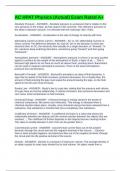
AC HPAT Physics (Actual) Exam Rated A+
Absolute Pressure - ANSWER-· Absolute pressure is a pressure that is relative to the
zero pressure in the empty, air-free space of the universe. This reference pressure is
the ideal or absolute vacuum. It is denoted with the subscript "abs": Pabs.
Acceleration - ANSWER-· Acceleration is the rate of change of velocity with time.
Alternating current vs direct current - ANSWER-· AC vs. DC (Alternating Current vs.
Direct current) The difference between AC and DC lies in the direction in which the
electrons flow. In DC, the electrons flow steadily in a single direction, or "forward." In
AC, electrons keep switching directions, sometimes going "forward" and then going
"backward."
Atmospheric pressure - ANSWER-· Atmospheric pressure is a force in an area pushed
against a surface by the weight of the atmosphere of Earth, a layer of air. ... This is
because high places do not have as much air above them, pushing down. Barometers
can be used to measure atmospheric pressure. There is the same atmospheric
pressure from all directions.
Bernoulli's Principle - ANSWER-· Bernoulli's principle is an idea of fluid dynamics. It
says that as speed of the fluid increases, pressure decreases. For a steady flow, the
amount of fluid entering the pipe must equal the amount leaving the pipe, so the fluid
speed in the thin part must increase.
Boyles Law - ANSWER-· Boyle's law is a gas law, stating that the pressure and volume
of a gas have an inverse relationship. If volume increases, then pressure decreases and
vice versa, when temperature is held constant.
Chemical Energy - ANSWER-· Chemical energy is energy stored in the bonds of
chemical compounds, like atoms and molecules. This energy is released when a
chemical reaction takes place. Usually, once chemical energy has been released from a
substance, that substance is transformed into a completely new substance.
Coefficient of friction - ANSWER-· A coefficient of friction is a value that shows the
relationship between two objects and the normal reaction between the objects that are
involved. ... The coefficient of friction depends on the objects that are causing friction.
The value is usually between 0 and 1 but can be greater than 1.
Conventional current - ANSWER-· assumes that current flows out of the positive
terminal, through the circuit and into the negative terminal of the source. ... Electron
Flow is what actually happens, and electrons flow out of the negative terminal, through
the circuit and into the positive terminal of the source
Density - ANSWER-· Density is a measure of mass per volume. The average density of
an object equals its total mass divided by its total volume. An object made from a
, comparatively dense material (such as iron) will have less volume than an object of
equal mass made from some less dense substance (such as water).
Displacement - ANSWER-· Displacement is a vector quantity that refers to "how far out
of place an object is"; it is the object's overall change in position.
DIstance - ANSWER-· Distance is a scalar quantity that refers to "how much ground an
object has covered" during its motion.
Efficiency - ANSWER-· Efficiency is a measure of how much work or energy is
conserved in a process. In many processes, work or energy is lost, for example as
waste heat or vibration. The efficiency is the energy output, divided by the energy input,
and expressed as a percentage. A perfect process would have an efficiency of 100%.
Electric potential difference - ANSWER-· Electric potential difference, also known as
voltage, is the external work needed to bring a charge from one location to another
location in an electric field. Electric potential difference is the change of potential energy
experienced by a test charge that has a value of +1 .
Electromagnet - ANSWER-· An electromagnet is a magnet that runs on electricity.
Unlike a permanent magnet, the strength of an electromagnet can easily be changed by
changing the amount of electric current that flows through it. The poles of an
electromagnet can even be reversed by reversing the flow of electricity.
Enerfgy conversion/transformation - ANSWER-· the process of changing one form of
energy to another. In physics, the term energy describes the capacity to produce certain
changes within a system, without regard to limitations in transformation imposed by
Entropy.
Energy - ANSWER-· Energy, in physics, the capacity for doing work. It may exist in
potential, kinetic, thermal, electrical, chemical, nuclear, or other various forms. There
are, moreover, heat and work—i.e., energy in the process of transfer from one body to
another.
Friction - ANSWER-· Friction is a force that holds back the movement of a sliding
object. That's it. Friction is just that simple. You will find friction everywhere that objects
come into contact with each other.
Gravitational force - ANSWER-· The gravitational force is a force that attracts any two
objects with mass. ... In fact, every object, including you, is pulling on every other object
in the entire universe! This is called Newton's Universal Law of Gravitation.
gravitational potential energy - ANSWER-· Gravitational potential energy is energy an
object possesses because of its position in a gravitational field. The most common use
of gravitational potential energy is for an object near the surface of the Earth where the
gravitational acceleration can be assumed to be constant at about 9.8 m/s2.
Absolute Pressure - ANSWER-· Absolute pressure is a pressure that is relative to the
zero pressure in the empty, air-free space of the universe. This reference pressure is
the ideal or absolute vacuum. It is denoted with the subscript "abs": Pabs.
Acceleration - ANSWER-· Acceleration is the rate of change of velocity with time.
Alternating current vs direct current - ANSWER-· AC vs. DC (Alternating Current vs.
Direct current) The difference between AC and DC lies in the direction in which the
electrons flow. In DC, the electrons flow steadily in a single direction, or "forward." In
AC, electrons keep switching directions, sometimes going "forward" and then going
"backward."
Atmospheric pressure - ANSWER-· Atmospheric pressure is a force in an area pushed
against a surface by the weight of the atmosphere of Earth, a layer of air. ... This is
because high places do not have as much air above them, pushing down. Barometers
can be used to measure atmospheric pressure. There is the same atmospheric
pressure from all directions.
Bernoulli's Principle - ANSWER-· Bernoulli's principle is an idea of fluid dynamics. It
says that as speed of the fluid increases, pressure decreases. For a steady flow, the
amount of fluid entering the pipe must equal the amount leaving the pipe, so the fluid
speed in the thin part must increase.
Boyles Law - ANSWER-· Boyle's law is a gas law, stating that the pressure and volume
of a gas have an inverse relationship. If volume increases, then pressure decreases and
vice versa, when temperature is held constant.
Chemical Energy - ANSWER-· Chemical energy is energy stored in the bonds of
chemical compounds, like atoms and molecules. This energy is released when a
chemical reaction takes place. Usually, once chemical energy has been released from a
substance, that substance is transformed into a completely new substance.
Coefficient of friction - ANSWER-· A coefficient of friction is a value that shows the
relationship between two objects and the normal reaction between the objects that are
involved. ... The coefficient of friction depends on the objects that are causing friction.
The value is usually between 0 and 1 but can be greater than 1.
Conventional current - ANSWER-· assumes that current flows out of the positive
terminal, through the circuit and into the negative terminal of the source. ... Electron
Flow is what actually happens, and electrons flow out of the negative terminal, through
the circuit and into the positive terminal of the source
Density - ANSWER-· Density is a measure of mass per volume. The average density of
an object equals its total mass divided by its total volume. An object made from a
, comparatively dense material (such as iron) will have less volume than an object of
equal mass made from some less dense substance (such as water).
Displacement - ANSWER-· Displacement is a vector quantity that refers to "how far out
of place an object is"; it is the object's overall change in position.
DIstance - ANSWER-· Distance is a scalar quantity that refers to "how much ground an
object has covered" during its motion.
Efficiency - ANSWER-· Efficiency is a measure of how much work or energy is
conserved in a process. In many processes, work or energy is lost, for example as
waste heat or vibration. The efficiency is the energy output, divided by the energy input,
and expressed as a percentage. A perfect process would have an efficiency of 100%.
Electric potential difference - ANSWER-· Electric potential difference, also known as
voltage, is the external work needed to bring a charge from one location to another
location in an electric field. Electric potential difference is the change of potential energy
experienced by a test charge that has a value of +1 .
Electromagnet - ANSWER-· An electromagnet is a magnet that runs on electricity.
Unlike a permanent magnet, the strength of an electromagnet can easily be changed by
changing the amount of electric current that flows through it. The poles of an
electromagnet can even be reversed by reversing the flow of electricity.
Enerfgy conversion/transformation - ANSWER-· the process of changing one form of
energy to another. In physics, the term energy describes the capacity to produce certain
changes within a system, without regard to limitations in transformation imposed by
Entropy.
Energy - ANSWER-· Energy, in physics, the capacity for doing work. It may exist in
potential, kinetic, thermal, electrical, chemical, nuclear, or other various forms. There
are, moreover, heat and work—i.e., energy in the process of transfer from one body to
another.
Friction - ANSWER-· Friction is a force that holds back the movement of a sliding
object. That's it. Friction is just that simple. You will find friction everywhere that objects
come into contact with each other.
Gravitational force - ANSWER-· The gravitational force is a force that attracts any two
objects with mass. ... In fact, every object, including you, is pulling on every other object
in the entire universe! This is called Newton's Universal Law of Gravitation.
gravitational potential energy - ANSWER-· Gravitational potential energy is energy an
object possesses because of its position in a gravitational field. The most common use
of gravitational potential energy is for an object near the surface of the Earth where the
gravitational acceleration can be assumed to be constant at about 9.8 m/s2.