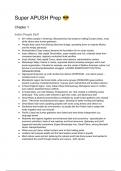
Super APUSH Prep 😎
Chapter 1
Indian People Stuff
● 60+ million people in Americas, Mesoamerica had empires rivalling Europe (Aztec, Inca)
while others were hunter-gatherers
● People likely came from Bering Strait land bridge, spreading down to majority Mexico
and the Andez (densest)
● Domesticated Crops (maize) became the foundation for an urban society
● Aztec (Mexico): Had capital Tenochtitlan, super wealthy and rich, collected taxes from
conquered peoples, regularly conducted ritual sacrifice
● Incas (Andes): Had capital Cusco, dense road network, administrative centers
● Mississippi Valley: thanks to maize, orgnaized distinct societies emerged, which had
social organization. Cahokia for example, was the center of Natitve American culture, but
fell due to environmental/warfare struggles. LACKED SIGNIFICANT POLITICAL
ORGANIZATIONS.
● Algonquian/Iroquoian up north divided into distinct CHIEFDOM - one claims power -
societies built on crops
● Mid-atlantic region had local chiefs, while some groups (IROQUOIS) gave political
powers to groups of leaders/sachems. Iroquois were matriarchial and avoided violence.
● In New England region, many indian tribes (Wampanoag, Mohegans) were in conflict -
euro nations exploited these conflicts.
● In Great lakes, you had Ottawas, Potawatomis, etc. that created a conflicting social
landscape. They used a lake network to get food, trade, and diplomacy stuff
● Great Plains (Lakota/Comanche/Sioux) inhabited by small hunter-gatheres who chased
bison. THe Horse revolutionized this region, allowing for better hunting and fighitng
● Great Basin had numic speaking peoples with some using horses and others not
● Southwest had hostile dry environment, so peuple like the Pueblo had to adapt with
water irrigation and cool mounds
● Pacific Coast had hunter gatherers who fished and were kinda independent cuz
language barrier
● Networks tied regions together and enhanced diets and economics - specialization in
economic activities), trade of war captives and food resources, diplomacy and stuff,
happened basically everywhere (Upper Mississippi river, Great Plains, among Nomadic
Hunts- Navajo/Apaches)
● When euro ppl came, Indian hunters went to their trading posts
● Leaders had unequal wealth and the best leaders would share it equally
● Most natives were animist, believing the natural world had divine power and wanted to
understand the world through dreams and visions - birth sacred
, ● SOCITIES PATRIARCHIAL!! Men hunted and got food and conducted war for land and
geographic advantage and just bragging rights, women tended to society and stuff
Western European Stuff
● Lots of kingdoms and republics where kings led nobles and were very corrupt and
exploited the peasants and stuff. Nobles in general regularly challenged kings.
● Society was Patriarchial as per the Christian Church values of women being subservient.
Plus, primogeniture took reign - eldest son getrs inheritance. Thanks to institutional
power, this authority persisted.
● Most people were peasants who led lives akin to Native AMericans, planting and
harvesting and trying to basically survive. However, serfs were exploited by their
masters. A majority of the migrant sot the new world would be these peasants from
Europe.
● Trade Networks: clocks, compasses, spices/silk, etc. Obtained this stuff from Arabs, who
brought cool asian stuff to Europe. As a result, merchants and bankers got rich, Kings
helped these merchants, and nobles lost power.
● ANimism prevalent inEurope, too - CHrisitanity, fro example (natural world flawed! Jesus
is the way!! DO NOT HERESY!! THATS SIN!). Islam threatened chrisitniaty, so crusades
happened.
● MArtin Luther began the reformation, protestant regime emerged w/ predestimantion (ur
already selected to be in heaven) and eventually protestant reformation.This shaped
European colonization as CATHOLIC POWERS (Spain, Portugal, France, mostly Spain
though) fopcused on CONVERSION while PROTESTANT NATIONS (England,
Netherlands) wanted christian communities based on cool protestantism - separate from
indian ppl, focus on trade/economy
Pro Africa Stuff
● Monotheistic Religions, divine kings, and rich empires (Ghana -> Mali -> Songhai). Gold
abundant and was very powerful. SMall kingdoms competed, no livestock and mostly
yams and stuff/resource gathering. African nations important in Trans-saharan but
outside Songhai/Mali it was costly and expensive
● Islam prevalent in most of thes nations, some pre-existing cultures emphasized
worshipping ancestors (Ancestral venertaion) and emphasized big families/many kids
(get coookin)
Start of Exploring
● Henry of Portugal wanted Sahara’s gold. Thanks to the caravan and lanteen sail, he
colinized some islands in the west (Cape Verde, Sao Tome). Meanwhile, atlantic islands
began getting exploited for cash crops with the ppl enslaved. In Africa, bc of disease,
direct conquest wasn’t possible so Euros established trading posts instead.
● Vasco Da Gama found East Africa/India and got spice trade. Euros now the leaders in
Asian commerce.
, ● Slavery is crazyin Africa, being held for security (debts, food, etc.). Many were war
captives and were sometiems freed. They were essential to teh Trans-saharan trade but
bc of vast profits Europeans built trading posts to exploit this trade and later exploit
slaves.
● Spanish funded many incursions to the west, including Christopher Columbus. He didnt
find gold but found livestock and ppl!!! Amerigo Vesapicci suggested a “new world” was
out tehre, rich for the spanish to brutally subdue native americans for gold and slaves
and other stuff.
● Spanish person Hernan Cortez destroyed Aztec with smallpox while Francisco Pizzaro
destroyed Incas with disease and civil rivalry. Disease in general jsut killed indians but
didnt wipe them out. EVOLUTIOn!!!!
● Portuguese found Brazil, made sugar plantations and became the leading producer,
using native and then slave ppls
Chapter 2
Spain is Cool Now
● Encomedia: land grants, tribute, and right to demand free labor. Along with mita system,
Spanish could increase their land grant size with the gold/silver mining.
● Spain got incredibly wealthy with all the silver mining but rapid inflation caused them to
fall. Plus, their fleet got outmatched by British fleet.
● Racial mixture prominent so casta system (racial hierarchy system) developed, they
supressed indian beleifs in favor of promoting chrisanity conversion. They also built large
estates (haciendas) and regional trade markets
● DIsease carried from Europe to Americas, decimating the population in the ensuing
COLUMBIAN EXCHANGE - disease, livestock, horses, tefchnology from Europe sent to
Americas, who changed Euro landscape with new crops. Slaves came from Africa.
● Calvinist Dutch republic born from protesting agwainst Catholic Spanish rule
● Henry VIII used to love catholicism, switched to protestantism, his daughter Elizabeth I
ordered aggressive action against Spanish western hemisphere control supporting
military expeditions (expanding navy - destroyed Spanish armada. Spain is no longer
cool.)
● As english population grew, monarchs supported commerce/manufacturing expansion,
allowing growth of economy - MERCANTILISM (gov assisted manufacturing). This
helped England grow the wealth necessary to challenge Spain’s western hemisphere
control
Plantation Colonies
● Brazil had thousands of factory-like sugar plantation using slaves
● England had Tobacco colonies - Jamestown (estbalished by Virginia Company of
Lnodon, focused on trade, survived on Indian goods, conflicted with neighboring
Powahatan)
, ● Indian war of 1622 saw Virgiia Company charter revoked (indiians killed many english
ppls). It became royal colony where CHurch of ENgland established.
● Maryland second tobacco colony, it was refuge for catholics escaping persecution. They
imported artisans and migrants but had political conflict -> Toleration Act allowe catholics
to practice their beliefs.
● English expanded into caribbean islands, adopting sugar cultivation (begame most
profitable colonies)
● Tobacco had huge demand in Europe, so plantations were dominated by indentured
servants (had too many rights, so switched to slaves after Bacon’s Rebellion). They had
harsh lives. Status of Africans began lwoering as tobacco industry collapsed.
Neo Euro Colonies
● French did fur trade and converted a few. Gave more rights than english did to
indentured servants, but lacked migration to the colony.
● Dutch created New Amsterdam for fur trade, only wanted businesses (traded with
iroquois). The Dutch East India company prioritized the brazilian sugar/african slave
trade, so the British took over New Amsterdam and made it New York.
● New England was religion-focused, settled by family groups. Puritans established the
Massachusetts bay colony w/ representative polticial institutions. They believed in
predestination. Meanwhile, Roger Williams was banned from Massachusetts so he
formed Rhode Island. Women were deemed inferior. Other puritans settled Connecticut
colony. Both Massachusetts and COnnecticut saw witch hangings. Lots of pro yeomen
farmers too.
War is Dangerous!
● Puritan-Pequot War fought bewteen ENglish “god’s chosen ones” and Pequot warriors
over land. ENglish were “divine” so they could have it. Metacom’s War was fought bc
Wampanoag Indians were outnumbered by whites 3:1. Bacon’s Rebellion was uprising
against royal governor bc of neighboring indian pop - bc of them, it was hard for serfs to
acquire land (indians were guaranteed land along the frontier). Nathaniel Bacon burned
Jamestown, issued “manifesto of the declaration of the people,” and died. He eventually
made chesapeake planters turn away from indentured servants.
Chapter 3
Colonies to Empires
● Charles II exists, who gave New Netherlands to James duke of York and gave
Pennsylvania to Willaim Penn as a sanctuary for the pacifist Quakers (pro indian trade,
anti war, prospered w/ religious freedom for all christians).
● Navigation Act and Revenue Act imposed on Colonies, using legal strat to enforce it.
James II wanted to strengthen the cointorl over the colonies with tehse acts. He also
Chapter 1
Indian People Stuff
● 60+ million people in Americas, Mesoamerica had empires rivalling Europe (Aztec, Inca)
while others were hunter-gatherers
● People likely came from Bering Strait land bridge, spreading down to majority Mexico
and the Andez (densest)
● Domesticated Crops (maize) became the foundation for an urban society
● Aztec (Mexico): Had capital Tenochtitlan, super wealthy and rich, collected taxes from
conquered peoples, regularly conducted ritual sacrifice
● Incas (Andes): Had capital Cusco, dense road network, administrative centers
● Mississippi Valley: thanks to maize, orgnaized distinct societies emerged, which had
social organization. Cahokia for example, was the center of Natitve American culture, but
fell due to environmental/warfare struggles. LACKED SIGNIFICANT POLITICAL
ORGANIZATIONS.
● Algonquian/Iroquoian up north divided into distinct CHIEFDOM - one claims power -
societies built on crops
● Mid-atlantic region had local chiefs, while some groups (IROQUOIS) gave political
powers to groups of leaders/sachems. Iroquois were matriarchial and avoided violence.
● In New England region, many indian tribes (Wampanoag, Mohegans) were in conflict -
euro nations exploited these conflicts.
● In Great lakes, you had Ottawas, Potawatomis, etc. that created a conflicting social
landscape. They used a lake network to get food, trade, and diplomacy stuff
● Great Plains (Lakota/Comanche/Sioux) inhabited by small hunter-gatheres who chased
bison. THe Horse revolutionized this region, allowing for better hunting and fighitng
● Great Basin had numic speaking peoples with some using horses and others not
● Southwest had hostile dry environment, so peuple like the Pueblo had to adapt with
water irrigation and cool mounds
● Pacific Coast had hunter gatherers who fished and were kinda independent cuz
language barrier
● Networks tied regions together and enhanced diets and economics - specialization in
economic activities), trade of war captives and food resources, diplomacy and stuff,
happened basically everywhere (Upper Mississippi river, Great Plains, among Nomadic
Hunts- Navajo/Apaches)
● When euro ppl came, Indian hunters went to their trading posts
● Leaders had unequal wealth and the best leaders would share it equally
● Most natives were animist, believing the natural world had divine power and wanted to
understand the world through dreams and visions - birth sacred
, ● SOCITIES PATRIARCHIAL!! Men hunted and got food and conducted war for land and
geographic advantage and just bragging rights, women tended to society and stuff
Western European Stuff
● Lots of kingdoms and republics where kings led nobles and were very corrupt and
exploited the peasants and stuff. Nobles in general regularly challenged kings.
● Society was Patriarchial as per the Christian Church values of women being subservient.
Plus, primogeniture took reign - eldest son getrs inheritance. Thanks to institutional
power, this authority persisted.
● Most people were peasants who led lives akin to Native AMericans, planting and
harvesting and trying to basically survive. However, serfs were exploited by their
masters. A majority of the migrant sot the new world would be these peasants from
Europe.
● Trade Networks: clocks, compasses, spices/silk, etc. Obtained this stuff from Arabs, who
brought cool asian stuff to Europe. As a result, merchants and bankers got rich, Kings
helped these merchants, and nobles lost power.
● ANimism prevalent inEurope, too - CHrisitanity, fro example (natural world flawed! Jesus
is the way!! DO NOT HERESY!! THATS SIN!). Islam threatened chrisitniaty, so crusades
happened.
● MArtin Luther began the reformation, protestant regime emerged w/ predestimantion (ur
already selected to be in heaven) and eventually protestant reformation.This shaped
European colonization as CATHOLIC POWERS (Spain, Portugal, France, mostly Spain
though) fopcused on CONVERSION while PROTESTANT NATIONS (England,
Netherlands) wanted christian communities based on cool protestantism - separate from
indian ppl, focus on trade/economy
Pro Africa Stuff
● Monotheistic Religions, divine kings, and rich empires (Ghana -> Mali -> Songhai). Gold
abundant and was very powerful. SMall kingdoms competed, no livestock and mostly
yams and stuff/resource gathering. African nations important in Trans-saharan but
outside Songhai/Mali it was costly and expensive
● Islam prevalent in most of thes nations, some pre-existing cultures emphasized
worshipping ancestors (Ancestral venertaion) and emphasized big families/many kids
(get coookin)
Start of Exploring
● Henry of Portugal wanted Sahara’s gold. Thanks to the caravan and lanteen sail, he
colinized some islands in the west (Cape Verde, Sao Tome). Meanwhile, atlantic islands
began getting exploited for cash crops with the ppl enslaved. In Africa, bc of disease,
direct conquest wasn’t possible so Euros established trading posts instead.
● Vasco Da Gama found East Africa/India and got spice trade. Euros now the leaders in
Asian commerce.
, ● Slavery is crazyin Africa, being held for security (debts, food, etc.). Many were war
captives and were sometiems freed. They were essential to teh Trans-saharan trade but
bc of vast profits Europeans built trading posts to exploit this trade and later exploit
slaves.
● Spanish funded many incursions to the west, including Christopher Columbus. He didnt
find gold but found livestock and ppl!!! Amerigo Vesapicci suggested a “new world” was
out tehre, rich for the spanish to brutally subdue native americans for gold and slaves
and other stuff.
● Spanish person Hernan Cortez destroyed Aztec with smallpox while Francisco Pizzaro
destroyed Incas with disease and civil rivalry. Disease in general jsut killed indians but
didnt wipe them out. EVOLUTIOn!!!!
● Portuguese found Brazil, made sugar plantations and became the leading producer,
using native and then slave ppls
Chapter 2
Spain is Cool Now
● Encomedia: land grants, tribute, and right to demand free labor. Along with mita system,
Spanish could increase their land grant size with the gold/silver mining.
● Spain got incredibly wealthy with all the silver mining but rapid inflation caused them to
fall. Plus, their fleet got outmatched by British fleet.
● Racial mixture prominent so casta system (racial hierarchy system) developed, they
supressed indian beleifs in favor of promoting chrisanity conversion. They also built large
estates (haciendas) and regional trade markets
● DIsease carried from Europe to Americas, decimating the population in the ensuing
COLUMBIAN EXCHANGE - disease, livestock, horses, tefchnology from Europe sent to
Americas, who changed Euro landscape with new crops. Slaves came from Africa.
● Calvinist Dutch republic born from protesting agwainst Catholic Spanish rule
● Henry VIII used to love catholicism, switched to protestantism, his daughter Elizabeth I
ordered aggressive action against Spanish western hemisphere control supporting
military expeditions (expanding navy - destroyed Spanish armada. Spain is no longer
cool.)
● As english population grew, monarchs supported commerce/manufacturing expansion,
allowing growth of economy - MERCANTILISM (gov assisted manufacturing). This
helped England grow the wealth necessary to challenge Spain’s western hemisphere
control
Plantation Colonies
● Brazil had thousands of factory-like sugar plantation using slaves
● England had Tobacco colonies - Jamestown (estbalished by Virginia Company of
Lnodon, focused on trade, survived on Indian goods, conflicted with neighboring
Powahatan)
, ● Indian war of 1622 saw Virgiia Company charter revoked (indiians killed many english
ppls). It became royal colony where CHurch of ENgland established.
● Maryland second tobacco colony, it was refuge for catholics escaping persecution. They
imported artisans and migrants but had political conflict -> Toleration Act allowe catholics
to practice their beliefs.
● English expanded into caribbean islands, adopting sugar cultivation (begame most
profitable colonies)
● Tobacco had huge demand in Europe, so plantations were dominated by indentured
servants (had too many rights, so switched to slaves after Bacon’s Rebellion). They had
harsh lives. Status of Africans began lwoering as tobacco industry collapsed.
Neo Euro Colonies
● French did fur trade and converted a few. Gave more rights than english did to
indentured servants, but lacked migration to the colony.
● Dutch created New Amsterdam for fur trade, only wanted businesses (traded with
iroquois). The Dutch East India company prioritized the brazilian sugar/african slave
trade, so the British took over New Amsterdam and made it New York.
● New England was religion-focused, settled by family groups. Puritans established the
Massachusetts bay colony w/ representative polticial institutions. They believed in
predestination. Meanwhile, Roger Williams was banned from Massachusetts so he
formed Rhode Island. Women were deemed inferior. Other puritans settled Connecticut
colony. Both Massachusetts and COnnecticut saw witch hangings. Lots of pro yeomen
farmers too.
War is Dangerous!
● Puritan-Pequot War fought bewteen ENglish “god’s chosen ones” and Pequot warriors
over land. ENglish were “divine” so they could have it. Metacom’s War was fought bc
Wampanoag Indians were outnumbered by whites 3:1. Bacon’s Rebellion was uprising
against royal governor bc of neighboring indian pop - bc of them, it was hard for serfs to
acquire land (indians were guaranteed land along the frontier). Nathaniel Bacon burned
Jamestown, issued “manifesto of the declaration of the people,” and died. He eventually
made chesapeake planters turn away from indentured servants.
Chapter 3
Colonies to Empires
● Charles II exists, who gave New Netherlands to James duke of York and gave
Pennsylvania to Willaim Penn as a sanctuary for the pacifist Quakers (pro indian trade,
anti war, prospered w/ religious freedom for all christians).
● Navigation Act and Revenue Act imposed on Colonies, using legal strat to enforce it.
James II wanted to strengthen the cointorl over the colonies with tehse acts. He also