GED math 1
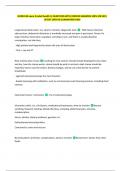
P stands for parentheses. You must first simplify any expressions that appear inside parentheses.
E is for exponents. Evaluate all exponents in the expression.
M stands for multiplication, and D stands for division. Multiply and divide from left to right within the
expression.
A means addition, and S means subtraction. This is the last step in the process. Add and subtract from
left to right within the expression.
If you need a better memory cue than the abbreviation, PEMDAS, think about the sentence "Please
Excuse My Dear Aunt Sally." Use it to help remember the order of operations. - correct answer
The Distributive Property you used can be written in the form of two general equations:
y × (a + b) = y × a + y × b, and
y × (a − b) = y × a − y × b.
If you multiply the sum or the difference of two or more values by a common number, you get the same
result as when you multiply each value within the parentheses separately.
The Distributive Property can be used to simplify mathematical expressions. Let's use the expression (32
+ 56) as an example. If a number exactly divides both numbers in the expression, you can pull that
number out of the parentheses. For example,
(32 + 56) = (16 × 2 + 28 × 2) = 2 × (16 + 28).
In the equation above, 2 is a factor of 32 and 56. Similarly, 4 is a factor of both 32 and 56. So we can
simplify the expression further as:
(32 + 56) = (4 × 8 + 4 × 14) = 4 × (8 + 14).
, Again, the number 2 is a common factor of 8 and 14. So the expression can be simplified further:
4 × (8 + 14) = 4 × 2 × - correct answer
magine you're making one sandwich for yourself and two more sandwiches for your brothers. To make
each sandwich, you need two slices of bread, one slice of cheese, and four slices of tomato. How can you
determine how much of each ingredient you need to make all three sandwiches?
The Distributive Property
The ingredients that you need for 1 sandwich can be written as the expression (2 + 1 + 4).
So, to make 3 sandwiches, you need 3 × (2 + 1 + 4).
Now multiply 3 by each number inside the parentheses:
=3×2+3×1+3×4
= 6 + 3 + 12.
You just used the Distributive Property. To make 3 sandwiches, you need 3 × 2 = 6 slices of bread, 3 × 1 =
3 slices of cheese, and 3 × 4 = 12 slices of tomato. Now you know the ingredients needed for three
sandwiches: 6 slices of bread, 3 slices of cheese, and 12 slices of tomato. - correct answer
Greatest Common Factor
You can apply the Distributive Property to the sum of a group of numbers only if there is at least one
whole number (other than 1) that divides all the numbers in the sum evenly. Such a number is called a
common factor.
For example, the sum (18 + 19) cannot be simplified by applying the Distributive Property because 18
and 19 do not have a common factor (other than 1): (18 + 19) = 1 × (18 + 19).
On the other hand, as you saw in the previous example, the numbers in the expression (32 + 56) have
three common factors: 2, 4, and 8.
P stands for parentheses. You must first simplify any expressions that appear inside parentheses.
E is for exponents. Evaluate all exponents in the expression.
M stands for multiplication, and D stands for division. Multiply and divide from left to right within the
expression.
A means addition, and S means subtraction. This is the last step in the process. Add and subtract from
left to right within the expression.
If you need a better memory cue than the abbreviation, PEMDAS, think about the sentence "Please
Excuse My Dear Aunt Sally." Use it to help remember the order of operations. - correct answer
The Distributive Property you used can be written in the form of two general equations:
y × (a + b) = y × a + y × b, and
y × (a − b) = y × a − y × b.
If you multiply the sum or the difference of two or more values by a common number, you get the same
result as when you multiply each value within the parentheses separately.
The Distributive Property can be used to simplify mathematical expressions. Let's use the expression (32
+ 56) as an example. If a number exactly divides both numbers in the expression, you can pull that
number out of the parentheses. For example,
(32 + 56) = (16 × 2 + 28 × 2) = 2 × (16 + 28).
In the equation above, 2 is a factor of 32 and 56. Similarly, 4 is a factor of both 32 and 56. So we can
simplify the expression further as:
(32 + 56) = (4 × 8 + 4 × 14) = 4 × (8 + 14).
, Again, the number 2 is a common factor of 8 and 14. So the expression can be simplified further:
4 × (8 + 14) = 4 × 2 × - correct answer
magine you're making one sandwich for yourself and two more sandwiches for your brothers. To make
each sandwich, you need two slices of bread, one slice of cheese, and four slices of tomato. How can you
determine how much of each ingredient you need to make all three sandwiches?
The Distributive Property
The ingredients that you need for 1 sandwich can be written as the expression (2 + 1 + 4).
So, to make 3 sandwiches, you need 3 × (2 + 1 + 4).
Now multiply 3 by each number inside the parentheses:
=3×2+3×1+3×4
= 6 + 3 + 12.
You just used the Distributive Property. To make 3 sandwiches, you need 3 × 2 = 6 slices of bread, 3 × 1 =
3 slices of cheese, and 3 × 4 = 12 slices of tomato. Now you know the ingredients needed for three
sandwiches: 6 slices of bread, 3 slices of cheese, and 12 slices of tomato. - correct answer
Greatest Common Factor
You can apply the Distributive Property to the sum of a group of numbers only if there is at least one
whole number (other than 1) that divides all the numbers in the sum evenly. Such a number is called a
common factor.
For example, the sum (18 + 19) cannot be simplified by applying the Distributive Property because 18
and 19 do not have a common factor (other than 1): (18 + 19) = 1 × (18 + 19).
On the other hand, as you saw in the previous example, the numbers in the expression (32 + 56) have
three common factors: 2, 4, and 8.