NUSC 1165 FINAL EXAM questions with complete
solutions already passed
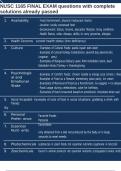
1. Availability - Food Environment; physical (restaurant stores)
-Location; locally processed food
-Socioeconomic Status; income, education lifestyle, living conditions
-Health Status; celiac disease, ability to carry groceries, allergies
2. Health Concerns current health status (iron deficiency)
3. Culture - Examples of Cultural Foods; paella (spain eats later)
-Examples of Cultural Holiday Celebrations; seventh day adventurists
(vegetari- ans)
-Examples of Religious Dietary Laws; Pork forbidden islam, beef
forbidden hindu Turkey = thanksgiving
4. Psychologic -Examples of Comfort Foods; chicken noodle & orange juice (stress / illnes
al and -Examples of Food as a Reward; elementary pizza party, ice cream
Emotional
-Examples of Removal of Food as a Punishment; no veggies = no desser
State
-Food usage during celebrations; cake for birthday
-Scenarios of food consumed based on emotional; chocolate when sad
5. Social Acceptabil- Examples of uses of food in social situations; grabbing a drink with
friends
ity
6. Personal Favorite Foods
Prefer- ence Personal
Convictions
7. Essential
Nutri- ents
only obtained from a diet not produced by the body or in large
amounts to meet needs
8. Phytochemicals substances in plant foods not essential nutrients (suphrane in broccoli)
9. Zoochemicals found in animal products not essential nutrients (conjugated Linoleic Acid)
1/
76
,NUSC 1165 FINAL EXAM questions with complete
solutions already passed
meats
10. Fortified Foods
2/
76
,NUSC 1165 FINAL EXAM questions with complete
solutions already passed
addition of nutrients to a food or beverage product
Milk added to vitamin A and breads to vitamin B
11. Dietary product intended for ingestion in the diet
Supple- Contains one or more; vitamins, minerals amino acids, plant-derived substances,
ments concentrates and extract
Nutrients; carbohydrates, proteins and lipids
12. Energy-
Yielding
Nutrient
13. Macronutrient carbohydrates, lipids, protein, water
14. Micronutrient Vitamins BC (water) ADEK (fat) and minerals (iron and calcium)
15. Inorganic minerals and water
16. Organic carbohydrates, lipids, protein and vitamins
17. Amount of Carbohydrates; 4 kcal/g
Ener- gy Protein; 4 kcal/g
Fat; 9 kcal/g
Alcohol; 7 kcal/g
18. Nutrient Density measure of the nutrient a food provides compared to its energy
context
Low-fat milk is more dense than iced tea
19. Epidemiologic 20. Depletion-Reple- tion Study
al Study
3/
76
,NUSC 1165 FINAL EXAM questions with complete
solutions already passed
observation of relationships
between diet, health and
disease patterns in ditterent
populations
-Focuses on patterns rather
than cause-ettect relationships
-Correlation; two or more
factors occurring together
the nutrient is eliminated in
the diet until deficiency
when symptoms appear,
nutrient is added back to
the diet to a level which
symptoms are eliminated
4/
76
solutions already passed
1. Availability - Food Environment; physical (restaurant stores)
-Location; locally processed food
-Socioeconomic Status; income, education lifestyle, living conditions
-Health Status; celiac disease, ability to carry groceries, allergies
2. Health Concerns current health status (iron deficiency)
3. Culture - Examples of Cultural Foods; paella (spain eats later)
-Examples of Cultural Holiday Celebrations; seventh day adventurists
(vegetari- ans)
-Examples of Religious Dietary Laws; Pork forbidden islam, beef
forbidden hindu Turkey = thanksgiving
4. Psychologic -Examples of Comfort Foods; chicken noodle & orange juice (stress / illnes
al and -Examples of Food as a Reward; elementary pizza party, ice cream
Emotional
-Examples of Removal of Food as a Punishment; no veggies = no desser
State
-Food usage during celebrations; cake for birthday
-Scenarios of food consumed based on emotional; chocolate when sad
5. Social Acceptabil- Examples of uses of food in social situations; grabbing a drink with
friends
ity
6. Personal Favorite Foods
Prefer- ence Personal
Convictions
7. Essential
Nutri- ents
only obtained from a diet not produced by the body or in large
amounts to meet needs
8. Phytochemicals substances in plant foods not essential nutrients (suphrane in broccoli)
9. Zoochemicals found in animal products not essential nutrients (conjugated Linoleic Acid)
1/
76
,NUSC 1165 FINAL EXAM questions with complete
solutions already passed
meats
10. Fortified Foods
2/
76
,NUSC 1165 FINAL EXAM questions with complete
solutions already passed
addition of nutrients to a food or beverage product
Milk added to vitamin A and breads to vitamin B
11. Dietary product intended for ingestion in the diet
Supple- Contains one or more; vitamins, minerals amino acids, plant-derived substances,
ments concentrates and extract
Nutrients; carbohydrates, proteins and lipids
12. Energy-
Yielding
Nutrient
13. Macronutrient carbohydrates, lipids, protein, water
14. Micronutrient Vitamins BC (water) ADEK (fat) and minerals (iron and calcium)
15. Inorganic minerals and water
16. Organic carbohydrates, lipids, protein and vitamins
17. Amount of Carbohydrates; 4 kcal/g
Ener- gy Protein; 4 kcal/g
Fat; 9 kcal/g
Alcohol; 7 kcal/g
18. Nutrient Density measure of the nutrient a food provides compared to its energy
context
Low-fat milk is more dense than iced tea
19. Epidemiologic 20. Depletion-Reple- tion Study
al Study
3/
76
,NUSC 1165 FINAL EXAM questions with complete
solutions already passed
observation of relationships
between diet, health and
disease patterns in ditterent
populations
-Focuses on patterns rather
than cause-ettect relationships
-Correlation; two or more
factors occurring together
the nutrient is eliminated in
the diet until deficiency
when symptoms appear,
nutrient is added back to
the diet to a level which
symptoms are eliminated
4/
76