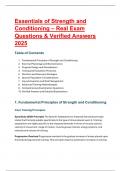
Essentials of Strength and
Conditioning – Real Exam
Questions & Verified Answers
2025
Table of Contents
1. Fundamental Principles of Strength and Conditioning
2. Exercise Physiology and Biomechanics
3. Program Design and Periodization
4. Testing and Evaluation Protocols
5. Nutrition and Recovery Strategies
6. Special Population Considerations
7. Injury Prevention and Risk Management
8. Advanced Training Methodologies
9. Comprehensive Examination Questions
10. Verified Answers and Detailed Explanations
1. Fundamental Principles of Strength and Conditioning
Core Training Principles
Specificity (SAID Principle) The Specific Adaptations to Imposed Demands principle
states that the body adapts specifically to the type of stress placed upon it. Training
adaptations are highly specific to the imposed demands in terms of muscle actions,
velocity of movement, range of motion, muscle groups trained, energy systems, and
intensity and volume of training.
Progressive Overload Progressive overload is the gradual increase of stress placed upon
the body during exercise training. This principle requires systematic increases in training
,variables including intensity, volume, frequency, or complexity to continually challenge the
neuromuscular system and promote adaptation.
Variation (Periodization) Systematic variation in training variables prevents
accommodation and staleness while optimizing performance gains. Variation can be
implemented through changes in exercises, intensities, volumes, rest periods, and training
frequencies across different time periods.
Recovery and Adaptation The recovery period following training stress is when
physiological adaptations occur. Adequate recovery allows for supercompensation, where
the body rebuilds stronger than its previous state. Recovery encompasses both immediate
post-exercise recovery and long-term adaptation periods.
Energy System Development
Phosphocreatine System (ATP-PC) The phosphocreatine system provides immediate
energy for high-intensity activities lasting 0-15 seconds. This system operates
anaerobically and is crucial for explosive movements, maximum strength efforts, and
power development. Training this system requires high-intensity, short-duration exercises
with complete recovery periods.
Glycolytic System The glycolytic system provides energy for moderate to high-intensity
activities lasting 15 seconds to 2 minutes. This system can operate with or without oxygen,
producing energy through the breakdown of glucose or glycogen. Training focuses on
interval work and sustained high-intensity efforts.
Oxidative System The oxidative system provides energy for prolonged, lower-intensity
activities lasting longer than 2 minutes. This aerobic system metabolizes carbohydrates,
fats, and proteins in the presence of oxygen. Training emphasizes steady-state
cardiorespiratory exercises and aerobic base development.
Neuromuscular Adaptations
Neural Adaptations Early strength gains (first 6-8 weeks) are primarily due to neural
adaptations including improved motor unit recruitment, increased firing frequency, better
intermuscular coordination, and reduced antagonist co-activation. These adaptations
occur before significant structural changes in muscle tissue.
Structural Adaptations Long-term training produces structural adaptations including
muscle fiber hypertrophy, changes in muscle architecture, increased capillarization,
, mitochondrial density improvements, and alterations in enzyme activity. These
adaptations typically become prominent after 6-8 weeks of consistent training.
2. Exercise Physiology and Biomechanics
Muscle Fiber Types and Training Implications
Type I Fibers (Slow-Twitch) Type I fibers are characterized by high oxidative capacity,
fatigue resistance, and slower contraction speeds. These fibers are predominant in
endurance athletes and respond well to high-volume, moderate-intensity training with
shorter rest periods.
Type IIa Fibers (Fast-Twitch Oxidative) Type IIa fibers possess both high glycolytic and
oxidative capacities, making them adaptable to various training stimuli. These fibers can
be trained for both power and endurance applications through varied intensity and volume
manipulations.
Type IIx Fibers (Fast-Twitch Glycolytic) Type IIx fibers have high glycolytic capacity and
are capable of generating high force rapidly but fatigue quickly. These fibers are crucial for
explosive movements and respond best to high-intensity, low-volume training with
adequate recovery.
Biomechanical Principles
Force-Velocity Relationship The force-velocity relationship describes the inverse
relationship between the force a muscle can produce and the velocity of contraction.
Maximum force is produced at zero velocity (isometric), while maximum velocity occurs at
minimal force production.
Power-Velocity Relationship Power output is maximized at approximately 30% of
maximum velocity and 30% of maximum force. This relationship is crucial for determining
optimal training loads for power development across different sports and activities.
Length-Tension Relationship Muscle force production varies with muscle length due to
actin-myosin filament overlap. Optimal force production occurs at resting length, with
reduced force at shortened or lengthened positions. Understanding this relationship is
essential for exercise selection and range of motion considerations.
Conditioning – Real Exam
Questions & Verified Answers
2025
Table of Contents
1. Fundamental Principles of Strength and Conditioning
2. Exercise Physiology and Biomechanics
3. Program Design and Periodization
4. Testing and Evaluation Protocols
5. Nutrition and Recovery Strategies
6. Special Population Considerations
7. Injury Prevention and Risk Management
8. Advanced Training Methodologies
9. Comprehensive Examination Questions
10. Verified Answers and Detailed Explanations
1. Fundamental Principles of Strength and Conditioning
Core Training Principles
Specificity (SAID Principle) The Specific Adaptations to Imposed Demands principle
states that the body adapts specifically to the type of stress placed upon it. Training
adaptations are highly specific to the imposed demands in terms of muscle actions,
velocity of movement, range of motion, muscle groups trained, energy systems, and
intensity and volume of training.
Progressive Overload Progressive overload is the gradual increase of stress placed upon
the body during exercise training. This principle requires systematic increases in training
,variables including intensity, volume, frequency, or complexity to continually challenge the
neuromuscular system and promote adaptation.
Variation (Periodization) Systematic variation in training variables prevents
accommodation and staleness while optimizing performance gains. Variation can be
implemented through changes in exercises, intensities, volumes, rest periods, and training
frequencies across different time periods.
Recovery and Adaptation The recovery period following training stress is when
physiological adaptations occur. Adequate recovery allows for supercompensation, where
the body rebuilds stronger than its previous state. Recovery encompasses both immediate
post-exercise recovery and long-term adaptation periods.
Energy System Development
Phosphocreatine System (ATP-PC) The phosphocreatine system provides immediate
energy for high-intensity activities lasting 0-15 seconds. This system operates
anaerobically and is crucial for explosive movements, maximum strength efforts, and
power development. Training this system requires high-intensity, short-duration exercises
with complete recovery periods.
Glycolytic System The glycolytic system provides energy for moderate to high-intensity
activities lasting 15 seconds to 2 minutes. This system can operate with or without oxygen,
producing energy through the breakdown of glucose or glycogen. Training focuses on
interval work and sustained high-intensity efforts.
Oxidative System The oxidative system provides energy for prolonged, lower-intensity
activities lasting longer than 2 minutes. This aerobic system metabolizes carbohydrates,
fats, and proteins in the presence of oxygen. Training emphasizes steady-state
cardiorespiratory exercises and aerobic base development.
Neuromuscular Adaptations
Neural Adaptations Early strength gains (first 6-8 weeks) are primarily due to neural
adaptations including improved motor unit recruitment, increased firing frequency, better
intermuscular coordination, and reduced antagonist co-activation. These adaptations
occur before significant structural changes in muscle tissue.
Structural Adaptations Long-term training produces structural adaptations including
muscle fiber hypertrophy, changes in muscle architecture, increased capillarization,
, mitochondrial density improvements, and alterations in enzyme activity. These
adaptations typically become prominent after 6-8 weeks of consistent training.
2. Exercise Physiology and Biomechanics
Muscle Fiber Types and Training Implications
Type I Fibers (Slow-Twitch) Type I fibers are characterized by high oxidative capacity,
fatigue resistance, and slower contraction speeds. These fibers are predominant in
endurance athletes and respond well to high-volume, moderate-intensity training with
shorter rest periods.
Type IIa Fibers (Fast-Twitch Oxidative) Type IIa fibers possess both high glycolytic and
oxidative capacities, making them adaptable to various training stimuli. These fibers can
be trained for both power and endurance applications through varied intensity and volume
manipulations.
Type IIx Fibers (Fast-Twitch Glycolytic) Type IIx fibers have high glycolytic capacity and
are capable of generating high force rapidly but fatigue quickly. These fibers are crucial for
explosive movements and respond best to high-intensity, low-volume training with
adequate recovery.
Biomechanical Principles
Force-Velocity Relationship The force-velocity relationship describes the inverse
relationship between the force a muscle can produce and the velocity of contraction.
Maximum force is produced at zero velocity (isometric), while maximum velocity occurs at
minimal force production.
Power-Velocity Relationship Power output is maximized at approximately 30% of
maximum velocity and 30% of maximum force. This relationship is crucial for determining
optimal training loads for power development across different sports and activities.
Length-Tension Relationship Muscle force production varies with muscle length due to
actin-myosin filament overlap. Optimal force production occurs at resting length, with
reduced force at shortened or lengthened positions. Understanding this relationship is
essential for exercise selection and range of motion considerations.