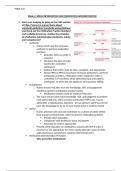
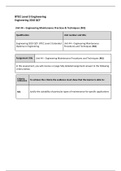
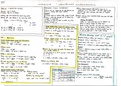
Summary of Study Unit 1: Expert Evidence 1
1.1 Introduction
This unit provides an overview of expert evidence and its presentation in
court. Investigators may occasionally be considered expert witnesses
based on their experience, knowledge, and qualifications. Understanding
the role and function of expert witnesses is crucial for investigators, even
if they are not experts themselves.
1.2 Presenting Evidence to a Court or Hearing
Legal concepts influencing evidence presentation include:
Criminal cases: Standard of proof is "beyond a reasonable doubt."
Civil cases: Standard of proof is "on a balance of probabilities."
Evidence categories:
Real evidence: Physical objects.
Documentary evidence: Documents and recordings, requiring
authentication.
Witness evidence: Testimonies based on personal observations,
typically presented orally.
1.3 What is an Expert?
An expert is someone with exceptional knowledge or skills in a specific
field. Investigators may be considered experts in specialized fields, such
as vehicle accident investigations, but must meet strict requirements.
1.4 Expert Witnesses and the Court/Hearing
Expert witnesses are professionals who provide opinions on matters
outside the court's common knowledge. Their reports, based on
investigations, examinations, and experiments, form the basis of their
testimony.
1.5 Expert Report
An expert report helps judges or presiding officers make informed
decisions. It includes:
Facts observed or reported.
Reasoned analysis and conclusions.
Written details to support oral testimony.
1.6 Format of an Expert Report
An expert report should be well-structured with clear headings, numbered
pages, and professional binding. Suggested format:
1. Introduction (expert details, investigation summary, conclusions).
, 2. Issues addressed.
3. Investigation of facts (documents, interviews, research,
experiments).
4. Expert opinion.
5. Facts, analysis, and argued conclusion.
1.7 Value of Expert Evidence
Expert evidence must be logical, consistent, and unbiased. Judges
evaluate the expert's reasoning, supporting evidence, and responses
during cross-examination. Experts must provide independent assistance
to the court.
1.8 Concluding Remarks
Experts bridge their professional expertise with legal
requirements. Investigators must understand the role of expert witnesses
and how expert evidence is gathered, prepared, and presented in court.
Summary of Study Unit 2: Interrogation 1
2.1 Introduction
Interrogation is a critical investigative technique used to obtain
information or confessions from suspects. It must be conducted within
legal and ethical frameworks, respecting the rights of arrested, detained,
and accused persons as outlined in Section 35 of the South African
Constitution.
2.2 Understanding Interrogation
Interrogation involves formal questioning of suspects, while interviewing is
used for witnesses. The moment a person is suspected of involvement in a
crime, they are interrogated. Legal requirements must be met during this
process.
2.3 Interrogation as a Modern-Day Law Enforcement Technique
Interrogation is a complex skill developed through experience. It involves
personal communication and interaction between the interrogator and the
suspect, with the goal of eliciting cooperation and information.
2.4 Objectives of an Interrogation
Key objectives include:
Obtaining a confession.
Determining whether a crime was committed.
Establishing a suspect’s involvement.
, Gathering information about the crime.
Suspects may confess for psychological reasons, curiosity, paranoia,
or a desire to be understood.
2.5 Interrogation Techniques
Two main types:
Inquisitorial: Seeks information when guilt is uncertain.
Persuasive: Uses tactics to overcome resistance.
The interrogation process includes four phases:
1. Orientation: Define purpose and objectives.
2. Narration: Establish rapport and listen to the suspect’s story.
3. Cross-examination: Ask specific questions and explore details.
4. Resolution: Expose deception and seek a confession.
2.6 Communication
Effective communication is essential for successful interrogation. It
involves verbal and nonverbal cues, building rapport, and creating a safe
space for suspects to cooperate.
2.7 The Interrogation Process
Steps include:
1. Preparation: Gather information about the suspect and case.
2. Introduction: Set a professional tone.
3. Reading of rights: Inform suspects of their legal rights.
4. Rapport building: Establish trust and respect.
5. Questioning: Use open-ended and specific questions.
6. Verification: Confirm the accuracy of information.
7. Presenting evidence: Confront the suspect with evidence and
seek a confession.
2.8 Interrogation Tactics
Key tactics include:
Recording the interrogation.
Avoiding interruptions during narration.
Using open-ended questions.
Maintaining professionalism and credibility.
1.1 Introduction
This unit provides an overview of expert evidence and its presentation in
court. Investigators may occasionally be considered expert witnesses
based on their experience, knowledge, and qualifications. Understanding
the role and function of expert witnesses is crucial for investigators, even
if they are not experts themselves.
1.2 Presenting Evidence to a Court or Hearing
Legal concepts influencing evidence presentation include:
Criminal cases: Standard of proof is "beyond a reasonable doubt."
Civil cases: Standard of proof is "on a balance of probabilities."
Evidence categories:
Real evidence: Physical objects.
Documentary evidence: Documents and recordings, requiring
authentication.
Witness evidence: Testimonies based on personal observations,
typically presented orally.
1.3 What is an Expert?
An expert is someone with exceptional knowledge or skills in a specific
field. Investigators may be considered experts in specialized fields, such
as vehicle accident investigations, but must meet strict requirements.
1.4 Expert Witnesses and the Court/Hearing
Expert witnesses are professionals who provide opinions on matters
outside the court's common knowledge. Their reports, based on
investigations, examinations, and experiments, form the basis of their
testimony.
1.5 Expert Report
An expert report helps judges or presiding officers make informed
decisions. It includes:
Facts observed or reported.
Reasoned analysis and conclusions.
Written details to support oral testimony.
1.6 Format of an Expert Report
An expert report should be well-structured with clear headings, numbered
pages, and professional binding. Suggested format:
1. Introduction (expert details, investigation summary, conclusions).
, 2. Issues addressed.
3. Investigation of facts (documents, interviews, research,
experiments).
4. Expert opinion.
5. Facts, analysis, and argued conclusion.
1.7 Value of Expert Evidence
Expert evidence must be logical, consistent, and unbiased. Judges
evaluate the expert's reasoning, supporting evidence, and responses
during cross-examination. Experts must provide independent assistance
to the court.
1.8 Concluding Remarks
Experts bridge their professional expertise with legal
requirements. Investigators must understand the role of expert witnesses
and how expert evidence is gathered, prepared, and presented in court.
Summary of Study Unit 2: Interrogation 1
2.1 Introduction
Interrogation is a critical investigative technique used to obtain
information or confessions from suspects. It must be conducted within
legal and ethical frameworks, respecting the rights of arrested, detained,
and accused persons as outlined in Section 35 of the South African
Constitution.
2.2 Understanding Interrogation
Interrogation involves formal questioning of suspects, while interviewing is
used for witnesses. The moment a person is suspected of involvement in a
crime, they are interrogated. Legal requirements must be met during this
process.
2.3 Interrogation as a Modern-Day Law Enforcement Technique
Interrogation is a complex skill developed through experience. It involves
personal communication and interaction between the interrogator and the
suspect, with the goal of eliciting cooperation and information.
2.4 Objectives of an Interrogation
Key objectives include:
Obtaining a confession.
Determining whether a crime was committed.
Establishing a suspect’s involvement.
, Gathering information about the crime.
Suspects may confess for psychological reasons, curiosity, paranoia,
or a desire to be understood.
2.5 Interrogation Techniques
Two main types:
Inquisitorial: Seeks information when guilt is uncertain.
Persuasive: Uses tactics to overcome resistance.
The interrogation process includes four phases:
1. Orientation: Define purpose and objectives.
2. Narration: Establish rapport and listen to the suspect’s story.
3. Cross-examination: Ask specific questions and explore details.
4. Resolution: Expose deception and seek a confession.
2.6 Communication
Effective communication is essential for successful interrogation. It
involves verbal and nonverbal cues, building rapport, and creating a safe
space for suspects to cooperate.
2.7 The Interrogation Process
Steps include:
1. Preparation: Gather information about the suspect and case.
2. Introduction: Set a professional tone.
3. Reading of rights: Inform suspects of their legal rights.
4. Rapport building: Establish trust and respect.
5. Questioning: Use open-ended and specific questions.
6. Verification: Confirm the accuracy of information.
7. Presenting evidence: Confront the suspect with evidence and
seek a confession.
2.8 Interrogation Tactics
Key tactics include:
Recording the interrogation.
Avoiding interruptions during narration.
Using open-ended questions.
Maintaining professionalism and credibility.