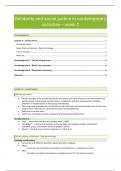
Solidarity and social justice in contemporary
societies – week 2
Inhoudsopgave
Lecture 2 – social justice ............................................................................................................... 1
Recap last week ............................................................................................................................... 1
Rawls theory of fairness – Key terminology ......................................................................................... 1
Forms of justice ............................................................................................................................... 2
Wrap-up .......................................................................................................................................... 3
Knowledge clip 1 – The veil of ignorance ........................................................................................ 4
Knowledge clip 2 – Rawls’ key concepts ........................................................................................ 4
Knowledge clip 3 – Dimensions of justice ...................................................................................... 5
Glossary ...................................................................................................................................... 6
Lecture 2 – social justice
Recap last week
• Social inequality is the uneven distribution of burdens and valued resources across members of
society based on their group membership in combination with the undervaluation of these
members of society based on their group membership
• Reducing social inequality as a social dilemma & Justice as a self-transcending value to put more
weight on the collective (vs. self-interest) side of social dilemmas
• Justice as a societal value
• Justice is a contested concept; situational and dispositional differences
Social justice is …
• Lind: “…where the individual and society meet” (1995)
• Jost & Kay: “… a theme that requires one to consider and integrate insights arising from
individual, group, and system levels of analysis” (2010)
• Rawls: “…the first virtue of social institutions” (1971, p. 3).
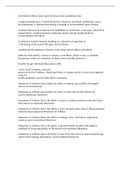
Rawls theory of fairness – Key terminology
Defining social justice
• Concerned with different questions about allocation of goods
• What…
- …would be a fair distribution of burdens and benefits? (i.e., distributive justice)
• Who…
- …should be included in the decision-making process? (cf. the scope of justice)
, • How…
- …can one create a fair decision-making process? (i.e., procedural justice)
- …do we treat all parties involved fairly and with dignity, acknowledging different viewpoints?
(cf. recognitive justice)
Forms of justice
Disruptive justice principles
Equity theory (e.g., Adams, 1965; Walster, Walster, & Berscheid, 1978)
• People are assumed to judge an outcome as just or fair when their own outcome-to-input ratio
equals some comparative or referent outcome-to-input ratio
• Unfair disadvantage & unfair advantage!
• Social and temporal comparisons
Distributive & procedural justice
Van den Bos, K., Vermunt, R., & Wilke, H. A. (1997).
Procedural and distributive justice: What is fair depends more on what comes first than on what comes
next. (Journal of Personality and Social Psychology, 72, 95.)
Procedural Justice
Fairness heuristic theory
People care (more) about procedural (vs.
distributive) justice because:
- Provides insight into relationship quality
- Order effect
- Ease of interpretation (i.e., no need for social
comparison)
Recognitive justice
• Justice as recognition (Fraser, 1998; Honneth, 2003)
- “Justice is not primarily concerned with how many goods a person should have but rather
with what kind of standing vis-à-vis others persons she deserves.” (Young, 1990)
- Recognition & Respect → Autonomy & Participation
• In subsequent waves of social movements:
- Balance shifts from distributive to recognitive justice emphasis
- Gaining equal rights → recognizing differences & compensating inequalities → valuing
differences
societies – week 2
Inhoudsopgave
Lecture 2 – social justice ............................................................................................................... 1
Recap last week ............................................................................................................................... 1
Rawls theory of fairness – Key terminology ......................................................................................... 1
Forms of justice ............................................................................................................................... 2
Wrap-up .......................................................................................................................................... 3
Knowledge clip 1 – The veil of ignorance ........................................................................................ 4
Knowledge clip 2 – Rawls’ key concepts ........................................................................................ 4
Knowledge clip 3 – Dimensions of justice ...................................................................................... 5
Glossary ...................................................................................................................................... 6
Lecture 2 – social justice
Recap last week
• Social inequality is the uneven distribution of burdens and valued resources across members of
society based on their group membership in combination with the undervaluation of these
members of society based on their group membership
• Reducing social inequality as a social dilemma & Justice as a self-transcending value to put more
weight on the collective (vs. self-interest) side of social dilemmas
• Justice as a societal value
• Justice is a contested concept; situational and dispositional differences
Social justice is …
• Lind: “…where the individual and society meet” (1995)
• Jost & Kay: “… a theme that requires one to consider and integrate insights arising from
individual, group, and system levels of analysis” (2010)
• Rawls: “…the first virtue of social institutions” (1971, p. 3).
Rawls theory of fairness – Key terminology
Defining social justice
• Concerned with different questions about allocation of goods
• What…
- …would be a fair distribution of burdens and benefits? (i.e., distributive justice)
• Who…
- …should be included in the decision-making process? (cf. the scope of justice)
, • How…
- …can one create a fair decision-making process? (i.e., procedural justice)
- …do we treat all parties involved fairly and with dignity, acknowledging different viewpoints?
(cf. recognitive justice)
Forms of justice
Disruptive justice principles
Equity theory (e.g., Adams, 1965; Walster, Walster, & Berscheid, 1978)
• People are assumed to judge an outcome as just or fair when their own outcome-to-input ratio
equals some comparative or referent outcome-to-input ratio
• Unfair disadvantage & unfair advantage!
• Social and temporal comparisons
Distributive & procedural justice
Van den Bos, K., Vermunt, R., & Wilke, H. A. (1997).
Procedural and distributive justice: What is fair depends more on what comes first than on what comes
next. (Journal of Personality and Social Psychology, 72, 95.)
Procedural Justice
Fairness heuristic theory
People care (more) about procedural (vs.
distributive) justice because:
- Provides insight into relationship quality
- Order effect
- Ease of interpretation (i.e., no need for social
comparison)
Recognitive justice
• Justice as recognition (Fraser, 1998; Honneth, 2003)
- “Justice is not primarily concerned with how many goods a person should have but rather
with what kind of standing vis-à-vis others persons she deserves.” (Young, 1990)
- Recognition & Respect → Autonomy & Participation
• In subsequent waves of social movements:
- Balance shifts from distributive to recognitive justice emphasis
- Gaining equal rights → recognizing differences & compensating inequalities → valuing
differences