Report
Course MSCI 522 - Principles of Physiology II
Lesson Glucose Homeostasis
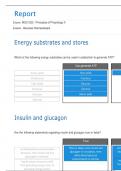
Energy substrates and stores
Which of the following energy substrates can be used in catabolism to generate ATP?
Amino acids Fatty acids
Cholesterol Fructose
Fatty acids Glucose
Fructose Glycerol
Glucose Amino acids
Glycerol
Insulin and glucagon
Are the following statements regarding insulin and glucagon true or false?
True
There is always some insulin and As b
As blood glucose concentration
glucagon in circulation, even dec
decreases, more insulin and less
when blood glucose
glucagon is released.
concentration is normal.
Insulin causes tissues to shift Ins
from generating energy stores to from
accessing energy stores. a
, Insulin signaling causes changes to each of the following metabolic pathways. Match each pa
Gluconeogenesis
Glycogenesis
Glycogenolysis
Lipogenesis
Lipolysis
The ow diagram below outlines how insulin release is triggered, and the e ects of insulin o
liver cells (hepatocytes), skeletal muscle cells, and adipose tissue (fat cells).
Use the metabolic pathways that you de ned above to complete the ow diagram.
Gluconeogenesis
Lipogenesis
Course MSCI 522 - Principles of Physiology II
Lesson Glucose Homeostasis
Energy substrates and stores
Which of the following energy substrates can be used in catabolism to generate ATP?
Amino acids Fatty acids
Cholesterol Fructose
Fatty acids Glucose
Fructose Glycerol
Glucose Amino acids
Glycerol
Insulin and glucagon
Are the following statements regarding insulin and glucagon true or false?
True
There is always some insulin and As b
As blood glucose concentration
glucagon in circulation, even dec
decreases, more insulin and less
when blood glucose
glucagon is released.
concentration is normal.
Insulin causes tissues to shift Ins
from generating energy stores to from
accessing energy stores. a
, Insulin signaling causes changes to each of the following metabolic pathways. Match each pa
Gluconeogenesis
Glycogenesis
Glycogenolysis
Lipogenesis
Lipolysis
The ow diagram below outlines how insulin release is triggered, and the e ects of insulin o
liver cells (hepatocytes), skeletal muscle cells, and adipose tissue (fat cells).
Use the metabolic pathways that you de ned above to complete the ow diagram.
Gluconeogenesis
Lipogenesis