Report
Course MSCI 522 - Principles of Physiology II
Lesson Autonomic Nervous System – Pre-Lab Prep
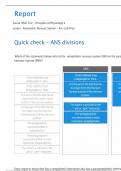
Quick check – ANS divisions
Which of the statements below refer to the sympathetic nervous system (SNS) or the para
nervous system (PNS)?
SNS
It has relatively long
It has relatively long
postganglionic bers.
postganglionic bers.
It is the part of the ANS that has It i
It has relatively short
its origin from the thoraco- ori
postganglionic bers.
lumbar portion of the nervous por
It is part of the ANS that has its system.
origin from the cranio-sacral
portion of the nervous system.
The system is activated in the
It is the part of the ANS that has " ght or ight" response.
its origin from the thoraco-
lumbar portion of the nervous The postganglionic
system. neurotransmitter is most
commonly norepinephrine.
The postganglionic
neurotransmitter is
acetylcholine.
The postganglionic
neurotransmitter is most
commonly norepinephrine.
The system is activated in the
" ght or ight" response.
Every organ or tissue that has a sympathetic innervation also has a parasympathetic innerva
, In measuring the autonomic nervous system skin potentials, which of the following is true f
median nerve?
Stimulation can be on either side.
Stimulation must be on the opposite side of the body to where the potentials are meas
Stimulation must be on the same side of the body as the potentials are measured.
Certain symptoms may be indicators of neuropathy, which can a ect nerves of the autonom
nervous systems. Categorize the following statements:
Alteration to normal Blurring of vision W
gastrointestinal function Loss of the ability to urinate Lo
Blurring of vision
Dizziness or fainting when
Di culty walking getting up at night
Dizziness or fainting when Erectile dysfunction
getting up at night Dry skin
Dry skin
Alteration to normal
Erectile dysfunction gastrointestinal function
Loss of sensation in the feet
Loss of the ability to urinate
Weakness in arm muscles
What are some typical responses of the two di erent divisions? Categorize the following sta
Decreases heart rate Dilate bronchioles
Dilate bronchioles Increase blood pressure
Increase blood pressure Increase heart rate
Course MSCI 522 - Principles of Physiology II
Lesson Autonomic Nervous System – Pre-Lab Prep
Quick check – ANS divisions
Which of the statements below refer to the sympathetic nervous system (SNS) or the para
nervous system (PNS)?
SNS
It has relatively long
It has relatively long
postganglionic bers.
postganglionic bers.
It is the part of the ANS that has It i
It has relatively short
its origin from the thoraco- ori
postganglionic bers.
lumbar portion of the nervous por
It is part of the ANS that has its system.
origin from the cranio-sacral
portion of the nervous system.
The system is activated in the
It is the part of the ANS that has " ght or ight" response.
its origin from the thoraco-
lumbar portion of the nervous The postganglionic
system. neurotransmitter is most
commonly norepinephrine.
The postganglionic
neurotransmitter is
acetylcholine.
The postganglionic
neurotransmitter is most
commonly norepinephrine.
The system is activated in the
" ght or ight" response.
Every organ or tissue that has a sympathetic innervation also has a parasympathetic innerva
, In measuring the autonomic nervous system skin potentials, which of the following is true f
median nerve?
Stimulation can be on either side.
Stimulation must be on the opposite side of the body to where the potentials are meas
Stimulation must be on the same side of the body as the potentials are measured.
Certain symptoms may be indicators of neuropathy, which can a ect nerves of the autonom
nervous systems. Categorize the following statements:
Alteration to normal Blurring of vision W
gastrointestinal function Loss of the ability to urinate Lo
Blurring of vision
Dizziness or fainting when
Di culty walking getting up at night
Dizziness or fainting when Erectile dysfunction
getting up at night Dry skin
Dry skin
Alteration to normal
Erectile dysfunction gastrointestinal function
Loss of sensation in the feet
Loss of the ability to urinate
Weakness in arm muscles
What are some typical responses of the two di erent divisions? Categorize the following sta
Decreases heart rate Dilate bronchioles
Dilate bronchioles Increase blood pressure
Increase blood pressure Increase heart rate