100% de satisfacción garantizada Inmediatamente disponible después del pago Tanto en línea como en PDF No estas atado a nada 4,6 TrustPilot
logo-home
Examen

BIOD 171- Exam 2 100% Correct Answers Save

Puntuación
-
Vendido
-
Páginas
3
Grado
A+
Subido en
26-05-2025
Escrito en
2024/2025

True or False: Metabolism is a controlled set of biochemical reactions that occur in living organisms in to maintain life - ANSWERSTrue T/F: Enzymes are polysaccharides that catalyze chemical reactions - ANSWERSFalse (enzymes are proteins) What are usually metal ions and assists enzyme during the catalysis reaction? - ANSWERSCofactors Define catabolism - ANSWERSThe process of breaking down larger molecules into useful energy sources. Upon cellular injury, which metabolic process is involved during the growth and repair phases of the cell? - ANSWERSThe anabolic process would be active as it is involved in the building up of small complexes into larger complexes Describe energy transfer process relative to both ATP and ADP - ANSWERSATP has the energy (phosphate group) to donate while ADP can accept energy in the form of a phosphate group. Thus ATP can be reduced (ATP-ADP+Pi) while ADP can be built into ATP (ADP+Pi-ATP) An organism that derives its energy (generates ATP) from photons of light is called - ANSWERSPhototrophic microorganism An organism that derives its energy by removing electrons from elemental sulfur would be classified as - ANSWERSLithotroph A reactive intermediate would be present in which phosphorylation process - ANSWERS? The chemical compound losing the phosphate group is referred to as the - ANSWERSphosphorylated reactive intermediate The catabolism of a single molecule of glucose goes through what 3 distinct transitions - ANSWERSGlycolysis, Fermentation or Respiration, then the ETC- electron transport chain What is the most energetic transition in the catabolism of glucose? - ANSWERSThe electron transport chain yields 34 ATP while both glycolysis and fermentation (or respiration) each yield only 2 ATP Identify the reactants of the following chemical equation: Glucose + 2NAD+ -> 2 NADH + 2 Pyruvate + 2ATP - ANSWERSThe reactants are to the left of the arrow: Glucose and 2NAD+ The presence of what molecule 'signals' to the cell that glycolysis is about to start? - ANSWERSGlucose-6-phosphate (G6P) T/F: In absence of oxygen fermentation produces only 2 ATP - ANSWERSFalse. Fermentation only reduces NADH back to NAD+ What is the primary byproduct of the TCA cycle? - ANSWERSC and D- TCA cycle produces an abundance of reduces electron carriers (NADH and FADH2) T/F: The reactants of the TCA cycle directly enter and fuel the electron transport system - ANSWERSFalse. The products of the TCA cycle (reduced electron carriers) enter and drive the production of ATP via the electron transport system. In the absence of glucose, which of the following can be used as alternative energy sources? Select all that apply - ANSWERSLactose, Carbohydrates, Lipids For the catabolism of proteins and lipids, which of the following enzymes are used? - ANSWERSProteases and Lipases, proteases breakdown proteins while lipases breakdown lipids. T/F- The B-oxidation pathway catabolizes the fatty acid chains of lipids - ANSWERSTrue Describe the relationship between chloroplasts and chlorophyll - ANSWERSBoth chloroplasts and chlorophyll are associated with photosynthesis. Chloroplasts are the double membrane-enclosed organelles that contain the photosynthetic pigment chlorophyll. T/F- Chloroplasts are specific to algae and plants - ANSWERSTrue The process of photophosphorylation produces which of the following: - ANSWERSATP, NADPH In phosphorylation, the light reactions always occur where? - ANSWERSThe process of converting light energy into chemical energy (photophosphorylation) always occurs in the membrane. T/F- The Calvin cycle must occur in the absence of light - ANSWERSFalse: the term "dark reactions" (also known as the Calvin Cycle) simply denotes the second stage in photosynthesis- dark reactions do not actually require darkness in order to occur. How many turns (or repetitions) of the Calvin Cycle are required to generate one molecule of glucose? - ANSWERSSix Complete the following equation by placing the appropriate numbers where indicated: __C02+ __ATP+ __NADPH+ __H2O -> __C6H12O6 + __ADP+ __NADP+ - ANSWERS6 C02+ 18 ATP+ 12 NADPH+ 12 H2O -> C6H12O6 + 18 ADP+ 12 NADP+ Match the following reactions to its corresponding enzyme - ANSWERS1D= A-B+H2O -> A-OH + B-H: Hydrolases 2F= A-B -> B-A: Isomerases 3E= A+B -> A-B: Ligases 4A= A-B -> A+B: Lyases

Mostrar más Leer menos
Institución
Biod
Grado
Biod


Ups! No podemos cargar tu documento ahora. Inténtalo de nuevo o contacta con soporte.

Escuela, estudio y materia

Institución
Biod
Grado
Biod

Información del documento

Subido en
26 de mayo de 2025
Número de páginas
3
Escrito en
2024/2025
Tipo
Examen
Contiene
Preguntas y respuestas

Temas

Vista previa del contenido

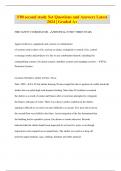
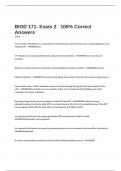
BIOD 171- Exam 2 100% Correct
Answers
Save

True or False: Metabolism is a controlled set of biochemical reactions that occur in living organisms in to
maintain life - ANSWERSTrue


T/F: Enzymes are polysaccharides that catalyze chemical reactions - ANSWERSFalse (enzymes are
proteins)


What are usually metal ions and assists enzyme during the catalysis reaction? - ANSWERSCofactors


Define catabolism - ANSWERSThe process of breaking down larger molecules into useful energy sources.


Upon cellular injury, which metabolic process is involved during the growth and repair phases of the
cell? - ANSWERSThe anabolic process would be active as it is involved in the building up of small
complexes into larger complexes


Describe energy transfer process relative to both ATP and ADP - ANSWERSATP has the energy
(phosphate group) to donate while ADP can accept energy in the form of a phosphate group. Thus ATP
can be reduced (ATP-ADP+Pi) while ADP can be built into ATP (ADP+Pi-ATP)


An organism that derives its energy (generates ATP) from photons of light is called -
ANSWERSPhototrophic microorganism


An organism that derives its energy by removing electrons from elemental sulfur would be classified as -
ANSWERSLithotroph


A reactive intermediate would be present in which phosphorylation process - ANSWERS?
$15.99
Accede al documento completo:

100% de satisfacción garantizada
Inmediatamente disponible después del pago
Tanto en línea como en PDF
No estas atado a nada

Conoce al vendedor
Seller avatar
paugrades1479
2.0
(1)

Documento también disponible en un lote

Conoce al vendedor

Seller avatar
paugrades1479 Nursing
Seguir Necesitas iniciar sesión para seguir a otros usuarios o asignaturas
Vendido
1
Miembro desde
2 año
Número de seguidores
1
Documentos
470
Última venta
2 año hace

2.0

1 reseñas

5
0
4
0
3
0
2
1
1
0

Recientemente visto por ti

Por qué los estudiantes eligen Stuvia

Creado por compañeros estudiantes, verificado por reseñas

Calidad en la que puedes confiar: escrito por estudiantes que aprobaron y evaluado por otros que han usado estos resúmenes.

¿No estás satisfecho? Elige otro documento

¡No te preocupes! Puedes elegir directamente otro documento que se ajuste mejor a lo que buscas.

Paga como quieras, empieza a estudiar al instante

Sin suscripción, sin compromisos. Paga como estés acostumbrado con tarjeta de crédito y descarga tu documento PDF inmediatamente.

Student with book image

“Comprado, descargado y aprobado. Así de fácil puede ser.”

Alisha Student

Preguntas frecuentes