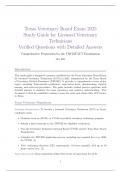
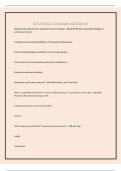
Texas Veterinary Board Exam 2025
Study Guide for Licensed Veterinary
Technicians
Verified Questions with Detailed Answers
Comprehensive Preparation for the TBVME LVT Examination
May 2025
Introduction
This study guide is designed to prepare candidates for the Texas Veterinary Board Exam
for Licensed Veterinary Technicians (LVTs) in 2025, administered by the Texas Board
of Veterinary Medical Examiners (TBVME). It provides a comprehensive review of key
topics, including Texas-specific regulations, supervision levels, pharmacology, surgical
nursing, and restricted procedures. The guide includes verified practice questions with
detailed answers to simulate the exam experience and reinforce understanding. This
document is ideal for candidates seeking to pass the exam and obtain their LVT license
in Texas.
Texas Veterinary Regulations
Licensing Requirements To become a Licensed Veterinary Technician (LVT) in Texas,
candidates must:
• Graduate from an AVMA- or CVMA-accredited veterinary technology program.
• Submit a final transcript to the TBVME for eligibility verification.
• Pass the Veterinary Technician National Exam (VTNE) and the Texas State Board
Examination.
• Complete the TBVME application process, including any required fees (e.g., $365
for VTNE). [1]
• Meet continuing education (CE) requirements: 10 hours annually, with up to 10
hours carried over. [3]
Supervision Levels Texas regulations define three levels of supervision for LVTs:
1
, • General Supervision: The veterinarian is not on-site but available via phone, email,
or other communication. [2]
• Direct Supervision: The veterinarian is present in the building. [2]
• Immediate Supervision: The veterinarian is within eyesight of the LVT. [2]
Restricted Procedures Non-veterinarians, including LVTs, are prohibited from performing
the following under Texas law:
• Diagnosing conditions.
• Prescribing medications.
• Performing surgery.
• Extracting teeth using an elevator.
• Providing prognoses. [2]
Pharmacology for LVTs
Key Responsibilities LVTs are responsible for:
• Preparing and dispensing medications as per veterinary orders.
• Educating clients on administered or dispensed pharmacological agents.
• Understanding drug classifications, mechanisms, and side effects.
• Ensuring patient and client safety during medication administration. [1]
Common Drug Classes
• Analgesics: E.g., NSAIDs (meloxicam), opioids (buprenorphine).
• Antibiotics: E.g., amoxicillin, enrofloxacin.
• >Anesthetics: E.g., propofol, isoflurane.
Surgical Nursing
Key Tasks LVTs assist in surgical procedures under supervision, including:
• Preparing surgical suites and equipment.
• Monitoring anesthesia and patient vitals.
• Understanding surgical anatomy and pathophysiology. [1]
2
Study Guide for Licensed Veterinary
Technicians
Verified Questions with Detailed Answers
Comprehensive Preparation for the TBVME LVT Examination
May 2025
Introduction
This study guide is designed to prepare candidates for the Texas Veterinary Board Exam
for Licensed Veterinary Technicians (LVTs) in 2025, administered by the Texas Board
of Veterinary Medical Examiners (TBVME). It provides a comprehensive review of key
topics, including Texas-specific regulations, supervision levels, pharmacology, surgical
nursing, and restricted procedures. The guide includes verified practice questions with
detailed answers to simulate the exam experience and reinforce understanding. This
document is ideal for candidates seeking to pass the exam and obtain their LVT license
in Texas.
Texas Veterinary Regulations
Licensing Requirements To become a Licensed Veterinary Technician (LVT) in Texas,
candidates must:
• Graduate from an AVMA- or CVMA-accredited veterinary technology program.
• Submit a final transcript to the TBVME for eligibility verification.
• Pass the Veterinary Technician National Exam (VTNE) and the Texas State Board
Examination.
• Complete the TBVME application process, including any required fees (e.g., $365
for VTNE). [1]
• Meet continuing education (CE) requirements: 10 hours annually, with up to 10
hours carried over. [3]
Supervision Levels Texas regulations define three levels of supervision for LVTs:
1
, • General Supervision: The veterinarian is not on-site but available via phone, email,
or other communication. [2]
• Direct Supervision: The veterinarian is present in the building. [2]
• Immediate Supervision: The veterinarian is within eyesight of the LVT. [2]
Restricted Procedures Non-veterinarians, including LVTs, are prohibited from performing
the following under Texas law:
• Diagnosing conditions.
• Prescribing medications.
• Performing surgery.
• Extracting teeth using an elevator.
• Providing prognoses. [2]
Pharmacology for LVTs
Key Responsibilities LVTs are responsible for:
• Preparing and dispensing medications as per veterinary orders.
• Educating clients on administered or dispensed pharmacological agents.
• Understanding drug classifications, mechanisms, and side effects.
• Ensuring patient and client safety during medication administration. [1]
Common Drug Classes
• Analgesics: E.g., NSAIDs (meloxicam), opioids (buprenorphine).
• Antibiotics: E.g., amoxicillin, enrofloxacin.
• >Anesthetics: E.g., propofol, isoflurane.
Surgical Nursing
Key Tasks LVTs assist in surgical procedures under supervision, including:
• Preparing surgical suites and equipment.
• Monitoring anesthesia and patient vitals.
• Understanding surgical anatomy and pathophysiology. [1]
2