HESI A2 BIOLOGY STUDY GUIDE 2024/2025
| 100+ PRACTICE QUESTIONS & ANSWER
RATIONALES
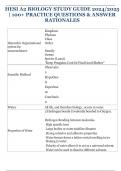
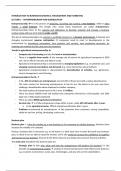
Kingdom
Phylum
Class
Hierarchic Organizational Order
system for
nomenclature Family
Genus
Species (Least)
"Keep Penguins Cool Or Find Good Shelter"
Observatio
n
Scientific Method
Hypothes
is
Experime
nt
Conclusio
n
Water All life, and therefore biology , occurs in water.
2 Hydrogen bonds Covalently bonded to Oxygen.
Hydrogen Bonding between molecules.
- High specific heat
- Large bodies or water stabilize climates
Properties of Water
- Strong cohesive and adhesive properties
- Water freezes forms a lattice crystal resulting in ice
floating in water.
- Polarity of water allows it to act as a universal solvent.
- Water can be used to dissolve different solvents.
,Carbohydrates Long chains, or polymers of sugar. Most
importantly form the backbone of DNA and
RNA.
Saturated Clogs arteries. NO DOUBLE BONDS in their
hydrocarbon tail. SOLID @ room
temperature.
Unsaturated Double bond in their hydrocarbon tail. LIQUID at room
temperature.
Phosphate group (polar)
soluble in water.
Phospholipids
Hydrocarbon tail of fatty
acids is nonpolar and
nonsoluble in water.
Ex. Cell Membrane
Steroids Are lipids, which are precursors to hormones and drugs
They are Polymers of 20 molecules called
Proteins Amino Acids. Enzymes are a type of protein,
which catalyze different reactions or
processes. LARGEST Biological Molecule
Cell Fundamental unit of biology
NO defined nucleus and NO
membrane- bound
Prokaryotic Cells
organelles.
Membrane-enclosed nucleus and series of
Eukaryotic Cells membrane-bound organelles that carry out the
functions of the cell as directed by the genetic
information contained in the nucleus.
Nucleus Contains DNA called Chromosomes.
Ribosomes Are organelles that read the RNA produced in
the nucleus and TRANSLATE the genetic
instructions to produce PROTEINS.
, Are found attached to the
endoplasmic reticulum (ER)
Bound ribosomes
Are found in the cytoplasm
Free ribosomes
| 100+ PRACTICE QUESTIONS & ANSWER
RATIONALES
Kingdom
Phylum
Class
Hierarchic Organizational Order
system for
nomenclature Family
Genus
Species (Least)
"Keep Penguins Cool Or Find Good Shelter"
Observatio
n
Scientific Method
Hypothes
is
Experime
nt
Conclusio
n
Water All life, and therefore biology , occurs in water.
2 Hydrogen bonds Covalently bonded to Oxygen.
Hydrogen Bonding between molecules.
- High specific heat
- Large bodies or water stabilize climates
Properties of Water
- Strong cohesive and adhesive properties
- Water freezes forms a lattice crystal resulting in ice
floating in water.
- Polarity of water allows it to act as a universal solvent.
- Water can be used to dissolve different solvents.
,Carbohydrates Long chains, or polymers of sugar. Most
importantly form the backbone of DNA and
RNA.
Saturated Clogs arteries. NO DOUBLE BONDS in their
hydrocarbon tail. SOLID @ room
temperature.
Unsaturated Double bond in their hydrocarbon tail. LIQUID at room
temperature.
Phosphate group (polar)
soluble in water.
Phospholipids
Hydrocarbon tail of fatty
acids is nonpolar and
nonsoluble in water.
Ex. Cell Membrane
Steroids Are lipids, which are precursors to hormones and drugs
They are Polymers of 20 molecules called
Proteins Amino Acids. Enzymes are a type of protein,
which catalyze different reactions or
processes. LARGEST Biological Molecule
Cell Fundamental unit of biology
NO defined nucleus and NO
membrane- bound
Prokaryotic Cells
organelles.
Membrane-enclosed nucleus and series of
Eukaryotic Cells membrane-bound organelles that carry out the
functions of the cell as directed by the genetic
information contained in the nucleus.
Nucleus Contains DNA called Chromosomes.
Ribosomes Are organelles that read the RNA produced in
the nucleus and TRANSLATE the genetic
instructions to produce PROTEINS.
, Are found attached to the
endoplasmic reticulum (ER)
Bound ribosomes
Are found in the cytoplasm
Free ribosomes