4) Economic Developments 1871-1914
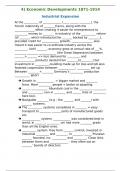
Industrial Expansion
At the __________ of _____________ (____ ______ ________), the
French indemnity of ________francs, along with the
______________ effect (making it easier for entrepreneurs to
_________ money to ________ in industry) of the __________ reform
(of _______, which introduced the _______ backed by ________),
provided credit for ____________ growth. _______________ also
meant it was easier to co-ordinate industry across the
_________. Until _______, economy grew at annual rate of ___%.
________ ________ ____________ (the Great Depression) between
_______+_______ => less demand for _________ and
______________ products (lasted from ________to________) but
investment in __________-building made up for loss and GD also
fostered cooperation between ____________: _________ set up.
Between ________+________ Germany’s _________ production
__________. WHY?
Growth in ____________. = bigger market and ________
force. More _________ people = better at adapting.
______ ___________. Abundant coal in the ________, _________,
and __________; iron in ________ and ______ (lots of _________
here too).
Navigable ________ (e.g – the _______ and _______) with
_______ systems.
The __________ systems completed in ________ = easy
transport to ________ ______ ports of manufactured goods
etc.
_____________ system. ____________ was considered best in
world. In _______, _________ uni had more ________ grads
than all the English ones.
__________ system. Free from _______ control, invested in
industrial _________ and ________. In _______, _____ Prussian
_______ founded, inc. __________ and _________. Close links
between them and _____________ - they often sat on
_______’ boards of directors.
Industrial Expansion
At the __________ of _____________ (____ ______ ________), the
French indemnity of ________francs, along with the
______________ effect (making it easier for entrepreneurs to
_________ money to ________ in industry) of the __________ reform
(of _______, which introduced the _______ backed by ________),
provided credit for ____________ growth. _______________ also
meant it was easier to co-ordinate industry across the
_________. Until _______, economy grew at annual rate of ___%.
________ ________ ____________ (the Great Depression) between
_______+_______ => less demand for _________ and
______________ products (lasted from ________to________) but
investment in __________-building made up for loss and GD also
fostered cooperation between ____________: _________ set up.
Between ________+________ Germany’s _________ production
__________. WHY?
Growth in ____________. = bigger market and ________
force. More _________ people = better at adapting.
______ ___________. Abundant coal in the ________, _________,
and __________; iron in ________ and ______ (lots of _________
here too).
Navigable ________ (e.g – the _______ and _______) with
_______ systems.
The __________ systems completed in ________ = easy
transport to ________ ______ ports of manufactured goods
etc.
_____________ system. ____________ was considered best in
world. In _______, _________ uni had more ________ grads
than all the English ones.
__________ system. Free from _______ control, invested in
industrial _________ and ________. In _______, _____ Prussian
_______ founded, inc. __________ and _________. Close links
between them and _____________ - they often sat on
_______’ boards of directors.