
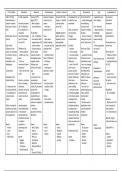
C & C tradition Culturalism Marxisms Psychoanalysis Gender in cult stud Class Structuralism Race postmodernism
19th C (till 50s) End 50s, begin 60s Classical(19thC- Approach critiqued Feminist PA in film Foundational for cult Struct (60s & 70s) = application post- No coherent
industrialization -> begin 20th C) by feminist cult studies <-> feminist studies but now - culture & language struct analysis theoretical
space for creation Post war prosperity - Marx & Engels studies cultural studies overlooked has underlying framework
new type of culture: UK, PC ubiquitous, - eco determinism - meaning = (since 70s) structures that race = discourse
WCC PC as mobilizer (<-> production-led Marx: eco determ shape our thinking - relation power & = post-struct
escapism), FS (30s-60s) highlight women's Consciousness & acting knowledge approach to
Britain (later US and Generation brought - nazi -> emigration Freud agency and their Struggle - focus on meaning- - differentiating postmodernity
rest Eu) up in PC, Diverse - mix marxism & PA - texts always capacity to resist 3-tiered model making at one point creates meaning ~
forms of PC - negative about MC implicit meaning and negotiate in time (synchronic) DS Postmodernity (vs
Base of fear: - culture industry - aud seek text that oppressive cultural Bourdieu - binary oppositions modernity)
influence of one Difference c&c - cultural products substitute their norms - fractions Post-struct (70s & not neutral ~
culture or civilization - Active audience of the culture desires - 3 forms capital 80s) Derrida PM in 60s (art)
on another: cultural - Bottom-up + top- industry served to - manifest & latent - cult consumption - questions the idea - critique on elitism
exchanges, down homogenize tastes, dream (~Althusser) produces social of fixed structures 3 key moments race - embracing MC
interactions, and - Focus on suppress critical - all humans difference and absolute truths ideology - eroding distinction
adaptations community & lived thinking, and universal - indiv’s from diff - focus on changing HC & LC
experience reinforce the status - meaning text social classes of meaning over Orientalism =
Conservative - WCC not the same quo depends on reader possess varying time (diachronic) °postcolonialism Lyotard
as MC - false association amounts of cultural -Meaning is not - science crisis
Nostalgia for pre- consciousness: by capital, influencing stable, but always Whiteness - money only value
industrial times culture as a primary presenting a Lacan their tastes, leads to new (discursive of culture
factor in shaping distorted version of - post-structuralist preferences, and references formation & - end meta-narrat.
1st attempt to look individuals, reality, PC prevented - condition of lack social mobility -Focus on how deconstruction)
at culture politically societies, and social people from - 3 stages - dominant classes powerful groups can Baudrillard
-> foundational for phenomena aka recognizing their are better equipped make a specific - life is mediated
cultural studies culture constructs exploitation and Mulvey with cultural capital, interpretation
Impact reality social inequalities - PA in cinema enabling them to ‘natural’ Jameson
inherent in capitalist - text determinism maintain their - Particular acts of - Marxist critic: PM
Elitist, no empirical reaction against systems privileged positions signification make cult as product of
evidence, top-down, more deterministic - meaning = and perpetuate sure that powerful late capitalism
passive audience, PC or structuralist production-led (not: inequality by setting relations - no critical distance
as homogeneous perspectives that Benjamin) cultural norms and exist/persist
prioritized economic standards that favor Mouffe: margins
or material their own tastes and critical of status quo
Names conditions in Names Names Names preferences Names Names
- Arnold explaining social - Marx, Engels - Freud - Stacey - De Saussure - Edward Said Global PM? no
- Leavis dynamics - Adorno - Lacan - Modleski Meritocratic myth - Lévi-Strauss
- Ross - Lowenthal - Mulvey - Coward - Wright Names
- MacDonald Names - Marcuse - Radway Names - Barthes - Lyotard
- Hoggart - Horkheimer - Ien Ang - Bourdieu - Derrida - Baudrillard
- Williams - Benjamin - Foucault - Jameson
- Thompson - Althusser (60s & - Mouffe
- Hall & Whannel 70s)
- Gramsci (70s-90s)
, Inhoudstafel
What is popular culture?
Definition through contrast + context dependent, each definition its own political & ideo statement
Williams: 3 definitions culture (ideal, social, documentary)
Ideology: 5 perspectives
- Body of knowledge of particular group (eg academic)
- Concealment (~Marx)
- Barthes: at level of secondary
- Ideological forms = particular image of the world
- Material practice
4 definitions PC Williams (well-liked, inferior, made to favour people, made by people)
6 perspectives popular culture
- Well-liked: quantitative
- Left-over
- Made by people (~folk)
- Mass culture
- Hegemony: compromised equilibrium
- PM: no distinction with HC, commercial
Development popular culture
- Out of industrialization & urbanization
o New relation employer-employee
o Residential class separation
o Repression against FR
Contextuality
- (historical) context crucial for understanding a cultural text
Culture & civilization tradition
Context
- 19th century (till 1950s): industrialization -> space for creation new type of culture: WCC
- Britain (later US and rest Eu)
- Conservative intellectuals
- Nostalgia for pre-industrial times (organic community, folk culture)
- 1st attempt to look at culture politically -> foundational for cultural studies
Impact
- More than a century dominant paradigm
- Leads to culturalism
Criticism
- Elitist, no empirical evidence, top-down, passive audience, PC as homogeneous
Arnold (19th century)
- Culture means 2 things
- WCC = anarchy = political threat -> sol: mobilization of culture
- 3 classes in society -> each need specific education
o Aristocracy: edu to deal with loss of authority
o Middle class: edu to become hegemonic
o Working class: edu by Centralized State to civilize & control tendency of anarchy
- Democracy = threat (eg franchise) -> sol: revolution from above
Leavisism (1930s – 1970s)
- 30s: crisis of cultural decline
, - Before: culture in minority keeping
30s: democracy & new literary taste -> irreparable chaos
- Solution: trainings in universities & schools
- Popular fiction = addictive -> end of critical thought
- Advertisement = biggest factor cultural decline
- Golden age Shakespeare: organic community
o Destroyed by IR: no quality of work -> °leisure: distraction
o Sol: missionaries
- Afraid of commercialization & americanization
- Focus on contemporary mass culture (A: wcc)
Post-war mass culture in USA
- Andrew ross
o In period of cold war, there was pol & cult consensus in America
▪ Classlessness, liberalism, pluralism
o Am intellectuals had for the first time national authority, and this because of debates on mass culture & the fact that mass
culture was seen as something sovjet-union
▪ Base for the politics of containment
o That cult authority was until the 50s, bcs then marginalized voices spoke up (race, gender …)
- 3 positions in debate on mass culture
o MC focuses on profit at the expense of intellectually stimulating content
▪ MC gives people pleasure of entertainment & can be thought-provoking + MC can be used to challenge authority
(active audience)
▪ MC is social control (SU propaganda threatens Am values)
- MacDonald
o Applies Leavis’ criticism on mass culture to post-war Am
o MC is not American, but from SU (standardized, commodification, propaganda …)
o But the emergence of MC in America is a problem: the bad will drive out the good
o MC homogenizes cultural diversity in America
Culturalism (end 50s, begin 60s in UK)
Context
- Post war prosperity in UK
- Post-colonial conflicts (no concrete enemy)
- PC ubiquitous
- Youth culture = political space
- PC as mobilizer (<-> escapism)
- Generation brought up in PC
- Diverse forms of PC
Difference with C&C tradition
- Active audience
- Bottom-up + top-down (= structure + agency)
- Focus on community & lived experience
- WCC not the same as MC
Hoggart 1957: the uses of literacy
- Part 2 (50s): MC threatens working class (~Leavis)
o MC = WCC, anti-american, pessimistic → MC dumbs down young people, it erases community & cohesion
- Part 1 (30s): MC ≠ WCC
o WCC = active consumption of MC products = agency within structure
o Nuanced impact of MC
o Eg. Beach vacation
- Influence Leavis
o Nostalgia, pessimistic, anti-america, anti-commerce
o New ideas: active audience, PC site of structure & agency
Williams 1958: culture & society
- Methodological
- You can use culture to understand society
- 3 definitions culture: ideal, recorded, social
o Social definition = base for cultural analysis
, - Cultural analysis
o Focus on common element, community of experience
o Structure of feeling
o Problem: selection
- Difference Leavis
o W: bottom-up culture (<-> L: hierarchical, top-down)
- Critique: what about power in culture?
Thompson 1963: the makings of the Englisch WC
- Marxist, but against determinism
- Class = consciousness of unity & difference
- How to form consciousness?
o Structure + agency
o Externalities + PC as internal reaction
- Culture = mobilizer
- pos about culturalism: use culture to understand society
- neg about culturalism: too deterministic
Hall & Whannel 1964: popular arts
- need tool to evaluate PC with (not HC)
- popular discrimination (HC and PC not opposing)
- popular art
- youth culture = mix of authentic & manufactured
CCCS
- centre for contemporary cultural studies
- founded by Hoggart, university of Birmingham
- later culturalism in conflict with structuralism
marxisms : overall pessimistic of popular culture
classical marxism (19th C – begin 20th C)
- Karl Marx
o You can’t study culture without being political
o Against industrialized capitalism
o Culture & class determined by historical mode of production
o Base-superstructure (material & social)
o Economic determinism
- Friedrich Engels
o Explains subtleties Marx
o Part of superstructure autonomous (structure + agency)
- Ideology: material force = intellectual force -> universality
- PC defined by economic structure behind it (reflection theory)
Frankfurt School (1930s-1960s)
- Marx’ prophecy not true
- Context: nazi party -> emigration US -> culture industry
- Mix between Marxism and PA
- Adorno (& Horkheimer)
o Culture industry: homogeneity, predictability
o Consumption = escapism, not critical (~ Leavis)
o ‘industry’ = also audience (prod, distr, cons)
- Lowenthal
o Stereotypes, standardization, superficiality
o PC depoliticizes working class
- Marcuse
o False consciousness, one-dimensional thought
o Good way of life resists qualitative change
- Horkheimer
o Authentic culture: radical potential
-> destroyed by PC due to commodification
o Work & leisure related in capitalism
- Benjamin
19th C (till 50s) End 50s, begin 60s Classical(19thC- Approach critiqued Feminist PA in film Foundational for cult Struct (60s & 70s) = application post- No coherent
industrialization -> begin 20th C) by feminist cult studies <-> feminist studies but now - culture & language struct analysis theoretical
space for creation Post war prosperity - Marx & Engels studies cultural studies overlooked has underlying framework
new type of culture: UK, PC ubiquitous, - eco determinism - meaning = (since 70s) structures that race = discourse
WCC PC as mobilizer (<-> production-led Marx: eco determ shape our thinking - relation power & = post-struct
escapism), FS (30s-60s) highlight women's Consciousness & acting knowledge approach to
Britain (later US and Generation brought - nazi -> emigration Freud agency and their Struggle - focus on meaning- - differentiating postmodernity
rest Eu) up in PC, Diverse - mix marxism & PA - texts always capacity to resist 3-tiered model making at one point creates meaning ~
forms of PC - negative about MC implicit meaning and negotiate in time (synchronic) DS Postmodernity (vs
Base of fear: - culture industry - aud seek text that oppressive cultural Bourdieu - binary oppositions modernity)
influence of one Difference c&c - cultural products substitute their norms - fractions Post-struct (70s & not neutral ~
culture or civilization - Active audience of the culture desires - 3 forms capital 80s) Derrida PM in 60s (art)
on another: cultural - Bottom-up + top- industry served to - manifest & latent - cult consumption - questions the idea - critique on elitism
exchanges, down homogenize tastes, dream (~Althusser) produces social of fixed structures 3 key moments race - embracing MC
interactions, and - Focus on suppress critical - all humans difference and absolute truths ideology - eroding distinction
adaptations community & lived thinking, and universal - indiv’s from diff - focus on changing HC & LC
experience reinforce the status - meaning text social classes of meaning over Orientalism =
Conservative - WCC not the same quo depends on reader possess varying time (diachronic) °postcolonialism Lyotard
as MC - false association amounts of cultural -Meaning is not - science crisis
Nostalgia for pre- consciousness: by capital, influencing stable, but always Whiteness - money only value
industrial times culture as a primary presenting a Lacan their tastes, leads to new (discursive of culture
factor in shaping distorted version of - post-structuralist preferences, and references formation & - end meta-narrat.
1st attempt to look individuals, reality, PC prevented - condition of lack social mobility -Focus on how deconstruction)
at culture politically societies, and social people from - 3 stages - dominant classes powerful groups can Baudrillard
-> foundational for phenomena aka recognizing their are better equipped make a specific - life is mediated
cultural studies culture constructs exploitation and Mulvey with cultural capital, interpretation
Impact reality social inequalities - PA in cinema enabling them to ‘natural’ Jameson
inherent in capitalist - text determinism maintain their - Particular acts of - Marxist critic: PM
Elitist, no empirical reaction against systems privileged positions signification make cult as product of
evidence, top-down, more deterministic - meaning = and perpetuate sure that powerful late capitalism
passive audience, PC or structuralist production-led (not: inequality by setting relations - no critical distance
as homogeneous perspectives that Benjamin) cultural norms and exist/persist
prioritized economic standards that favor Mouffe: margins
or material their own tastes and critical of status quo
Names conditions in Names Names Names preferences Names Names
- Arnold explaining social - Marx, Engels - Freud - Stacey - De Saussure - Edward Said Global PM? no
- Leavis dynamics - Adorno - Lacan - Modleski Meritocratic myth - Lévi-Strauss
- Ross - Lowenthal - Mulvey - Coward - Wright Names
- MacDonald Names - Marcuse - Radway Names - Barthes - Lyotard
- Hoggart - Horkheimer - Ien Ang - Bourdieu - Derrida - Baudrillard
- Williams - Benjamin - Foucault - Jameson
- Thompson - Althusser (60s & - Mouffe
- Hall & Whannel 70s)
- Gramsci (70s-90s)
, Inhoudstafel
What is popular culture?
Definition through contrast + context dependent, each definition its own political & ideo statement
Williams: 3 definitions culture (ideal, social, documentary)
Ideology: 5 perspectives
- Body of knowledge of particular group (eg academic)
- Concealment (~Marx)
- Barthes: at level of secondary
- Ideological forms = particular image of the world
- Material practice
4 definitions PC Williams (well-liked, inferior, made to favour people, made by people)
6 perspectives popular culture
- Well-liked: quantitative
- Left-over
- Made by people (~folk)
- Mass culture
- Hegemony: compromised equilibrium
- PM: no distinction with HC, commercial
Development popular culture
- Out of industrialization & urbanization
o New relation employer-employee
o Residential class separation
o Repression against FR
Contextuality
- (historical) context crucial for understanding a cultural text
Culture & civilization tradition
Context
- 19th century (till 1950s): industrialization -> space for creation new type of culture: WCC
- Britain (later US and rest Eu)
- Conservative intellectuals
- Nostalgia for pre-industrial times (organic community, folk culture)
- 1st attempt to look at culture politically -> foundational for cultural studies
Impact
- More than a century dominant paradigm
- Leads to culturalism
Criticism
- Elitist, no empirical evidence, top-down, passive audience, PC as homogeneous
Arnold (19th century)
- Culture means 2 things
- WCC = anarchy = political threat -> sol: mobilization of culture
- 3 classes in society -> each need specific education
o Aristocracy: edu to deal with loss of authority
o Middle class: edu to become hegemonic
o Working class: edu by Centralized State to civilize & control tendency of anarchy
- Democracy = threat (eg franchise) -> sol: revolution from above
Leavisism (1930s – 1970s)
- 30s: crisis of cultural decline
, - Before: culture in minority keeping
30s: democracy & new literary taste -> irreparable chaos
- Solution: trainings in universities & schools
- Popular fiction = addictive -> end of critical thought
- Advertisement = biggest factor cultural decline
- Golden age Shakespeare: organic community
o Destroyed by IR: no quality of work -> °leisure: distraction
o Sol: missionaries
- Afraid of commercialization & americanization
- Focus on contemporary mass culture (A: wcc)
Post-war mass culture in USA
- Andrew ross
o In period of cold war, there was pol & cult consensus in America
▪ Classlessness, liberalism, pluralism
o Am intellectuals had for the first time national authority, and this because of debates on mass culture & the fact that mass
culture was seen as something sovjet-union
▪ Base for the politics of containment
o That cult authority was until the 50s, bcs then marginalized voices spoke up (race, gender …)
- 3 positions in debate on mass culture
o MC focuses on profit at the expense of intellectually stimulating content
▪ MC gives people pleasure of entertainment & can be thought-provoking + MC can be used to challenge authority
(active audience)
▪ MC is social control (SU propaganda threatens Am values)
- MacDonald
o Applies Leavis’ criticism on mass culture to post-war Am
o MC is not American, but from SU (standardized, commodification, propaganda …)
o But the emergence of MC in America is a problem: the bad will drive out the good
o MC homogenizes cultural diversity in America
Culturalism (end 50s, begin 60s in UK)
Context
- Post war prosperity in UK
- Post-colonial conflicts (no concrete enemy)
- PC ubiquitous
- Youth culture = political space
- PC as mobilizer (<-> escapism)
- Generation brought up in PC
- Diverse forms of PC
Difference with C&C tradition
- Active audience
- Bottom-up + top-down (= structure + agency)
- Focus on community & lived experience
- WCC not the same as MC
Hoggart 1957: the uses of literacy
- Part 2 (50s): MC threatens working class (~Leavis)
o MC = WCC, anti-american, pessimistic → MC dumbs down young people, it erases community & cohesion
- Part 1 (30s): MC ≠ WCC
o WCC = active consumption of MC products = agency within structure
o Nuanced impact of MC
o Eg. Beach vacation
- Influence Leavis
o Nostalgia, pessimistic, anti-america, anti-commerce
o New ideas: active audience, PC site of structure & agency
Williams 1958: culture & society
- Methodological
- You can use culture to understand society
- 3 definitions culture: ideal, recorded, social
o Social definition = base for cultural analysis
, - Cultural analysis
o Focus on common element, community of experience
o Structure of feeling
o Problem: selection
- Difference Leavis
o W: bottom-up culture (<-> L: hierarchical, top-down)
- Critique: what about power in culture?
Thompson 1963: the makings of the Englisch WC
- Marxist, but against determinism
- Class = consciousness of unity & difference
- How to form consciousness?
o Structure + agency
o Externalities + PC as internal reaction
- Culture = mobilizer
- pos about culturalism: use culture to understand society
- neg about culturalism: too deterministic
Hall & Whannel 1964: popular arts
- need tool to evaluate PC with (not HC)
- popular discrimination (HC and PC not opposing)
- popular art
- youth culture = mix of authentic & manufactured
CCCS
- centre for contemporary cultural studies
- founded by Hoggart, university of Birmingham
- later culturalism in conflict with structuralism
marxisms : overall pessimistic of popular culture
classical marxism (19th C – begin 20th C)
- Karl Marx
o You can’t study culture without being political
o Against industrialized capitalism
o Culture & class determined by historical mode of production
o Base-superstructure (material & social)
o Economic determinism
- Friedrich Engels
o Explains subtleties Marx
o Part of superstructure autonomous (structure + agency)
- Ideology: material force = intellectual force -> universality
- PC defined by economic structure behind it (reflection theory)
Frankfurt School (1930s-1960s)
- Marx’ prophecy not true
- Context: nazi party -> emigration US -> culture industry
- Mix between Marxism and PA
- Adorno (& Horkheimer)
o Culture industry: homogeneity, predictability
o Consumption = escapism, not critical (~ Leavis)
o ‘industry’ = also audience (prod, distr, cons)
- Lowenthal
o Stereotypes, standardization, superficiality
o PC depoliticizes working class
- Marcuse
o False consciousness, one-dimensional thought
o Good way of life resists qualitative change
- Horkheimer
o Authentic culture: radical potential
-> destroyed by PC due to commodification
o Work & leisure related in capitalism
- Benjamin


