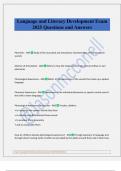
Language and Literacy Development Exam
2025 Questions and Answers
Phonetics - ANS Study of the acoustical and articulatory characteristics of human speech
sounds
Manner of Articulation - ANS Refers to how the tongue and/or lips control airflow to vary
phonemes
Phonological Awareness - ANS Refers to the awareness of the sounds that make up a spoken
language
Phonemic Awareness - ANS Awareness of the individual phonemes or speech sounds used in
the child's native language
Phonological Awareness Instruction - ANS Teaches children:
• to recognize the speech sounds they hear
• to identify and differentiate these sounds
• to produce them accurately
• and to manipulate them
How do children develop phonological awareness? - ANS Through exposure to language and
through direct training, both of which are provided by the adults around them and in their lives.
Pg. 1 Copyright © 2025 Jasonmcconell. ALL RIGHTS RESERVED.
,Phonics - ANS Knowledge of letter-sound relationships
Decoding - ANS The ability to use knowledge of letter-sound relationships to accurately read
a word.
Encoding - ANS Blending/combining individual sounds/letters to form words
Strong phonological and phonemic awareness in children is often a predictor of what? -
ANS Future long-term success in spelling, reading, and literacy performance
Orthography - ANS A set of conventions for writing a language. It includes norms of spelling,
hyphenation, capitalization, word breaks, emphasis, and punctuation.
Orthographic Processing - ANS Using the visual system to form, store, and recall words
Phonology - ANS the study of speech sounds and how they change depending on certain
situations or placements in syllables, words, and sentences.
What does skilled reading require? - ANS The coordination of orthographic processing,
phonological processing, and the processing of meaning and context.
Morphology - ANS the smallest unit of speech that has meaning.
-- plural "s" ending
-- past tense "ed" ending
Semantics - ANS the aspect of language function that relates to understanding the meanings
of words, phrases and sentences, and using words appropriately when we speak
Pg. 2 Copyright © 2025 Jasonmcconell. ALL RIGHTS RESERVED.
, Pragmatics - ANS he area of language function that embraces the use of language in social
contexts (knowing what to say, how to say it, and when to say it - and how to "be" with other
people).
-- how to speak at home vs. how to speak at school
"Following the CAR" - ANS Comment - the adult should comment on what a child is looking
at, handling, or talking about, then wait 5 seconds.
Ask - to continue the conversation the adult has begun and/or to start a new one, the adult
should then ask the child questions about something the child is looking at, handling, or talking
about. Adult should then wait 5 seconds again to give the child time to respond
Respond - Once the child gives an oral response, the adult should respond to what the child
says by repeating the child's response and then adding a bit more information to extend the
child's knowledge.
What is a "real" conversation? - ANS Conversations that interest the child and consist of
three to four exchanges/turns between the child and the adult
Teaching strategies that support children's active participation in real conversations - ANS •
attentively listening to what the children say
• inviting children to join extended conversations with adults and peers
• demonstrating a genuine interest in and affection for the children
• sending verbal and non-verbal messages that are consistent
• avoiding making judgemental comments about children or anybody else to or in front of the
children
• availing oneself of spontaneously occurring opportunities for informal conversations with
each child
• basing conversations on children's specific interests
Pg. 3 Copyright © 2025 Jasonmcconell. ALL RIGHTS RESERVED.
2025 Questions and Answers
Phonetics - ANS Study of the acoustical and articulatory characteristics of human speech
sounds
Manner of Articulation - ANS Refers to how the tongue and/or lips control airflow to vary
phonemes
Phonological Awareness - ANS Refers to the awareness of the sounds that make up a spoken
language
Phonemic Awareness - ANS Awareness of the individual phonemes or speech sounds used in
the child's native language
Phonological Awareness Instruction - ANS Teaches children:
• to recognize the speech sounds they hear
• to identify and differentiate these sounds
• to produce them accurately
• and to manipulate them
How do children develop phonological awareness? - ANS Through exposure to language and
through direct training, both of which are provided by the adults around them and in their lives.
Pg. 1 Copyright © 2025 Jasonmcconell. ALL RIGHTS RESERVED.
,Phonics - ANS Knowledge of letter-sound relationships
Decoding - ANS The ability to use knowledge of letter-sound relationships to accurately read
a word.
Encoding - ANS Blending/combining individual sounds/letters to form words
Strong phonological and phonemic awareness in children is often a predictor of what? -
ANS Future long-term success in spelling, reading, and literacy performance
Orthography - ANS A set of conventions for writing a language. It includes norms of spelling,
hyphenation, capitalization, word breaks, emphasis, and punctuation.
Orthographic Processing - ANS Using the visual system to form, store, and recall words
Phonology - ANS the study of speech sounds and how they change depending on certain
situations or placements in syllables, words, and sentences.
What does skilled reading require? - ANS The coordination of orthographic processing,
phonological processing, and the processing of meaning and context.
Morphology - ANS the smallest unit of speech that has meaning.
-- plural "s" ending
-- past tense "ed" ending
Semantics - ANS the aspect of language function that relates to understanding the meanings
of words, phrases and sentences, and using words appropriately when we speak
Pg. 2 Copyright © 2025 Jasonmcconell. ALL RIGHTS RESERVED.
, Pragmatics - ANS he area of language function that embraces the use of language in social
contexts (knowing what to say, how to say it, and when to say it - and how to "be" with other
people).
-- how to speak at home vs. how to speak at school
"Following the CAR" - ANS Comment - the adult should comment on what a child is looking
at, handling, or talking about, then wait 5 seconds.
Ask - to continue the conversation the adult has begun and/or to start a new one, the adult
should then ask the child questions about something the child is looking at, handling, or talking
about. Adult should then wait 5 seconds again to give the child time to respond
Respond - Once the child gives an oral response, the adult should respond to what the child
says by repeating the child's response and then adding a bit more information to extend the
child's knowledge.
What is a "real" conversation? - ANS Conversations that interest the child and consist of
three to four exchanges/turns between the child and the adult
Teaching strategies that support children's active participation in real conversations - ANS •
attentively listening to what the children say
• inviting children to join extended conversations with adults and peers
• demonstrating a genuine interest in and affection for the children
• sending verbal and non-verbal messages that are consistent
• avoiding making judgemental comments about children or anybody else to or in front of the
children
• availing oneself of spontaneously occurring opportunities for informal conversations with
each child
• basing conversations on children's specific interests
Pg. 3 Copyright © 2025 Jasonmcconell. ALL RIGHTS RESERVED.