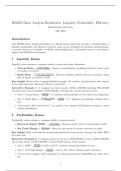
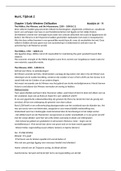
BS2203 Ratio Analysis Breakdown Liquidity, Profitability, Efficiency
Mount Kenya University
May 2025
Introduction
This BS2203 Ratio Analysis Breakdown for Mount Kenya University provides a detailed guide to
liquidity, profitability, and efficiency ratios for exam success. Designed for advanced undergraduates,
it includes interactive examples to solidify understanding and a 30-question exam to test mastery,
aligned with BS2203 exam formats.
1 Liquidity Ratios
Liquidity ratios measure a companys ability to meet short-term obligations:
Current Assets
• Current Ratio = Current Liabilities . Assesses overall liquidity, including all current assets (cash,
receivables, inventory).
• Quick Ratio = Current Assets−Inventory
Current Liabilities . Measures liquidity without relying on inventory, which
may be harder to convert to cash.
Key Insight: Ratios above 1 suggest liquidity strength, but industry benchmarks provide context.
A low quick ratio may signal over-reliance on inventory.
Interactive Example 1: A company has current assets of KSh 1,200,000 (including KSh 300,000
inventory) and current liabilities of KSh 600,000. Calculate the current and quick ratios.
1,200,000
• Step 1 : Current Ratio = 600,000 = 2. Indicates strong liquidity to cover short-term obligations.
1,200,000−300,000 900,000
• Step 2 : Quick Ratio = 600,000 = 600,000 = 1.5. Suggests good liquidity without inven-
tory.
• Commentary: Both ratios above 1 are positive, but compare with industry averages to assess
relative performance.
2 Profitability Ratios
Profitability ratios evaluate a companys ability to generate profit:
Net Income
• Return on Equity (ROE) = Average Equity . Measures profit relative to shareholders equity.
Net Income
• Net Profit Margin = Revenue . Shows the percentage of revenue converted to profit.
Key Insight: High ratios indicate strong profit generation, but excessive leverage can inflate ROE,
increasing risk.
Interactive Example 2: A company reports net income of KSh 800,000, revenue of KSh 5,000,000,
and average equity of KSh 3,000,000. Calculate ROE and net profit margin.
800,000
• Step 1 : ROE = 3,000,000 ≈ 0.267 or 26.7%. Indicates strong shareholder returns.
800,000
• Step 2 : Net Profit Margin = 5,000,000 = 0.16 or 16%. Shows efficient profit conversion.
• Commentary: Compare with competitors to evaluate performance; high ROE may reflect lever-
age.
1
, BS2203 Financial Analysis Mount Kenya University
3 Efficiency Ratios
Efficiency ratios measure how effectively a company uses assets:
Net Credit Sales
• Receivables Turnover = Average Accounts Receivable . Indicates how often receivables are collected
annually.
365
• Days to Collect = Receivables Turnover . Converts turnover to average collection days.
Cost of Sales
• Inventory Turnover = Average Inventory . Measures how often inventory is sold annually.
Key Insight: Higher turnover ratios indicate efficient asset use; lower ratios may signal collection or
inventory issues.
Interactive Example 3: A company has net credit sales of KSh 4,000,000, average accounts receiv-
able of KSh 800,000, cost of sales of KSh 2,500,000, and average inventory of KSh 500,000. Calculate
receivables turnover, days to collect, and inventory turnover.
4,000,000
• Step 1 : Receivables Turnover = 800,000 = 5 times. The company collects receivables 5 times
per year.
365
• Step 2 : Days to Collect = 5 = 73 days. Receivables are collected every 73 days.
2,500,000
• Step 3 : Inventory Turnover = 500,000 = 5 times. Inventory is sold 5 times per year.
• Commentary: Consistent turnover suggests efficiency, but industry comparisons are essential.
BS2203 Exam Ratio Analysis
This exam tests BS2203 ratio analysis concepts for high-scoring performance. It includes 30 questions:
20 multiple-choice (2 marks each, 40 marks), 5 calculation (4 marks each, 20 marks), and 5 analysis
(4 marks each, 20 marks). Total: 80 marks. Use a separate answer sheet for multiple-choice and start
each question in Sections B and C on a new page. Only Casio FX-83/85 calculators are permitted.
Section A: Multiple-Choice Questions (40 marks)
Answer all questions. Select the best answer. No negative marking. Allow for minor rounding
differences.
1. Which ratio measures liquidity without inventory?
A) Current Ratio B) Quick Ratio C) ROE D) Net Profit Margin
Hint: Focus on excluding inventory.
Answer: B. Quick Ratio = Current Assets−Inventory
Current Liabilities .
2. Which ratio measures profit relative to equity?
A) Current Ratio B) ROE C) Receivables Turnover D) Inventory Turnover
Hint: Focus on shareholder returns.
Net Income
Answer: B. ROE = Average Equity .
3. A high receivables turnover indicates:
A) Slow collections B) Efficient collections C) High leverage D) Low profitability
Hint: Consider collection efficiency.
Answer: B. High turnover means efficient collections.
4. Net profit margin is calculated as:
A) NetEquity
Income
B) Net Income
Revenue
Revenue
C) Net Income D) Net Income
Assets
Hint: Focus on revenue as the denominator.
Answer: B. Net Profit Margin = Net Income
Revenue .
5. Days to collect receivables uses:
365
A) Receivables Turnover B) Receivables
Sales
Sales
C) Receivables D) 365
Inventory Turnover
Hint: Recall the collection period formula.
2
Mount Kenya University
May 2025
Introduction
This BS2203 Ratio Analysis Breakdown for Mount Kenya University provides a detailed guide to
liquidity, profitability, and efficiency ratios for exam success. Designed for advanced undergraduates,
it includes interactive examples to solidify understanding and a 30-question exam to test mastery,
aligned with BS2203 exam formats.
1 Liquidity Ratios
Liquidity ratios measure a companys ability to meet short-term obligations:
Current Assets
• Current Ratio = Current Liabilities . Assesses overall liquidity, including all current assets (cash,
receivables, inventory).
• Quick Ratio = Current Assets−Inventory
Current Liabilities . Measures liquidity without relying on inventory, which
may be harder to convert to cash.
Key Insight: Ratios above 1 suggest liquidity strength, but industry benchmarks provide context.
A low quick ratio may signal over-reliance on inventory.
Interactive Example 1: A company has current assets of KSh 1,200,000 (including KSh 300,000
inventory) and current liabilities of KSh 600,000. Calculate the current and quick ratios.
1,200,000
• Step 1 : Current Ratio = 600,000 = 2. Indicates strong liquidity to cover short-term obligations.
1,200,000−300,000 900,000
• Step 2 : Quick Ratio = 600,000 = 600,000 = 1.5. Suggests good liquidity without inven-
tory.
• Commentary: Both ratios above 1 are positive, but compare with industry averages to assess
relative performance.
2 Profitability Ratios
Profitability ratios evaluate a companys ability to generate profit:
Net Income
• Return on Equity (ROE) = Average Equity . Measures profit relative to shareholders equity.
Net Income
• Net Profit Margin = Revenue . Shows the percentage of revenue converted to profit.
Key Insight: High ratios indicate strong profit generation, but excessive leverage can inflate ROE,
increasing risk.
Interactive Example 2: A company reports net income of KSh 800,000, revenue of KSh 5,000,000,
and average equity of KSh 3,000,000. Calculate ROE and net profit margin.
800,000
• Step 1 : ROE = 3,000,000 ≈ 0.267 or 26.7%. Indicates strong shareholder returns.
800,000
• Step 2 : Net Profit Margin = 5,000,000 = 0.16 or 16%. Shows efficient profit conversion.
• Commentary: Compare with competitors to evaluate performance; high ROE may reflect lever-
age.
1
, BS2203 Financial Analysis Mount Kenya University
3 Efficiency Ratios
Efficiency ratios measure how effectively a company uses assets:
Net Credit Sales
• Receivables Turnover = Average Accounts Receivable . Indicates how often receivables are collected
annually.
365
• Days to Collect = Receivables Turnover . Converts turnover to average collection days.
Cost of Sales
• Inventory Turnover = Average Inventory . Measures how often inventory is sold annually.
Key Insight: Higher turnover ratios indicate efficient asset use; lower ratios may signal collection or
inventory issues.
Interactive Example 3: A company has net credit sales of KSh 4,000,000, average accounts receiv-
able of KSh 800,000, cost of sales of KSh 2,500,000, and average inventory of KSh 500,000. Calculate
receivables turnover, days to collect, and inventory turnover.
4,000,000
• Step 1 : Receivables Turnover = 800,000 = 5 times. The company collects receivables 5 times
per year.
365
• Step 2 : Days to Collect = 5 = 73 days. Receivables are collected every 73 days.
2,500,000
• Step 3 : Inventory Turnover = 500,000 = 5 times. Inventory is sold 5 times per year.
• Commentary: Consistent turnover suggests efficiency, but industry comparisons are essential.
BS2203 Exam Ratio Analysis
This exam tests BS2203 ratio analysis concepts for high-scoring performance. It includes 30 questions:
20 multiple-choice (2 marks each, 40 marks), 5 calculation (4 marks each, 20 marks), and 5 analysis
(4 marks each, 20 marks). Total: 80 marks. Use a separate answer sheet for multiple-choice and start
each question in Sections B and C on a new page. Only Casio FX-83/85 calculators are permitted.
Section A: Multiple-Choice Questions (40 marks)
Answer all questions. Select the best answer. No negative marking. Allow for minor rounding
differences.
1. Which ratio measures liquidity without inventory?
A) Current Ratio B) Quick Ratio C) ROE D) Net Profit Margin
Hint: Focus on excluding inventory.
Answer: B. Quick Ratio = Current Assets−Inventory
Current Liabilities .
2. Which ratio measures profit relative to equity?
A) Current Ratio B) ROE C) Receivables Turnover D) Inventory Turnover
Hint: Focus on shareholder returns.
Net Income
Answer: B. ROE = Average Equity .
3. A high receivables turnover indicates:
A) Slow collections B) Efficient collections C) High leverage D) Low profitability
Hint: Consider collection efficiency.
Answer: B. High turnover means efficient collections.
4. Net profit margin is calculated as:
A) NetEquity
Income
B) Net Income
Revenue
Revenue
C) Net Income D) Net Income
Assets
Hint: Focus on revenue as the denominator.
Answer: B. Net Profit Margin = Net Income
Revenue .
5. Days to collect receivables uses:
365
A) Receivables Turnover B) Receivables
Sales
Sales
C) Receivables D) 365
Inventory Turnover
Hint: Recall the collection period formula.
2