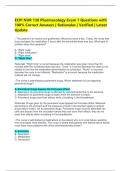
ECPI NUR 138 Pharmacology Exam 1 Questions with
100% Correct Answers | Rationales | Verified | Latest
Update
/. The patient is to receive oral guaifenesin (Mucinex) twice a day. Today, the nurse was
busy and gave the medication 2 hours after the scheduled dose was due. What type of
problem does this represent?
A. "Right route"
B. "Right medication"
C. "Right dose"
D. "Right time"
Rationale: "Right time" is correct because the medication was given more than 30
minutes after the scheduled dose was due. "Dose" is incorrect because the dose is not
related to the time the medication administration is scheduled. "Route" is incorrect
because the route is not affected. "Medication" is incorrect because the medication
ordered will not change.
/.The nurse is administering parenteral drugs. Which statement is true regarding
parenteral drugs?
A. Parenteral drugs bypass the first-pass effect.
B. Absorption of parenteral drugs is affected by reduced blood flow to the stomach.
C. Absorption of parenteral drugs is faster when the stomach is empty.
D. Parenteral drugs exert their effects while circulating in the bloodstream.
Rationale: Drugs given by the parenteral route bypass the first-pass effect. Reduced
blood flow to the stomach and the presence of food in the stomach apply to enteral
drugs (taken orally), not to parenteral drugs. Parenteral drugs must be absorbed into
cells and tissues from the circulation before they can exert their effects: they do not
exert their effects while circulating in the bloodstream.
/.The nurse is administering medications to the patient who is in renal failure resulting
from end-stage renal disease. The nurse is aware that patients with kidney failure would
most likely have problems with which pharmacokinetic phase?
A. Excretion
B. Absorption
C. Metabolism
D. Distribution
,Rationale: The kidneys are the organs that are most responsible for drug excretion.
Renal function does not affect the absorption and distribution of a drug. Renal function
may affect metabolism of drugs to a small extent.
/.The patient is complaining of a headache and asks the nurse which over-the-counter
medication form would work the fastest to help reduce the pain. Which medication form
will the nurse suggest?
A. A tablet
B. A capsule
C. A powder
D. An enteric-coated tablet
Rationale: Of the types of oral medications listed, the powder form would be absorbed
the fastest, thus having a faster onset. The tablet, the capsule, and, finally, the enteric-
coated tablet would be absorbed next, in that order.
/.Which drugs would be affected by the first-pass effect? (Select all that apply.)
A. Sublingual nitroglycerin tablets
B. Levothyroxine (Synthroid) tablets
C. Diphenhydramine (Benadryl) elixir
D. Penicillin given by IV piggyback infusion
E. Morphine given by IV push injection
F. Esomeprazole (Nexium) capsules
G. Transdermal nicotine patches
C. Diphenhydramine (Benadryl) elixir
F. Esomeprazole (Nexium) capsules
/.For accurate medication administration to pediatric patients, the nurse must take into
account which criteria?
A. Renal output
B. Height
C. Body temperature
D. Organ maturity
Rationale: To administer medications to pediatric patients accurately, one must take into
account organ maturity, body surface area, age, and weight. The other options are
incorrect: renal output and body temperature are not considerations, and height alone is
not sufficient.
/.During discharge patient teaching, the nurse reviews prescriptions with a patient.
Which statement is correct about refills for an analgesic that is classified as Schedule C-
III?
, A. The patient may have no more than five refills in a 6-month period.
B. Refills are allowed only by written prescription.
C. Written prescriptions expire in 12 months.
D. No prescription refills are permitted.
Rationale: Schedule C-III medications may be refilled no more than five times in a 6-
month period. The patient should be informed of this regulation. No prescription refills
are permitted for Schedule C-II drugs. Requiring refills by written prescription only
applies to Schedule C-II drugs. Schedule C-III prescriptions (written or oral) expire in 6
months.
/.The nurse is assessing an elderly Hispanic woman who is being treated for
hypertension. During the assessment, what is important for the nurse to remember
about cultural aspects?
A. The patient should be discouraged from using folk remedies and rituals.
B. The nurse will remember that the balance among body, mind, and environment is
important for this patient's health beliefs.
C. The nurse will expect the patient to value protective bracelets and "root workers" as
healers.
D. The nurse's assessment needs to include gathering information regarding
religious practices and beliefs regarding medication, treatment, and healing
Rationale: All beliefs need to be considered clearly so as to prevent a conflict from
arising between the goals of nursing and health care and the dictates of a patient's
cultural background. Assessing religious practices and beliefs is part of a thorough
cultural assessment. The other options are incorrect. The nurse should not ignore a
patient's cultural practices. The concept of balance among body, mind, and environment
and the valuing of protective bracelets and root workers reflect beliefs or practices that
usually do not apply to the Hispanic cultural group.
/.When reviewing the various schedules of controlled drugs, the nurse knows that which
description correctly describes Schedule II drugs?
A. Medically accepted drugs that may cause moderate physical or psychologic
dependence
B. Drugs with high potential for abuse that do not have accepted medical use
C. Medically accepted drugs with limited potential for causing physical or psychologic
dependence
D. Drugs with high potential for abuse that have accepted medical use
Rationale: Schedule II drugs are those with high potential for abuse but that have
accepted medical use. Drugs that have high potential for abuse but do not have
accepted medical use are Schedule I drugs. Medically accepted drugs that may cause
moderate physical or psychologic dependence are Schedule III drugs. Medically
100% Correct Answers | Rationales | Verified | Latest
Update
/. The patient is to receive oral guaifenesin (Mucinex) twice a day. Today, the nurse was
busy and gave the medication 2 hours after the scheduled dose was due. What type of
problem does this represent?
A. "Right route"
B. "Right medication"
C. "Right dose"
D. "Right time"
Rationale: "Right time" is correct because the medication was given more than 30
minutes after the scheduled dose was due. "Dose" is incorrect because the dose is not
related to the time the medication administration is scheduled. "Route" is incorrect
because the route is not affected. "Medication" is incorrect because the medication
ordered will not change.
/.The nurse is administering parenteral drugs. Which statement is true regarding
parenteral drugs?
A. Parenteral drugs bypass the first-pass effect.
B. Absorption of parenteral drugs is affected by reduced blood flow to the stomach.
C. Absorption of parenteral drugs is faster when the stomach is empty.
D. Parenteral drugs exert their effects while circulating in the bloodstream.
Rationale: Drugs given by the parenteral route bypass the first-pass effect. Reduced
blood flow to the stomach and the presence of food in the stomach apply to enteral
drugs (taken orally), not to parenteral drugs. Parenteral drugs must be absorbed into
cells and tissues from the circulation before they can exert their effects: they do not
exert their effects while circulating in the bloodstream.
/.The nurse is administering medications to the patient who is in renal failure resulting
from end-stage renal disease. The nurse is aware that patients with kidney failure would
most likely have problems with which pharmacokinetic phase?
A. Excretion
B. Absorption
C. Metabolism
D. Distribution
,Rationale: The kidneys are the organs that are most responsible for drug excretion.
Renal function does not affect the absorption and distribution of a drug. Renal function
may affect metabolism of drugs to a small extent.
/.The patient is complaining of a headache and asks the nurse which over-the-counter
medication form would work the fastest to help reduce the pain. Which medication form
will the nurse suggest?
A. A tablet
B. A capsule
C. A powder
D. An enteric-coated tablet
Rationale: Of the types of oral medications listed, the powder form would be absorbed
the fastest, thus having a faster onset. The tablet, the capsule, and, finally, the enteric-
coated tablet would be absorbed next, in that order.
/.Which drugs would be affected by the first-pass effect? (Select all that apply.)
A. Sublingual nitroglycerin tablets
B. Levothyroxine (Synthroid) tablets
C. Diphenhydramine (Benadryl) elixir
D. Penicillin given by IV piggyback infusion
E. Morphine given by IV push injection
F. Esomeprazole (Nexium) capsules
G. Transdermal nicotine patches
C. Diphenhydramine (Benadryl) elixir
F. Esomeprazole (Nexium) capsules
/.For accurate medication administration to pediatric patients, the nurse must take into
account which criteria?
A. Renal output
B. Height
C. Body temperature
D. Organ maturity
Rationale: To administer medications to pediatric patients accurately, one must take into
account organ maturity, body surface area, age, and weight. The other options are
incorrect: renal output and body temperature are not considerations, and height alone is
not sufficient.
/.During discharge patient teaching, the nurse reviews prescriptions with a patient.
Which statement is correct about refills for an analgesic that is classified as Schedule C-
III?
, A. The patient may have no more than five refills in a 6-month period.
B. Refills are allowed only by written prescription.
C. Written prescriptions expire in 12 months.
D. No prescription refills are permitted.
Rationale: Schedule C-III medications may be refilled no more than five times in a 6-
month period. The patient should be informed of this regulation. No prescription refills
are permitted for Schedule C-II drugs. Requiring refills by written prescription only
applies to Schedule C-II drugs. Schedule C-III prescriptions (written or oral) expire in 6
months.
/.The nurse is assessing an elderly Hispanic woman who is being treated for
hypertension. During the assessment, what is important for the nurse to remember
about cultural aspects?
A. The patient should be discouraged from using folk remedies and rituals.
B. The nurse will remember that the balance among body, mind, and environment is
important for this patient's health beliefs.
C. The nurse will expect the patient to value protective bracelets and "root workers" as
healers.
D. The nurse's assessment needs to include gathering information regarding
religious practices and beliefs regarding medication, treatment, and healing
Rationale: All beliefs need to be considered clearly so as to prevent a conflict from
arising between the goals of nursing and health care and the dictates of a patient's
cultural background. Assessing religious practices and beliefs is part of a thorough
cultural assessment. The other options are incorrect. The nurse should not ignore a
patient's cultural practices. The concept of balance among body, mind, and environment
and the valuing of protective bracelets and root workers reflect beliefs or practices that
usually do not apply to the Hispanic cultural group.
/.When reviewing the various schedules of controlled drugs, the nurse knows that which
description correctly describes Schedule II drugs?
A. Medically accepted drugs that may cause moderate physical or psychologic
dependence
B. Drugs with high potential for abuse that do not have accepted medical use
C. Medically accepted drugs with limited potential for causing physical or psychologic
dependence
D. Drugs with high potential for abuse that have accepted medical use
Rationale: Schedule II drugs are those with high potential for abuse but that have
accepted medical use. Drugs that have high potential for abuse but do not have
accepted medical use are Schedule I drugs. Medically accepted drugs that may cause
moderate physical or psychologic dependence are Schedule III drugs. Medically