2. Classical & Instrumental Conditioning
Classical Conditioning (Pavlov)
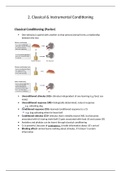
One stimulus is paired with another so that person/animal forms a relationship
between the two
Unconditioned stimulus (US)= stimulus independent of any learning (e.g food, sex
mate)
Unconditioned response (UR)= biologically determined, natural response
e.g. salivating dog
Conditioned response (CR)= learned/conditioned response to a CS
e.g. dog salivating when he hears bell
Conditioned stimulus (CS)= stimulus that is initially neutral (NS), but becomes
associated with US during trials (bell CS gets associated with food US and causes CR)
Anxieties and phobias can be learnt through classical conditioning
Cs is powerful, because of contingency, it holds information about US´s arrival
Blocking effect= animal learns nothing about stimulus, if it doesn´t contain
information
,Acquisition of Conditioned Responses:
Acquisition= the CR is only formed over time, the more pairings of CS + US the
stronger the CR
Second-order or higher order conditioning= conditioning to one CS, which is the
paired with another neutral stimulus, hence why it becomes a CS as well
Extinction:
Extinction= weakening of CR by repeatedly presenting the CS without the US (food)
Reconditioning takes much less time, because extinction never fully erases the
original learning
Spontaneous recovery= rest interval after extinction, CS elicits CR response again
e.g animal checking if bell is informative again
,Generalisation:
Stimulus generalisation= stimuli similar enough to CS also elicit learned response CR
e.g. lil Albert is also afraid of white fluffy rabbit, which is similar to rat, dog
conditioned to high tone, also responds to higher pitched tone
Generalisation gradient= the greater the difference between new stimulus and CS,
the weaker the CR
Discrimination:
Overgeneralising can cause negative consequences, to example fearing stimuli that
are in fact harmless. Therefore, we need to discriminate certain stimuli
e.g conditioned to CS red light signalling loud noise US, when red light is paired with
new NS – orange light, you first associate the orange light with the loud noise too.
But no sound ever comes when orange light shines. So you learn to discriminate the
or. Light orange light becomes inhibitor
Inhibitor= stimulus that is signalling that event is not coming
Study by Watson: Conditioned Emotional Reactions (lil Albert)
Goal:
In early childhood emotional responses can be conditioned
1: Can fear be conditioned by presenting a rat while simultaneously making a loud
noise?
2: Will this conditioned fear to rat transfer to other stimuli (generalization)?
3: How does time affect the conditioned responses?
4: What methods can be used to remove the conditioning?
Procedure:
Tests run on toddler Albert in hospital
Discussion:
Result 1: fear can be conditioned baby started to cry when he saw CS rat
Result 2: emotional transfer (stimuli generalization) does take place white rabbit
or fluffy blanket also provoked fear in baby
Result 3: conditioned response persisted, but with loss in intensity (1 month),
opinion: learned response likely to persist indefinitely
Result 4: no experiment, suggested strategies: - constant exposure to stimulus,
recondition (sexual, positive side stimulus)
Conclusion:
Emotional disturbance in adulthood cannot be traced back to sex alone (Freud), also
conditioned responses in infancy about fear, rage and love
, Instrumental/Operant Conditioning (Skinner)
Law of effect (Thorndike)= response followed by reward strengthened
Response followed by punishment will weaken resp.
Instrumental conditioning=
- Learning about relationship of response and stimulus
- individual gets reinforced after response and therefore learns behaviour, learning of
new voluntary behaviour
Operant= response that is defined by its effect on environment
Reinforcer= stimulus delivered after a response, makes response more likely/unlikely
in the future
Shaping (successive approximation)= shaping someone´s behaviour by step by step
reinforcements
e.g. experimenter rewards rat of going near lever, next step: rewarding for touching it
etc. or parents reward for increasing demands of eating with utensils (kids)
Primary reinforcer= stimuli with importance for survival like water, food, escape
Classical Conditioning (Pavlov)
One stimulus is paired with another so that person/animal forms a relationship
between the two
Unconditioned stimulus (US)= stimulus independent of any learning (e.g food, sex
mate)
Unconditioned response (UR)= biologically determined, natural response
e.g. salivating dog
Conditioned response (CR)= learned/conditioned response to a CS
e.g. dog salivating when he hears bell
Conditioned stimulus (CS)= stimulus that is initially neutral (NS), but becomes
associated with US during trials (bell CS gets associated with food US and causes CR)
Anxieties and phobias can be learnt through classical conditioning
Cs is powerful, because of contingency, it holds information about US´s arrival
Blocking effect= animal learns nothing about stimulus, if it doesn´t contain
information
,Acquisition of Conditioned Responses:
Acquisition= the CR is only formed over time, the more pairings of CS + US the
stronger the CR
Second-order or higher order conditioning= conditioning to one CS, which is the
paired with another neutral stimulus, hence why it becomes a CS as well
Extinction:
Extinction= weakening of CR by repeatedly presenting the CS without the US (food)
Reconditioning takes much less time, because extinction never fully erases the
original learning
Spontaneous recovery= rest interval after extinction, CS elicits CR response again
e.g animal checking if bell is informative again
,Generalisation:
Stimulus generalisation= stimuli similar enough to CS also elicit learned response CR
e.g. lil Albert is also afraid of white fluffy rabbit, which is similar to rat, dog
conditioned to high tone, also responds to higher pitched tone
Generalisation gradient= the greater the difference between new stimulus and CS,
the weaker the CR
Discrimination:
Overgeneralising can cause negative consequences, to example fearing stimuli that
are in fact harmless. Therefore, we need to discriminate certain stimuli
e.g conditioned to CS red light signalling loud noise US, when red light is paired with
new NS – orange light, you first associate the orange light with the loud noise too.
But no sound ever comes when orange light shines. So you learn to discriminate the
or. Light orange light becomes inhibitor
Inhibitor= stimulus that is signalling that event is not coming
Study by Watson: Conditioned Emotional Reactions (lil Albert)
Goal:
In early childhood emotional responses can be conditioned
1: Can fear be conditioned by presenting a rat while simultaneously making a loud
noise?
2: Will this conditioned fear to rat transfer to other stimuli (generalization)?
3: How does time affect the conditioned responses?
4: What methods can be used to remove the conditioning?
Procedure:
Tests run on toddler Albert in hospital
Discussion:
Result 1: fear can be conditioned baby started to cry when he saw CS rat
Result 2: emotional transfer (stimuli generalization) does take place white rabbit
or fluffy blanket also provoked fear in baby
Result 3: conditioned response persisted, but with loss in intensity (1 month),
opinion: learned response likely to persist indefinitely
Result 4: no experiment, suggested strategies: - constant exposure to stimulus,
recondition (sexual, positive side stimulus)
Conclusion:
Emotional disturbance in adulthood cannot be traced back to sex alone (Freud), also
conditioned responses in infancy about fear, rage and love
, Instrumental/Operant Conditioning (Skinner)
Law of effect (Thorndike)= response followed by reward strengthened
Response followed by punishment will weaken resp.
Instrumental conditioning=
- Learning about relationship of response and stimulus
- individual gets reinforced after response and therefore learns behaviour, learning of
new voluntary behaviour
Operant= response that is defined by its effect on environment
Reinforcer= stimulus delivered after a response, makes response more likely/unlikely
in the future
Shaping (successive approximation)= shaping someone´s behaviour by step by step
reinforcements
e.g. experimenter rewards rat of going near lever, next step: rewarding for touching it
etc. or parents reward for increasing demands of eating with utensils (kids)
Primary reinforcer= stimuli with importance for survival like water, food, escape