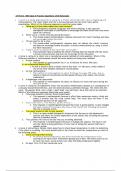
ATI Form 1500 Quiz 5 Practice Questions with Rationales
1. A nurse in a family planning clinic is caring for a 17-year-old female client who is requesting oral contraceptives. The client states that she is nervous because she has never had a pelvic examination. Which of the following responses should the nurse make? a. "What part of the exam makes you most nervous?" i. This therapeutic response recognizes the client's feelings. It also uses the therapeutic technique of clarification to encourage the client to tell the nurse more about her concerns. b. "Don't worry, I will be with you during the exam." i. This closed-ended nontherapeutic response discounts the client's feelings and does not encourage further discussion. c. "All you need to do is relax." i. This closed-ended nontherapeutic response does not address the client's concerns and does not encourage further discussion. It blocks communication by using a cliché and false reassurance. d. "A pelvic exam is required if you want birth control pills." i. This statement fails to address the client’s feelings that she shared with the nurse. It blocks communication and does not encourage further discussion. 2. A nurse is caring for a client who is considering several methods of contraception. Which of the following methods of contraception should the nurse identify as being most reliable? a. A male condom i. This method of contraception has 11 to 16 failures for every 100 users. b. An intrauterine device (IUD) i. An IUD is found to have a failure rate of less than 1 in 100 users, which makes it one of the most reliable methods of contraception. c. An oral contraceptive i. This method of contraception has about 8 failures for every 100 users, due to failure to take pill consistently and decreased efficacy when taken with certain medications. d. A diaphragm with spermicide. i. This method of contraception has about 16 failures for every 100 users during the first year of use. 3. A nurse is caring for an adolescent client who has pelvic inflammatory disease as a consequence of a sexually transmitted infection, and will need intravenous antibiotic therapy. The client tells the nurse, "My parents think I am a virgin. I don't think I can tell them I have this kind of an infection." Which of the following responses should the nurse make? a. "Give your parents a chance; they'll understand." i. This response is nontherapeutic because it offers false reassurance using a cliché and makes a promise that the nurse cannot keep. The nurse does not know if the adolescent's parents will be supportive. b. "If you want me to, I can tell your parents for you." i. This response is nontherapeutic because the nurse is giving advice. It also changes the topic instead of focusing on the issue of the client's fear of telling her parents that she is sexually active. c. "You seem scared to talk to your parents." i. This is an open-ended therapeutic statement that focuses on the adolescent's concern and allows for further exploration of the client's fear of telling her parents that she is sexually active. d. "Your parents will have to be told why you are being admitted." i. This response is nontherapeutic because it changes the subject. The issue is not why the client is being admitted, it is her fear of telling her parents that she is sexually active. 4. A nurse is instructing a female client about how to check basal temperature in order to determine if the client is ovulating. The nurse should instruct the client to check her temperature at which of the following times a. Every morning before arising i. To measure basal temperature, the client must take her temperature every morning at the same exact time before getting out of bed. The client must try not to move too much, as any activity can raise the body temperature slightly. b. On days 13 to 17 of her menstrual cycle i. The client should take her basal temperature every day of the month to accurately map the decrease in temperature that occurs at ovulation and the subsequent elevation in temperature that occurs until menses begin. c. 1 hour following intercourse i. Measuring the temperature after intercourse would not be accurate, as any activity can raise the body temperature slightly. d. Before going to bed every night i. Measuring the temperature after a full day's activity would not be accurate, as any activity can raise the body temperature slightly. 5. A nurse in a college health clinic is speaking to a group of adolescents about toxic shock syndrome (TSS). Which of the following should the nurse include in the teaching as increasing the risk for contracting TSS? a. High-absorbency tampons i. Toxic shock syndrome, a severe disease caused by a toxin made by Staphylococcus aureus, is characterized by shock and multiple organ dysfunction. Approximately 50% of all cases involve menstruating women using highly absorbent tampons. b. Mosquito bites i. Mosquito bites are not associated with TSS. c. Travel to foreign countries i. Travel to foreign countries is not associated with TSS. d. Multiple sexual partners i. Multiple sexual partners is not associated with TSS. 6. A nurse in a community clinic is counseling a client who received a positive test result for chlamydia. Which of the following statements should the nurse provide? a. "This infection is treated with one dose of azithromycin." i. A single dose of azithromycin is an appropriate treatment for a chlamydial infection. An acceptable alternative is doxycycline twice a day for 7 days. b. "If your sexual partner has no symptoms, no medication is needed." i. Chlamydia is often asymptomatic in women. The Centers for Disease Control and Prevention recommend evaluating, testing, and treating all of a client’s sexual partners. c. "You have to avoid sexual relations for 3 days." i. The Centers for Disease Control and Prevention recommend abstaining from sexual relations for 7 days after a single-dose antibiotic or until the client completes a 7- day course of antibiotics. d. "You need to return in 6 months for retesting." i. The client should return for chlamydia testing in 3 months. 7. A nurse is reviewing the health history of a client who has a new prescription for a combined oral contraceptive (COC). The nurse recognizes that which of the following client medications can interfere with the effectiveness of the COC? a. Antihypertensives i. Antihypertensives do not interfere with the effectiveness of COCs when taken simultaneously. b. Anticonvulsants i. Anticonvulsants when taken simultaneously with COCs can decrease their effectiveness. The anticonvulsants included are: phenytoin, phenobarbital, carbamazepine, oxcarbazepine, topiramate, and primidone. c. Antioxidants i. Antioxidants do not interfere with the effectiveness of COCs when taken simultaneously. d. Antiemetics i. Antiemetics do not interfere with the effectiveness of COCs when taken simultaneously. 8. A nurse is leading a discussion about contraception with a group of 14-year-old clients. After the presentation, a client asks the nurse which method would be best for her to use. Which of the following responses should the nurse make? a. “You are so young. Are you ready for the responsibilities of a sexual relationship?" i. This response is an example of the nontherapeutic communication technique of probing and is likely to make the client feel defensive or to withdraw from seeking help with contraception. b. "Because of your age, I think that a barrier method would be the best choice." i. This response is an example of the nontherapeutic communication technique of passing judgment. The nurse implies that she knows what is best for the client and does not take the client’s concerns or preferences into consideration. c. "Before I can help you, I need to know more about your sexual activity." i. This is an example of providing a general lead when using therapeutic communication. It allows the client to provide information that will enhance effective consultation about the best form of contraception for her. d. "A provider can help you with that after a physical examination." i. By referring the client to a provider, the nurse ends further communication with the client about her concerns. 9. A nurse is reviewing contraception options for four clients. The nurse should identify that which of the following clients has a contraindication for receiving oral contraceptives? a. A 26-year-old client who has migraine headaches at the start of each menstrual cycle i. Oral contraceptives can decrease the frequency of menstrual-associated migraine headaches. b. A 28-year-old client who has a history of pelvic inflammatory disease i. Oral contraceptives can decrease the risk of pelvic inflammatory disease. c. A 32-year-old client who has benign breast disease i. Oral contraceptives can decrease the risk of benign breast disease. d. A 38-year-old client who reports smoking one pack of cigarettes every day i. A client who is over the age of 35 and smokes is at increased risk of thromboembolism. 10. A nurse is reinforcing teaching about contraceptive methods with a client. Which of the following should the nurse recognize as a contraindication for diaphragm use? a. The client is 42 years old. i. Age is not a contraindication to the use of a diaphragm. b. The client smokes cigarettes. i. Cigarette smoking is not a contraindication to the use of a diaphragm. c. The client has pelvic relaxation. i. Pelvic relaxation and large cystocele are contraindications for diaphragm use. d. The client has a 3-month-old infant. i. Pregnancy changes the size and shape of the cervical opening, which will affect the fit of the diaphragm. The uterus and cervix returns to the prepregnant state at 6 weeks postpartum. At this time, the client should consider being refitted for a diaphragm to resume sexual activity. The diaphragm is contraindicated immediately after pregnancy to allow healing and avoid infection. 11. A nurse is instructing a male client about a semen analysis to be done for suspected infertility. Which of the following should be included in the teaching? a. Abstain from ejaculation for at least 2 to 5 days prior to the test. i. The client should be instructed to abstain from ejaculation for at least 2 to 5 days prior to the test. b. Refrigerate the specimen after collection. i. The specimen should be protected from excessive cold after collection. c. Leave the specimen at room temperature for 3 to 4 hr prior to transport to the laboratory. i. The specimen should be transported to the laboratory within 2 hr of ejaculation. d. Collect the specimen using a condom with spermicidal lubricant. i. A plastic sheath for semen collection should not contain a spermicidal agent.
Escuela, estudio y materia
- Institución
- West Coast University
- Grado
- NURS 306
Información del documento
- Subido en
- 19 de mayo de 2025
- Número de páginas
- 13
- Escrito en
- 2024/2025
- Tipo
- Examen
- Contiene
- Preguntas y respuestas
Temas
-
ati form
-
ati form 1500
-
ati form 1500 quiz 5

Documento también disponible en un lote