MGT 420 Final Exam Study Guide well answered to
pass (latest update)
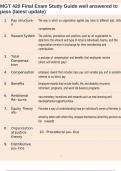
1. Pay structure The way in which an organization applies pay rates to different jobs, skills
or
competencies
2. Reward System The policies, procedures and practices used by an organization to
determine the amount and type of returns individuals, teams, and the
organization receive in exchange for their membership and
contributions
3. Total a package of compensation and benefits that employees receive
Compensa- (direct and indirect pay)
tion
4. Compensation employee reward that includes base pay and variable pay and is sometime
referred to as direct pay
5. Benefits Employee rewards that include health, life, and disability insurance,
retirement programs, and work life balance programs
6. Relational non-monetary incentives and rewards such as new learning and
Re- turns developmental opportunities
7. Equity Theory Provides a way of understanding how an individual's sense of fairness is
influ-
enced by others with whom they compare themselves (what they perceive as
fair reward)
8. Organization
al Justice 10. Procedural jus- tice
theory
9. Distributive
jus- tice
1/
24
,MGT 420 Final Exam Study Guide well answered to
pass (latest update)
focuses on perceptions of equity regarding the allocation of an outcome or re- source, which can
fairness in the workplace include rewards, punishments, or other organizational conse- quences
the perceived fairness of the process used to determine how an outcome
the perceived fairness or or resource is determined or distributed
11. the perceived fairness of an interpersonal or informational interaction
2/
24
, MGT 420 Final Exam Study
Guide
Interactional jus- tice
12. Internal Equity the fairness of pay rates across job within an organization
13. Job structure the ranking of jobs within an organization based on respective work
14. Job evaluation a systematic process used to determine the relative worth of jobs within a
organization
15. Ranking method SMEs evaluate the job descriptions and specifications for a selection
of jobs and order them in terms of their relative contribution to the
orgs strategic objectives and mission
16. Classificatio a written classification description is developed for SMEs to a class
n method level where class description is most similar
17. Point a team of SMEs systematically identifies compensable factors and
factor
develop and apply scales and weights for compensable factors
method
resulting in points being assigned to jobs to describe relative worth
the common dimensions by which jobs vary in terms of worth to the
18. compensabl
organization
e factors
19. Compa Ratio reflects how much employees are actually paid for given jobs as
compared to the espoused pay structure policies to assess is
systematic compression or inversion are occurring
20. compa ratio (average actual pay of employees)/(midpoint of pay range/grade)
for- mula
21. Broadbanding process of collapsing multiple pay grades into one large grade with a
single
minimum and maximum resulting in fewer pay grades
3/
24
pass (latest update)
1. Pay structure The way in which an organization applies pay rates to different jobs, skills
or
competencies
2. Reward System The policies, procedures and practices used by an organization to
determine the amount and type of returns individuals, teams, and the
organization receive in exchange for their membership and
contributions
3. Total a package of compensation and benefits that employees receive
Compensa- (direct and indirect pay)
tion
4. Compensation employee reward that includes base pay and variable pay and is sometime
referred to as direct pay
5. Benefits Employee rewards that include health, life, and disability insurance,
retirement programs, and work life balance programs
6. Relational non-monetary incentives and rewards such as new learning and
Re- turns developmental opportunities
7. Equity Theory Provides a way of understanding how an individual's sense of fairness is
influ-
enced by others with whom they compare themselves (what they perceive as
fair reward)
8. Organization
al Justice 10. Procedural jus- tice
theory
9. Distributive
jus- tice
1/
24
,MGT 420 Final Exam Study Guide well answered to
pass (latest update)
focuses on perceptions of equity regarding the allocation of an outcome or re- source, which can
fairness in the workplace include rewards, punishments, or other organizational conse- quences
the perceived fairness of the process used to determine how an outcome
the perceived fairness or or resource is determined or distributed
11. the perceived fairness of an interpersonal or informational interaction
2/
24
, MGT 420 Final Exam Study
Guide
Interactional jus- tice
12. Internal Equity the fairness of pay rates across job within an organization
13. Job structure the ranking of jobs within an organization based on respective work
14. Job evaluation a systematic process used to determine the relative worth of jobs within a
organization
15. Ranking method SMEs evaluate the job descriptions and specifications for a selection
of jobs and order them in terms of their relative contribution to the
orgs strategic objectives and mission
16. Classificatio a written classification description is developed for SMEs to a class
n method level where class description is most similar
17. Point a team of SMEs systematically identifies compensable factors and
factor
develop and apply scales and weights for compensable factors
method
resulting in points being assigned to jobs to describe relative worth
the common dimensions by which jobs vary in terms of worth to the
18. compensabl
organization
e factors
19. Compa Ratio reflects how much employees are actually paid for given jobs as
compared to the espoused pay structure policies to assess is
systematic compression or inversion are occurring
20. compa ratio (average actual pay of employees)/(midpoint of pay range/grade)
for- mula
21. Broadbanding process of collapsing multiple pay grades into one large grade with a
single
minimum and maximum resulting in fewer pay grades
3/
24