Approaches notes
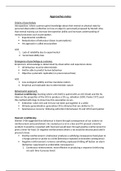
Origins of psychology
Introspection: where a person gains knowledge about their mental or physical state by
personal observation (reflection on how an object is perceived) proposed by Wundt. Also,
that mental training can increase introspection ability and increases understanding of
mental processes such as perception.
Experimental conditions
Reductionism of behaviour (down to perceptions)
His approach is called structuralism
AO3
1. Lack of reliability due to experimental
2. Social desirability bias
Emergence of psychology as a science
Empiricism: all knowledge is determined by observation and experience alone
All behaviour must be deterministic
And be able to predict human behaviour
Objective systematic replicable (no preconceived bias)
AO3
1. Low ecological validity and low mundane realism
2. Empirical and replicable due to deterministic nature
Behaviourist approach
Classical conditioning: learning where a NS (bell) is paired with an UCS (food) and the Ns
takes on the properties of the UCS to produce a CR e.g. salivation (UCR). Pavlov 1972 used
this method with dogs to show how this association occurs.
Extinction: when UCS and CS have not been put together in a while
Stimulus generalisation: generalises CR to stimulus that are similar to CS
Spontaneous recovery: following extinction link between CS and UCS found quicker
Operant conditioning
Skinner 1938 suggested that behaviour is learnt through consequences of our actions via
reinforcement and punishment. He created put a rat in a box and if it pressed a level by
accident it would be rewarded with food and would learn through positive reinforcement to
press a lever for food. Or negative reinforcement where a rat would be electrocuted until it
pressed a lever.
Positive reinforcement: a behaviour produces a satisfying consequence food given to
a hungry person or praise to a child (behaviour repeated as desirable consequence)
Negative reinforcement: removes something unpleasant hitting off button on alarm
(behaviour suppressed as undesirable consequence)
1. Continuous reinforcement: most effective in producing a response (reinforcing
rat each time it presses lever)
, 2. Partial reinforcement: most effective in maintaining a response and avoiding
extinction (reinforcing every 3rd lever press)
P behaviourists have contributed to the recognition of psychology as a science
E P+S rejected earlier emphasis on introspection instead focussing on objection
E more valid and reliable understanding of human behaviour due to cause and effect
hypothesis
L helped psychology gain credibility as a science attracting more funding and opportunities
P behaviourists such as P+S used animals in their research
E believed that learning process was similar to humans (P dogs and S rats)
E without any demand characteristics or individual differences that occur when research is
conducted on humans
P less concern about protection from harm for animals so unethical
P animal studies can’t be generalised to humans
E this is because humans have freewill their life isn’t determined by just reinforcement
E show understanding for animal behaviour but not human
L but they argue humans do display environmental determinism and we have little choice
as its predetermined by past learning
Social learning theory Bandura 1986
Behaviour learned through imitation of others and is influenced if the model gains
punishment or not and if they identify with model (same gender)
Imitation: using someone or something as a model and copying them
Modelling: learn a behaviour by observing another person
Vicarious reinforcement: learning through indirect reinforcement (someone else
being reinforced for that behaviour)
Identification: where an individual adopts a behaviour as they want to be associated
with a group
Meditational processes: mental representation of behaviour and weigh up pros and
cons of copying
Bandura 1961, bobo doll experiment
1. Children observed an aggressive (to bobo dolls hitting with a mallet saying POW) or
non-aggressive role model (half and half)
2. Then taken to a room with a bobo doll in those who witnessed aggressive models
reproduced that behaviour 1/3 of aggressive group used aggressive language none
of the non-aggressive group used such language
P methodology in research to support SLT such as banduras has been criticised
E experimental laboratory method artificial strictly controlled
E demand characteristics (guess aim) lowering internal validity
L aggressive to doll because that’s what’s expected not something that they had learnt
P a limitation of SLT is its issue of causality (people learn from models or seek out models
which produce behaviour which they already favour)
Origins of psychology
Introspection: where a person gains knowledge about their mental or physical state by
personal observation (reflection on how an object is perceived) proposed by Wundt. Also,
that mental training can increase introspection ability and increases understanding of
mental processes such as perception.
Experimental conditions
Reductionism of behaviour (down to perceptions)
His approach is called structuralism
AO3
1. Lack of reliability due to experimental
2. Social desirability bias
Emergence of psychology as a science
Empiricism: all knowledge is determined by observation and experience alone
All behaviour must be deterministic
And be able to predict human behaviour
Objective systematic replicable (no preconceived bias)
AO3
1. Low ecological validity and low mundane realism
2. Empirical and replicable due to deterministic nature
Behaviourist approach
Classical conditioning: learning where a NS (bell) is paired with an UCS (food) and the Ns
takes on the properties of the UCS to produce a CR e.g. salivation (UCR). Pavlov 1972 used
this method with dogs to show how this association occurs.
Extinction: when UCS and CS have not been put together in a while
Stimulus generalisation: generalises CR to stimulus that are similar to CS
Spontaneous recovery: following extinction link between CS and UCS found quicker
Operant conditioning
Skinner 1938 suggested that behaviour is learnt through consequences of our actions via
reinforcement and punishment. He created put a rat in a box and if it pressed a level by
accident it would be rewarded with food and would learn through positive reinforcement to
press a lever for food. Or negative reinforcement where a rat would be electrocuted until it
pressed a lever.
Positive reinforcement: a behaviour produces a satisfying consequence food given to
a hungry person or praise to a child (behaviour repeated as desirable consequence)
Negative reinforcement: removes something unpleasant hitting off button on alarm
(behaviour suppressed as undesirable consequence)
1. Continuous reinforcement: most effective in producing a response (reinforcing
rat each time it presses lever)
, 2. Partial reinforcement: most effective in maintaining a response and avoiding
extinction (reinforcing every 3rd lever press)
P behaviourists have contributed to the recognition of psychology as a science
E P+S rejected earlier emphasis on introspection instead focussing on objection
E more valid and reliable understanding of human behaviour due to cause and effect
hypothesis
L helped psychology gain credibility as a science attracting more funding and opportunities
P behaviourists such as P+S used animals in their research
E believed that learning process was similar to humans (P dogs and S rats)
E without any demand characteristics or individual differences that occur when research is
conducted on humans
P less concern about protection from harm for animals so unethical
P animal studies can’t be generalised to humans
E this is because humans have freewill their life isn’t determined by just reinforcement
E show understanding for animal behaviour but not human
L but they argue humans do display environmental determinism and we have little choice
as its predetermined by past learning
Social learning theory Bandura 1986
Behaviour learned through imitation of others and is influenced if the model gains
punishment or not and if they identify with model (same gender)
Imitation: using someone or something as a model and copying them
Modelling: learn a behaviour by observing another person
Vicarious reinforcement: learning through indirect reinforcement (someone else
being reinforced for that behaviour)
Identification: where an individual adopts a behaviour as they want to be associated
with a group
Meditational processes: mental representation of behaviour and weigh up pros and
cons of copying
Bandura 1961, bobo doll experiment
1. Children observed an aggressive (to bobo dolls hitting with a mallet saying POW) or
non-aggressive role model (half and half)
2. Then taken to a room with a bobo doll in those who witnessed aggressive models
reproduced that behaviour 1/3 of aggressive group used aggressive language none
of the non-aggressive group used such language
P methodology in research to support SLT such as banduras has been criticised
E experimental laboratory method artificial strictly controlled
E demand characteristics (guess aim) lowering internal validity
L aggressive to doll because that’s what’s expected not something that they had learnt
P a limitation of SLT is its issue of causality (people learn from models or seek out models
which produce behaviour which they already favour)