Geography 2025 – full spec. Human
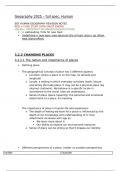
EOY HUMAN GEOGRAPHY REVISION NOTES
RED = CASE STUDY DATA (MUST KNOW)
GREEN= IMPORTANT INFORMATION/DEFENITIONS
= subheading / title for new topic
Underlined = new topic area (general title of topic area) ( eg Urban
heat island effect)
3.2.2 CHANGING PLACES
3.2.2.1 The nature and importance of places
Defining place
- The geographical concept of place has 3 different aspects:
o Location: where a place is on the map, its latitude and
longitude
o Locale: a setting in which everyday activities (work, leisure
and family life) take place. It may not be a physical place (eg
internet chatroom). We behave in a specific locale in
accordance to the social rules we understand.
o Sense of place (place meaning): the personal and emotional
attachment to a place, its meaning
- The importance of place in human life and experience:
o The depth of feeling we have for a place is influenced by the
depth of our knowledge and understanding of it- thus
attachment increases with age as:
We learn more about it
Our ability to explore our environment improves
o Sense of place can be strong so that it shpaes our identity
Different perspectives of a place. Insider vs outsider perspectives
Insider Outsider
, - A viewpoint from an individual within - A viewpoint of someone who is
a place, who lives there and has an not from the certain place/doesn’t
experience of the place live there/has little or no
- Will have adapted to the customs and experience within that place.
norms of the area - May no fit in with norms
- You will have family and connections - May feel socially excluded
in that place - Less sense of social belonging
- Often associated with topophilia - Often associated with topophobia
(strong sense of attachment to a (strong dislike or fear of a place.
place, which often becomes mixed Could have a strong but negative
with the love of a place) attachment to a place (eg prison
cell)
Categories of a place
- “Place is security, space is freedom” (Yi-Fu Tuan, 1977)
Near places Far places Experienced places Media places
Places that are - Places that - A place that a - Places a person
geographically are person has has either read
close or you have geographicall spent time in or seen about, in
an emotional y far away or media such as
attatchment to have a distant film, tv , social
(eg town you gre connection to media.
up in but moved someone - Media places
away from) emotionally lack a sense of
genius loci ( a
spirit of a place)
- Can be hard to
interpret +
bases your
opinion off other
peoples
Factors contributing to the character of a place
Exogenous factors: factors that originate from other places or
relationships
Examples of exogenous factors;
1. Migration – a shifting flow of PEOPLE. For example, in 2004
the EU enlarged and allowed the free movement of people
from 8 countries in Eastern Europe (Czech Republic,
Estonia, Hungary, Latvia, Lithuania, Poland, Slovakia and
Slovenia). This can have a huge affect on places which
receive these migrants. New cultures, food music, ways of
living are imported into the place, changing its character.
, 2. Technological change – a shifting flow of IDEAS - consider
the changes that have taken place in our places because
of innovations in technology. Our city centres often have
Wi-Fi access now and people are connected when
experiencing places. Historically, ideas shifted more
slowly.
3. Economic changes – the shifting flows of MONEY AND
INVESTMENT. We have seen a tremendous change in
patterns of production across the globe. The new
International Division of Labour has transferred a lot of
manufacturing production Eastwards to Asia. This is also
connected to the shifting flow of resources
4. Government rules and decisions – governments can make
decisions that impact areas. For example, many of the
BBCs functions were relocated from London to
Manchester, helping to create Media City in Salford.
Endogenous factors: factors which have originated internally
, Key words :
- topophilia (strong sense of attachment to a place, which often
becomes mixed with the love of a place)
- topophobia (strong dislike or fear of a place. Could have a
strong but negative attachment to a place (eg prison cell)
- Xenophobia : fear and hatred of strangers or anything foreign
- Placelessness: a place that lacks ‘uniqueness’ and could be
anywhere (Eg a clown town)
- Genius loci : spirit of a place
3.2.2.2 relationships, connections, meaning and representation
EOY HUMAN GEOGRAPHY REVISION NOTES
RED = CASE STUDY DATA (MUST KNOW)
GREEN= IMPORTANT INFORMATION/DEFENITIONS
= subheading / title for new topic
Underlined = new topic area (general title of topic area) ( eg Urban
heat island effect)
3.2.2 CHANGING PLACES
3.2.2.1 The nature and importance of places
Defining place
- The geographical concept of place has 3 different aspects:
o Location: where a place is on the map, its latitude and
longitude
o Locale: a setting in which everyday activities (work, leisure
and family life) take place. It may not be a physical place (eg
internet chatroom). We behave in a specific locale in
accordance to the social rules we understand.
o Sense of place (place meaning): the personal and emotional
attachment to a place, its meaning
- The importance of place in human life and experience:
o The depth of feeling we have for a place is influenced by the
depth of our knowledge and understanding of it- thus
attachment increases with age as:
We learn more about it
Our ability to explore our environment improves
o Sense of place can be strong so that it shpaes our identity
Different perspectives of a place. Insider vs outsider perspectives
Insider Outsider
, - A viewpoint from an individual within - A viewpoint of someone who is
a place, who lives there and has an not from the certain place/doesn’t
experience of the place live there/has little or no
- Will have adapted to the customs and experience within that place.
norms of the area - May no fit in with norms
- You will have family and connections - May feel socially excluded
in that place - Less sense of social belonging
- Often associated with topophilia - Often associated with topophobia
(strong sense of attachment to a (strong dislike or fear of a place.
place, which often becomes mixed Could have a strong but negative
with the love of a place) attachment to a place (eg prison
cell)
Categories of a place
- “Place is security, space is freedom” (Yi-Fu Tuan, 1977)
Near places Far places Experienced places Media places
Places that are - Places that - A place that a - Places a person
geographically are person has has either read
close or you have geographicall spent time in or seen about, in
an emotional y far away or media such as
attatchment to have a distant film, tv , social
(eg town you gre connection to media.
up in but moved someone - Media places
away from) emotionally lack a sense of
genius loci ( a
spirit of a place)
- Can be hard to
interpret +
bases your
opinion off other
peoples
Factors contributing to the character of a place
Exogenous factors: factors that originate from other places or
relationships
Examples of exogenous factors;
1. Migration – a shifting flow of PEOPLE. For example, in 2004
the EU enlarged and allowed the free movement of people
from 8 countries in Eastern Europe (Czech Republic,
Estonia, Hungary, Latvia, Lithuania, Poland, Slovakia and
Slovenia). This can have a huge affect on places which
receive these migrants. New cultures, food music, ways of
living are imported into the place, changing its character.
, 2. Technological change – a shifting flow of IDEAS - consider
the changes that have taken place in our places because
of innovations in technology. Our city centres often have
Wi-Fi access now and people are connected when
experiencing places. Historically, ideas shifted more
slowly.
3. Economic changes – the shifting flows of MONEY AND
INVESTMENT. We have seen a tremendous change in
patterns of production across the globe. The new
International Division of Labour has transferred a lot of
manufacturing production Eastwards to Asia. This is also
connected to the shifting flow of resources
4. Government rules and decisions – governments can make
decisions that impact areas. For example, many of the
BBCs functions were relocated from London to
Manchester, helping to create Media City in Salford.
Endogenous factors: factors which have originated internally
, Key words :
- topophilia (strong sense of attachment to a place, which often
becomes mixed with the love of a place)
- topophobia (strong dislike or fear of a place. Could have a
strong but negative attachment to a place (eg prison cell)
- Xenophobia : fear and hatred of strangers or anything foreign
- Placelessness: a place that lacks ‘uniqueness’ and could be
anywhere (Eg a clown town)
- Genius loci : spirit of a place
3.2.2.2 relationships, connections, meaning and representation