100% de satisfacción garantizada Inmediatamente disponible después del pago Tanto en línea como en PDF No estas atado a nada 4.2 TrustPilot
logo-home
Examen

AED3701 Assignment 2 (100% COMPLETE ANSWERS) 2025 (761142)

Puntuación
-
Vendido
3
Páginas
27
Grado
A+
Subido en
08-05-2025
Escrito en
2024/2025

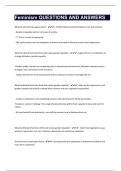
Assessment in Education - AED3701 Assignment 2 2025 (Unique Number: 761142) ;100 % TRUSTED workings, Expert Solved, Explanations and Solutions. For assistance call or W.h.a.t.s.a.p.p us on ...(.+.2.5.4.7.7.9.5.4.0.1.3.2)........... QUESTION 1 [10 marks] 1.1 1.2 What is the primary purpose of assessment planning? A) To give learners homework B) C) D) To prepare report cards To improve teaching and learning processes To promote learners to the next grade The National Protocol for Assessment (NPA) Grades R–12 standardises which of the following? A) B) C) D) School times Curriculum content Recording and reporting processes Textbook distribution 4 AED3701/ASS02/2025 5 1.3 According to the NPPPPR, assessments must be aligned with _____. A) learners' interests B) grade and subject-specific requirements C) extracurricular activities D) daily homework tasks 1.4 What are the four steps in the assessment process, as per the Section 4 policy? A) Planning, teaching, learning, grading B) Generating evidence, evaluating evidence, recording findings, using information C) Studying, revising, taking tests, receiving feedback D) Setting tests, marking, grading, and reporting 1.5 Which of the following is an example of an assessment instrument? A) Textbook B) Lesson plan C) Rubric D) Red pen 1.6 The Policy on Screening, Identification, Assessment, and Support (SIAS) helps in _____. A) developing teaching material B) managing learners' personal issues C) screening and supporting learners with disabilities D) assigning school tasks 1.7 Diagnostic assessment results are used to _____. A) improve report card grades B) identify barriers to learning C) change the school curriculum AED3701/ASS02/2025 6 D) test the teacher’s knowledge 1.8 The principle of sufficiency in assessments ensures that _____. A) the test includes enough content from the syllabus B) all learners receive extra time C) the test is difficult enough to challenge learners D) only the best learners are assessed 1.9 Moderation of assessments ensures that _____. A) assessments are reviewed for fairness, validity, and reliability B) assessments are not too easy C) learners are given extra credit D) assessments are conducted in groups 1.10 The role of ICT in assessment includes _____. A) allowing learners to take breaks during assessments B) providing digital tools to create, submit, and receive feedback on assessments C) replacing traditional teaching methods D) limiting teacher-learner interaction (10) QUESTION 2 [10 marks] Match the description in column B with the concept in column A. Column A: Term Column B: Description 2.1 Section 4 of CAPS document A. Guides learners with criteria and level descriptors for task completion 2.2 Fairness B. Continuous assessment that provides feedback during the learning process 2.3 Assessment rubric AED3701/ASS02/2025 C. Standardises the documentation of learner achievements from Grades R–12 2.4 Social Constructivism D. Sets procedures for promoting learners to the next grade 2.5 Formative assessment E. Emphasises knowledge acquisition through social interaction F. Ensures that learners are assessed on what they have been taught (10) QUESTION 3 [25 marks] 3.1 3.2 Every teacher is expected to have a subject file, and it should contain assessment tasks. The file must…. (a) (b) (c) have a complete assessment record in that particular subject. be maintained by the teacher for every subject concerning the National Curriculum Statement, Grades R–12. be available for monitoring and moderation purposes at every level. What is your understanding of each statement above, as it relates to the assessment of learners? (9) Use the Link to download the CAPS document for your subject of specialisation. Use the document to differentiate between recording and reporting, as presented in Section 4 (do not copy and paste but instead present your understanding of the two concepts). (6) 7 AED3701/ASS02/2025 3.3 The ATP is a critical document that a teacher should possess and keep in the subject file. Use the ATP for your subject to analyse the key sections and describe how these sections can assist you in assessing your learners. Provide specific examples from your subject-specific ATP. Focus your response on the following aspects: • Term content overview • Assessment guidelines • Time allocations • Cognitive levels QUESTION 4 [55 marks] 4.1 4.2 Provide a brief background of the school where you completed your teaching practice. Include the following details: 4.1.1 School details (Name, location, contact details, etc.) 4.1.2 Type of school (e.g., public or private, primary or secondary) 4.1.3 The grades and subjects you taught 4.1.4 Socioeconomic context of the surrounding community 4.1.5 Approximate size of the school (number of learners and teachers) (10) (5) One of the seven roles of a teacher is being an “assessor”, which is tied to the value of quality. Drawing on your experience from teaching practice, critically explain the role of a teacher as an assessor and discuss the importance of quality in assessment. Provide examples from your classroom experiences to illustrate how your mentor teacher designed, implemented, and moderated assessments to support learner progress and ensure fairness and reliability. (10) 8 AED3701/ASS02/2025 4.3 4.4 Mrs Ndlovu is a Grade 10 teacher at a public secondary school. Her diverse classroom includes learners from various socioeconomic backgrounds, who speak different languages and have different learning abilities. She aims to implement differentiated instruction and assessment to cater to her learners' diverse needs, meet subject objectives, and improve learner outcomes. Drawing on your teaching practice experience, discuss these five (5) challenges that she might encounter in her classroom. Please provide specific examples from your experience to suggest the differentiated assessment strategies she could implement to address these challenges and support learner success. (10) Answer the questions below using the Grade 9 EMS ATP. 4.4.1 How can the EMS teacher use the ATP to develop the baseline assessment? (3) 4.4.2 How do summative assessments differ from formative assessments in terms of their purpose and implementation? (4) 4.4.3 Identify the forms of informal assessment that can be used to assess core concepts taught in Term 2. (4) 4.4.4 Which formal assessment do learners complete in Term 2? 9 (1) AED3701/ASS02/2025 4.4.5 How should this formal task (mentioned in 4.4.4) be structured regarding its cognitive levels? (3) 4.4.6 Formal assessment must be fair, reliable, and valid. Mention two (for each principle) undertakings that a teacher should implement to meet the requirements of these principles. (6) 4.4.7 Evaluate the importance of identifying requisite pre-knowledge when teaching and analyse how it supports effective teaching and learning in the classroom context. (3) 4.5 Analyse three strategies a teacher can use to make the environment conducive for learners to complete the summative assessment. (6) TOTAL: [100]

Mostrar más Leer menos
Institución
Grado


Ups! No podemos cargar tu documento ahora. Inténtalo de nuevo o contacta con soporte.

Libro relacionado

Escuela, estudio y materia

Institución
Grado

Información del documento

Subido en
8 de mayo de 2025
Número de páginas
27
Escrito en
2024/2025
Tipo
Examen
Contiene
Preguntas y respuestas

Temas

Vista previa del contenido

AED3701
ASSIGNMENT 2 2025

UNIQUE NO. 761142
DUE DATE: MAY 2025

, AED3701

Assignment 2 2025


Unique Number: 761142

Due Date: May 2025

Assessment in Education

QUESTION 1 [10 marks]

1.1
What is the main goal of assessment planning?
A) To give learners homework
B) To prepare report cards
C) To improve teaching and learning processes
D) To promote learners to the next grade
Answer: C) To improve teaching and learning processes


1.2
The National Protocol for Assessment (NPA) Grades R–12 sets standards for
which of the following?
A) School times
B) Curriculum content
C) Recording and reporting processes
D) Textbook distribution
Answer: C) Recording and reporting processes

$2.77
Accede al documento completo:

100% de satisfacción garantizada
Inmediatamente disponible después del pago
Tanto en línea como en PDF
No estas atado a nada

Conoce al vendedor

Seller avatar
Los indicadores de reputación están sujetos a la cantidad de artículos vendidos por una tarifa y las reseñas que ha recibido por esos documentos. Hay tres niveles: Bronce, Plata y Oro. Cuanto mayor reputación, más podrás confiar en la calidad del trabajo del vendedor.
LIBRARYpro University of South Africa (Unisa)
Seguir Necesitas iniciar sesión para seguir a otros usuarios o asignaturas
Vendido
10518
Miembro desde
2 año
Número de seguidores
4904
Documentos
4814
Última venta
1 semana hace
LIBRARY

On this page, you find all documents, Package Deals, and Flashcards offered by seller LIBRARYpro (LIBRARY). Knowledge is Power. #You already got my attention!

3.7

1457 reseñas

5
683
4
235
3
243
2
78
1
218

Recientemente visto por ti

Por qué los estudiantes eligen Stuvia

Creado por compañeros estudiantes, verificado por reseñas

Calidad en la que puedes confiar: escrito por estudiantes que aprobaron y evaluado por otros que han usado estos resúmenes.

¿No estás satisfecho? Elige otro documento

¡No te preocupes! Puedes elegir directamente otro documento que se ajuste mejor a lo que buscas.

Paga como quieras, empieza a estudiar al instante

Sin suscripción, sin compromisos. Paga como estés acostumbrado con tarjeta de crédito y descarga tu documento PDF inmediatamente.

Student with book image

“Comprado, descargado y aprobado. Así de fácil puede ser.”

Alisha Student

Preguntas frecuentes