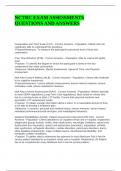
NCTRC EXAM ASSESSMENTS
QUESTIONS AND ANSWERS
Cooperation and Trust Scale (CAT) - Correct Answers --Population: Clients who are
cognitively able to understand the questions.
-Purpose/measures: To measure the participant's perceived level of trust and
cooperation.
Free Time Boredom (FTB) - Correct Answers --Population: Able to read at 4th grade
level.
-Purpose: To identify the degree to which the participant is bored in the four
components that make up boredom.
-Measures: Meaningfulness, Mental Involvement, Speed of Time, and Physical
Involvement.
Idyll Arbor Leisure Battery (IALB) - Correct Answers --Population: Clients with moderate
to no cognitive impairment.
-Purpose/measures: Leisure attitude measurement, leisure interest measure, leisure
motivation scale, leisure satisfaction measure
Idyll Arbor Activity Assessment (IAAA) - Correct Answers --Population: Written specially
to meet OBRA regulations (Long-Term Care regulations). Best suited for clients who
live in a nursing home or other LTC facility. Covers both physical medicine and
psychiatric LTC assessment needs.
-Purpose: To obtain enough information about a client, in a reasonable amount of time,
to be able to develop a treatment plan.
-Measures: 5 sections: personal and medical history, leisure interests, leisure history,
individual performance/social strengths, and maladaptive behaviors.
Inpatient Rehabilitation Facility- Patient Assessment Instrument (IRF-PAI) - Correct
Answers --Population: Clients admitted to an inpatient rehab unit or hospital. Impairment
(diagnostic) groups include: stroke, brain dysfunction, neurologic conditions, spinal cord
dysfunction (non traumatic), spinal cord dysfunction (traumatic), amputation, arthritis,
pain syndromes, orthopedic disorders, cardiac disorders, pulmonary disorders, burns,
other disabling impairments, major multiple trauma, developmental disability, and
medically complex conditions.
-Purpose: To gather data to determine the payment for each Medicare Part A fee-for-
service patient admitted to an inpatient rehab unit or hospital. Required by US federal
law to be completed for every Medicare Part A fee-for-service patient.
, -Measures: What the client actually does, whatever the diagnosis or impairment, not
what s/he ought to be able to do, or might be able to do under different circumstances.
Leisure Attitude Measurement - Correct Answers --Population: Adapted IQ of 80+,
Mental age of 12+, Rancho Los Amigos Level 7+, Reality Orientation Level of "Mild to
no orientation disability"
-Purpose: To review (and quantify) the participant's attitude toward leisure on three
different levels.
-Measures: Cognitive, affective, and behavioral.
Leisure Interest Measure (LIM) - Correct Answers --Population: Clients with moderate to
no cognitive impairment
-Purpose: To measure how much interest the client has in each of the eight domains of
leisure activities.
-Measures: Physical, outdoor, mechanical, artistic, service, social, cultural, and reading.
Leisure Motivation Scale (LMS) - Correct Answers --Population: Clients with moderate
to no cognitive disability.
-Purpose: To measure a patient's motivation(s) for engaging in leisure activities.
-Measures: Primary motivators identified through research: intellectual, social,
competence-mastery, stimulus-avoidance
Leisure Satisfaction Measure (LSM) - Correct Answers --Population: Clients with
moderate to no cognitive impairment
-Purpose: To measure the degree to which a client perceives his/her general "needs"
are being met through leisure.
-Measures: Six categories: Psychological, educational, social, relaxation, physiological,
aesthetic.
Leisure Diagnostic Battery (LDB) - Correct Answers --Population: Adults, Adapted for
children 9-14 as well with statements. Information will be used for interventions.
-Purpose:
1. To assess the client's leisure functioning.
2. To determine the areas in which improvement of current leisure functioning is
needed.
3. To determine the impact of offered services on the client's leisure functioning.
4. To facilitate research on the structure of leisure to enable a better understanding of
the value, purpose, and outcomes of leisure experiences.
-Measures: Perceived leisure competence, perceived leisure control, leisure needs,
depth of involvement in leisure, and playfulness.
Leisurescope Plus - Correct Answers --Population: Adolescent and adults clients with
little to no cognitive impairment.
-Purpose:
1. To identify ares of high leisure interest.
2. To identify the emotional motivation for participation.
QUESTIONS AND ANSWERS
Cooperation and Trust Scale (CAT) - Correct Answers --Population: Clients who are
cognitively able to understand the questions.
-Purpose/measures: To measure the participant's perceived level of trust and
cooperation.
Free Time Boredom (FTB) - Correct Answers --Population: Able to read at 4th grade
level.
-Purpose: To identify the degree to which the participant is bored in the four
components that make up boredom.
-Measures: Meaningfulness, Mental Involvement, Speed of Time, and Physical
Involvement.
Idyll Arbor Leisure Battery (IALB) - Correct Answers --Population: Clients with moderate
to no cognitive impairment.
-Purpose/measures: Leisure attitude measurement, leisure interest measure, leisure
motivation scale, leisure satisfaction measure
Idyll Arbor Activity Assessment (IAAA) - Correct Answers --Population: Written specially
to meet OBRA regulations (Long-Term Care regulations). Best suited for clients who
live in a nursing home or other LTC facility. Covers both physical medicine and
psychiatric LTC assessment needs.
-Purpose: To obtain enough information about a client, in a reasonable amount of time,
to be able to develop a treatment plan.
-Measures: 5 sections: personal and medical history, leisure interests, leisure history,
individual performance/social strengths, and maladaptive behaviors.
Inpatient Rehabilitation Facility- Patient Assessment Instrument (IRF-PAI) - Correct
Answers --Population: Clients admitted to an inpatient rehab unit or hospital. Impairment
(diagnostic) groups include: stroke, brain dysfunction, neurologic conditions, spinal cord
dysfunction (non traumatic), spinal cord dysfunction (traumatic), amputation, arthritis,
pain syndromes, orthopedic disorders, cardiac disorders, pulmonary disorders, burns,
other disabling impairments, major multiple trauma, developmental disability, and
medically complex conditions.
-Purpose: To gather data to determine the payment for each Medicare Part A fee-for-
service patient admitted to an inpatient rehab unit or hospital. Required by US federal
law to be completed for every Medicare Part A fee-for-service patient.
, -Measures: What the client actually does, whatever the diagnosis or impairment, not
what s/he ought to be able to do, or might be able to do under different circumstances.
Leisure Attitude Measurement - Correct Answers --Population: Adapted IQ of 80+,
Mental age of 12+, Rancho Los Amigos Level 7+, Reality Orientation Level of "Mild to
no orientation disability"
-Purpose: To review (and quantify) the participant's attitude toward leisure on three
different levels.
-Measures: Cognitive, affective, and behavioral.
Leisure Interest Measure (LIM) - Correct Answers --Population: Clients with moderate to
no cognitive impairment
-Purpose: To measure how much interest the client has in each of the eight domains of
leisure activities.
-Measures: Physical, outdoor, mechanical, artistic, service, social, cultural, and reading.
Leisure Motivation Scale (LMS) - Correct Answers --Population: Clients with moderate
to no cognitive disability.
-Purpose: To measure a patient's motivation(s) for engaging in leisure activities.
-Measures: Primary motivators identified through research: intellectual, social,
competence-mastery, stimulus-avoidance
Leisure Satisfaction Measure (LSM) - Correct Answers --Population: Clients with
moderate to no cognitive impairment
-Purpose: To measure the degree to which a client perceives his/her general "needs"
are being met through leisure.
-Measures: Six categories: Psychological, educational, social, relaxation, physiological,
aesthetic.
Leisure Diagnostic Battery (LDB) - Correct Answers --Population: Adults, Adapted for
children 9-14 as well with statements. Information will be used for interventions.
-Purpose:
1. To assess the client's leisure functioning.
2. To determine the areas in which improvement of current leisure functioning is
needed.
3. To determine the impact of offered services on the client's leisure functioning.
4. To facilitate research on the structure of leisure to enable a better understanding of
the value, purpose, and outcomes of leisure experiences.
-Measures: Perceived leisure competence, perceived leisure control, leisure needs,
depth of involvement in leisure, and playfulness.
Leisurescope Plus - Correct Answers --Population: Adolescent and adults clients with
little to no cognitive impairment.
-Purpose:
1. To identify ares of high leisure interest.
2. To identify the emotional motivation for participation.