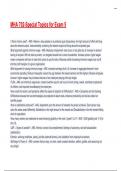
MHA 702-Special Topics for Exam 5
3 Terms Vroom used? - ANS -Valence- value placed on a particular goal. Expectancy- the right amount of effort will bring
about the desired output. Instrumentality- achieving the desired output will bring about the expected goal.
\Brief argument against minimum wage - ANS -Reduces employment- less hours or less jobs due to increase in amount
having to be paid. Will not reduce poverty- not targeted toward low in-come households. Increase prices- higher wages
means companies will have to raise their prices to pay for labor. Reduces profits-increasing minimum wages may not fit
into the profit margins of a given organization.
\Brief argument for raising minimum wage - ANS -increase earnings (duh). An increase in aggregate demand- more
economical spending. Reduced inequality- lessen the gap between the lowest earners and the highest. Reduce employee
turnover- higher wages may increase chances of an employee staying at the job longer.
\FLSA - ANS -set minimum wage level, created overtime pay for set hours of work during a week, restricted employment
of children, and required recordkeeping for employers.
\How could the recent covid pandemic effect the speed of adoption of AI/Robotics? - ANS -Companies are fast tracking
AI/Robotics because the new technologies are projected to slash costs, enhance productivity and be less reliant on
real-life people.
\How is satisfaction produced? - ANS -dependent upon the amount of rewards the person achieves. Each person may
value the same award differently. Satisfaction is the right amount of the reward and Dissatisfaction is the the reward falling
short of expectation.
\How many workers are estimated to need retraining globally in the next 3 years? U.S.? - ANS -120M globally and 11.5 for
the U.S.
\L&P - 2 types of awards? - ANS -Intrinsic- sense of accomplishment, feelings of autonomy, and self actualization
(satisfaction).
Extrinsic- working conditions, salary, job title (external factors), and validation from employer/co-workers.
\McGregor's Theory X - ANS -workers that are lazy, no drive, need constant direction, selfish, gullible, and assuming not
very bright.
3 Terms Vroom used? - ANS -Valence- value placed on a particular goal. Expectancy- the right amount of effort will bring
about the desired output. Instrumentality- achieving the desired output will bring about the expected goal.
\Brief argument against minimum wage - ANS -Reduces employment- less hours or less jobs due to increase in amount
having to be paid. Will not reduce poverty- not targeted toward low in-come households. Increase prices- higher wages
means companies will have to raise their prices to pay for labor. Reduces profits-increasing minimum wages may not fit
into the profit margins of a given organization.
\Brief argument for raising minimum wage - ANS -increase earnings (duh). An increase in aggregate demand- more
economical spending. Reduced inequality- lessen the gap between the lowest earners and the highest. Reduce employee
turnover- higher wages may increase chances of an employee staying at the job longer.
\FLSA - ANS -set minimum wage level, created overtime pay for set hours of work during a week, restricted employment
of children, and required recordkeeping for employers.
\How could the recent covid pandemic effect the speed of adoption of AI/Robotics? - ANS -Companies are fast tracking
AI/Robotics because the new technologies are projected to slash costs, enhance productivity and be less reliant on
real-life people.
\How is satisfaction produced? - ANS -dependent upon the amount of rewards the person achieves. Each person may
value the same award differently. Satisfaction is the right amount of the reward and Dissatisfaction is the the reward falling
short of expectation.
\How many workers are estimated to need retraining globally in the next 3 years? U.S.? - ANS -120M globally and 11.5 for
the U.S.
\L&P - 2 types of awards? - ANS -Intrinsic- sense of accomplishment, feelings of autonomy, and self actualization
(satisfaction).
Extrinsic- working conditions, salary, job title (external factors), and validation from employer/co-workers.
\McGregor's Theory X - ANS -workers that are lazy, no drive, need constant direction, selfish, gullible, and assuming not
very bright.