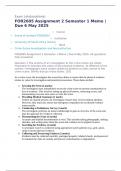
,FOR2605 Assignment 2 Semester 1 Memo | Due 6
May 2025. All questions fully answered.
MULTIPLE CHOICE,ASSURED EXCELLENCE
Question 1 The actions of an investigator at the crime scene are
vitally important to maintain the value of the physical evidence.
At different crime scenes, investigators have certain duties to
perform to take control of the crime scene. Briefly discuss those
duties. [10] Question 2 A crime scene can be classified into five
types, discuss any four of these crime scenes. [8] Question 3
Investigators that attend a crime scene where networks and
internet crime has occurred should be aware that criminals may
use the internet or the network for many reasons. List these
reasons. [10] Question 4 4.1. There are three types of
fingerprints impression that are found at crime scenes, discuss
these three impressions. 4.2. Ballistics is divided into three units
of study, the internal, terminal and external in your own
understanding discuss these units of study [12] Question 5
Discuss five (5) search methods and their advantages. [10]
Question 1: Duties of an Investigator at the Crime Scene (10)
1. Securing the Scene: The first priority is to secure the crime
scene by establishing a perimeter and ensuring that no
unauthorized persons enter. This helps preserve the
integrity of the evidence.
, 2. Protecting Evidence: Investigators must take steps to
protect physical evidence from contamination or
destruction. This includes limiting the movement within
the crime scene.
3. Photographic Documentation: The investigator should
take photographs of the entire scene, focusing on any
evidence that may be important.
4. Note Taking: The investigator should take detailed notes
on their observations and the actions they take during the
investigation, such as where evidence is found and who
was present.
5. Evidence Collection: Physical evidence, such as weapons,
clothing, and DNA, should be collected carefully to avoid
contamination. Chain of custody should be documented.
6. Interviews: The investigator may begin interviewing
witnesses and victims at the scene to gather preliminary
information.
7. Sketching the Scene: A sketch of the crime scene should
be made, including all the relevant physical features and
evidence locations.
8. Calling for Support: If necessary, the investigator should
call for additional resources, such as forensic experts or
specialized personnel.
May 2025. All questions fully answered.
MULTIPLE CHOICE,ASSURED EXCELLENCE
Question 1 The actions of an investigator at the crime scene are
vitally important to maintain the value of the physical evidence.
At different crime scenes, investigators have certain duties to
perform to take control of the crime scene. Briefly discuss those
duties. [10] Question 2 A crime scene can be classified into five
types, discuss any four of these crime scenes. [8] Question 3
Investigators that attend a crime scene where networks and
internet crime has occurred should be aware that criminals may
use the internet or the network for many reasons. List these
reasons. [10] Question 4 4.1. There are three types of
fingerprints impression that are found at crime scenes, discuss
these three impressions. 4.2. Ballistics is divided into three units
of study, the internal, terminal and external in your own
understanding discuss these units of study [12] Question 5
Discuss five (5) search methods and their advantages. [10]
Question 1: Duties of an Investigator at the Crime Scene (10)
1. Securing the Scene: The first priority is to secure the crime
scene by establishing a perimeter and ensuring that no
unauthorized persons enter. This helps preserve the
integrity of the evidence.
, 2. Protecting Evidence: Investigators must take steps to
protect physical evidence from contamination or
destruction. This includes limiting the movement within
the crime scene.
3. Photographic Documentation: The investigator should
take photographs of the entire scene, focusing on any
evidence that may be important.
4. Note Taking: The investigator should take detailed notes
on their observations and the actions they take during the
investigation, such as where evidence is found and who
was present.
5. Evidence Collection: Physical evidence, such as weapons,
clothing, and DNA, should be collected carefully to avoid
contamination. Chain of custody should be documented.
6. Interviews: The investigator may begin interviewing
witnesses and victims at the scene to gather preliminary
information.
7. Sketching the Scene: A sketch of the crime scene should
be made, including all the relevant physical features and
evidence locations.
8. Calling for Support: If necessary, the investigator should
call for additional resources, such as forensic experts or
specialized personnel.