

ECN 104 - Midterm Exam questions and answers
graded A+ already passed
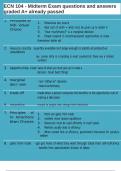
1. Principles of
1. Resources are scarce
Indi- vidual
2. Real cost of smith = what must be given up to obtain it
Choice
3. "how much/many?" is a marginal decision
4. People respond to incentives/exploit opportunities to make
themselves better ott
2. resource scarcity quantity available isnt large enough to satisfy all productive
uses/desires
(ex. corner oflce in a building is most coveted b/c there are a limited
number)
3. opportunity cost value of what you must give up to make a
decision (next best thing)
4. marginal -non "either-or" decision
deci- sion -how much/many
5. trade off made when a person compares the benefits vs the opportunity cost of
making a decision
6. incentive reward to people who change their behaviour
7. Principles of 1. there are gains from trade
In- teractions 2. markets move toward equilibrium
btwn Choices 3. Resources must be used eflciently to reach goals
4. Markets usually lead to eflciency
5. When market fails at eflciency, government intervenes for society's
welfare
8. gains from trade - ppl get more of what they want through trade than self-suflciency
-benefits from specialization/ division of labour
1/
29
,ECN 104 - Midterm Exam questions and answers
graded A+ already passed
9. equilibrium when demand = supply
³every buyer finds a seller
when no individual would be better ott doing something ditterent
2/
29
, ECN 104 - Midterm Exam questions and answers
graded A+ already passed
-when change occurs, economy moves toward equilibrium
-equilibrium is reached by changes in price and quantities
10. efficient market in which it is impossible to make someone better ott w/o making
another worse ott
11. equity everyone gets their fair share
-ex. eflciency vs equity --> handicapp parking
12. types of 1. natural resources/raw materials
re- 2. labour
sources 3. capital
4. technology
ingredients/raw materials used to make product
13. natural re-
sources/ raw
ma- terials
14. labour human ettort (physical & mental)
15. capital physical capital:
machinery, equipment, buildings used to make
product financial capital:
processes for producing product
16. model simplified representation of real situation (often system of complex
equations)
3/
29
graded A+ already passed
1. Principles of
1. Resources are scarce
Indi- vidual
2. Real cost of smith = what must be given up to obtain it
Choice
3. "how much/many?" is a marginal decision
4. People respond to incentives/exploit opportunities to make
themselves better ott
2. resource scarcity quantity available isnt large enough to satisfy all productive
uses/desires
(ex. corner oflce in a building is most coveted b/c there are a limited
number)
3. opportunity cost value of what you must give up to make a
decision (next best thing)
4. marginal -non "either-or" decision
deci- sion -how much/many
5. trade off made when a person compares the benefits vs the opportunity cost of
making a decision
6. incentive reward to people who change their behaviour
7. Principles of 1. there are gains from trade
In- teractions 2. markets move toward equilibrium
btwn Choices 3. Resources must be used eflciently to reach goals
4. Markets usually lead to eflciency
5. When market fails at eflciency, government intervenes for society's
welfare
8. gains from trade - ppl get more of what they want through trade than self-suflciency
-benefits from specialization/ division of labour
1/
29
,ECN 104 - Midterm Exam questions and answers
graded A+ already passed
9. equilibrium when demand = supply
³every buyer finds a seller
when no individual would be better ott doing something ditterent
2/
29
, ECN 104 - Midterm Exam questions and answers
graded A+ already passed
-when change occurs, economy moves toward equilibrium
-equilibrium is reached by changes in price and quantities
10. efficient market in which it is impossible to make someone better ott w/o making
another worse ott
11. equity everyone gets their fair share
-ex. eflciency vs equity --> handicapp parking
12. types of 1. natural resources/raw materials
re- 2. labour
sources 3. capital
4. technology
ingredients/raw materials used to make product
13. natural re-
sources/ raw
ma- terials
14. labour human ettort (physical & mental)
15. capital physical capital:
machinery, equipment, buildings used to make
product financial capital:
processes for producing product
16. model simplified representation of real situation (often system of complex
equations)
3/
29

