5 Examples of Evidence-Informed
Nursing Practice Protocols
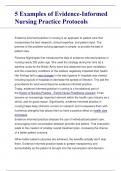
Evidence-informed practice in nursing is an approach to patient care that
incorporates the best research, clinical expertise, and patient input. The
premise of this problem-solving approach is simple: to provide the best in
patient care.
Florence Nightingale first introduced the idea of evidence-informed practice in
nursing nearly 200 years ago. She used the strategy during her time as a
wartime nurse for the British Army when she observed how poor ventilation
and the unsanitary conditions of the soldiers negatively impacted their health.
Her findings led to vast changes in the way hygiene in hospitals was viewed,
including layouts of hospitals to decrease the spread of infection. This laid the
groundwork for what would become evidence-informed practice.
Today, evidence-informed practice in nursing is a foundational part of
the Doctor of Nursing Practice - Family Nurse Practitioner program. It has
become an increasingly important element within the health care industry as a
whole, and for good reason. Significantly, evidence-informed practice in
nursing helps keep clinicians current on research and it empowers them with
numerous strengths that allows them to have a positive effect on health care
processes.
Evidence-informed practice stresses the use of individualized patient care,
encouraging more conversation between provider and patient. That interaction
leads to the creation of a better overall treatment plan, increasing the chance
of a better patient outcome.
When better patient outcomes are achieved, the benefits actually don’t stop
there. Evidence-informed practice leads to greater transparency and
accountability as the patient is brought into the conversation and decision-
, making process. The approach leads to cost savings as the demands on
health care resources and providers are decreased.
A Healthcare Financial Management Association article explains it best: “In
addition to curbing cost, evidence-based care addresses six components of
healthcare quality: safety, effectiveness, patient-centeredness, timeliness,
efficiency, and equitability.”
Protocols of Evidence-
informed Practice in Nursing
The idea of evidence-informed practice in nursing has developed greatly over
the years. For decades after Nightingale, there was no movement on the
practice. Up until the 1960s, nursing was still generally viewed as more of
an applied science that was based on theory rather than research. Then came
professor Archie Cochrane. Often called the father of evidence-informed
medicine, Cochrane noted that problem in the 1970s, stressing the need
for evidence in medicine. By the mid-1990s, it was realized that new
knowledge alone wasn’t enough. It must be applied in clinical settings,
preferably across an entire team.
Evidence-informed medicine became more of a focus in the 1980s and 1990s,
and it replaced many protocols and policies that were at one time standard.
For example, previously, a BRAT (bananas, rice, applesauce, and toast) diet
was standard for children with gastrointestinal issues. Today, it’s known that
children with gastrointestinal issues should continue a well-balanced diet as
quickly as possible.
Previously, protocol said to turn a patient every two hours to avoid skin
breakdowns. Evidence-informed practice revealed that patients should be
turned when and if their condition permits. Another protocol change is that at
one time aspirin was given to children to control fever. With evidence-informed
2
Nursing Practice Protocols
Evidence-informed practice in nursing is an approach to patient care that
incorporates the best research, clinical expertise, and patient input. The
premise of this problem-solving approach is simple: to provide the best in
patient care.
Florence Nightingale first introduced the idea of evidence-informed practice in
nursing nearly 200 years ago. She used the strategy during her time as a
wartime nurse for the British Army when she observed how poor ventilation
and the unsanitary conditions of the soldiers negatively impacted their health.
Her findings led to vast changes in the way hygiene in hospitals was viewed,
including layouts of hospitals to decrease the spread of infection. This laid the
groundwork for what would become evidence-informed practice.
Today, evidence-informed practice in nursing is a foundational part of
the Doctor of Nursing Practice - Family Nurse Practitioner program. It has
become an increasingly important element within the health care industry as a
whole, and for good reason. Significantly, evidence-informed practice in
nursing helps keep clinicians current on research and it empowers them with
numerous strengths that allows them to have a positive effect on health care
processes.
Evidence-informed practice stresses the use of individualized patient care,
encouraging more conversation between provider and patient. That interaction
leads to the creation of a better overall treatment plan, increasing the chance
of a better patient outcome.
When better patient outcomes are achieved, the benefits actually don’t stop
there. Evidence-informed practice leads to greater transparency and
accountability as the patient is brought into the conversation and decision-
, making process. The approach leads to cost savings as the demands on
health care resources and providers are decreased.
A Healthcare Financial Management Association article explains it best: “In
addition to curbing cost, evidence-based care addresses six components of
healthcare quality: safety, effectiveness, patient-centeredness, timeliness,
efficiency, and equitability.”
Protocols of Evidence-
informed Practice in Nursing
The idea of evidence-informed practice in nursing has developed greatly over
the years. For decades after Nightingale, there was no movement on the
practice. Up until the 1960s, nursing was still generally viewed as more of
an applied science that was based on theory rather than research. Then came
professor Archie Cochrane. Often called the father of evidence-informed
medicine, Cochrane noted that problem in the 1970s, stressing the need
for evidence in medicine. By the mid-1990s, it was realized that new
knowledge alone wasn’t enough. It must be applied in clinical settings,
preferably across an entire team.
Evidence-informed medicine became more of a focus in the 1980s and 1990s,
and it replaced many protocols and policies that were at one time standard.
For example, previously, a BRAT (bananas, rice, applesauce, and toast) diet
was standard for children with gastrointestinal issues. Today, it’s known that
children with gastrointestinal issues should continue a well-balanced diet as
quickly as possible.
Previously, protocol said to turn a patient every two hours to avoid skin
breakdowns. Evidence-informed practice revealed that patients should be
turned when and if their condition permits. Another protocol change is that at
one time aspirin was given to children to control fever. With evidence-informed
2