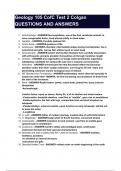
Geology 105 CofC Test 2 Colgan
QUESTIONS AND ANSWERS
1. Acanthostega - ANSWER-first amphibian; one of the first vertebrate animals to
have recognizable limbs; lived almost totally in clean water
2. Agnatha - ANSWER-chordate jawless fish
3. Amino Acids - ANSWER-proteins of life
4. Amphioxus - ANSWER-chordate; intermediate shape among invertebrates; has a
notochord and gills, narrow fish without eyes or exact head
5. Anomalocaris - ANSWER-extinct shrimp-like lifestyles form carefully associated
with arthropods; pinnacle predator that policies all through Cambrian length
6. Archaea - ANSWER-any organization of single celled prokaryotic organisms;
satisfactory candidate for earliest life (can live in extreme environments)
7. Arthodires - ANSWER-armored jaw fish that flourished within the Devonian
duration earlier than their sudden extinction, surviving for 50 mill. Years and
penetrating maximum marine ecological area of interest
8. BIF (Banded Iron Formations) - ANSWER-sedimentary rocks observed specially in
sequences older than 1800MYA; we find increasing accumulations of those from
the start of the Archaean
9. Bone - ANSWER-Rayfin fishes- jawed, actual teeth, paired fins, bony (calcium
phosphate)
-Actinopterygii
Lobefin fishes- equal as above, fleshy fin, a hit in shallow and inland waters
-Coelacanths- backside dwellers, used fins to "waddle"; gave rise to amphibians
-Euthenophteron- the fish with legs, comparable limb and skull structure as
tetrapods
-Panderrichthys- ecternal nostrils, equal function as early tetrapods; started out
to leave the water
-Lungfishes
10.C. Lyell - ANSWER-father of modern geology, created idea of uniformitarianism
11.C. Megalodon - ANSWER-large shark of South Carolina, consumed whales
12.Coelacanths - ANSWER-transition to land animals; used fins to waddle-gave
upward push to amphibians
13.Cooksonia - ANSWER-world's oldest acknowledged plant, underwater,
mushroom-formed and had vascular characteristics
14.Describe and draw a totally early fish. Label its functions. - ANSWER--jawless,
toothless, boneless
-no skeleton or internal structure
-notochord and gills
15.Describe Haden Crust - ANSWER--oldest rocks on earth--beginning of the earth
, -four.6-three.8 BYA
-very warm--warmth launch
-segregation fo center, mantle, and crust
-incandescent magma ocean
16.Describe the first land community. When did it seem? - ANSWER--Appeared 385 MYA
-consisted of a fish with limbs- no gills or neck
-shared comparable skull pattern as the animals inside the mater
17.Describe the first metazoan - ANSWER--sponge- 780 million years vintage
-small- grain of sand, microscopic
18.Deuterostome - ANSWER-filter-feeders with floating larvae; encompass
echinoderms and chordates
19.Did limbs and air breathing occur before or after tetrapods emerged to live on land.
Please provide an explanation for. - ANSWER-Before land-->limbs got here from
lobefins and air breathing developed from gill arches
20.Discuss the blessings of skeletonization - ANSWER--served as an adaptive step
forward
-allowing preferential survival and area of interest exploitation
-protection from predators
-storage of mineral nutrients
-movement-muscular tissues can connect
-help boom in size
21.Discuss the trade needed to the skeleton of Acanthostega to permit an animal to
transport on land. - ANSWER--connection between the pelvis and hind limbs
22.-extremely useful for terrestrial organisms to walk around on land- terrestrial locomotion
23.Discuss the evolution of shark teeth - ANSWER--Shark skin- small, jagged
overlapping scaled for low resistance and turbidity
-teeth emerge as outgrowth/changed quantities of pores and skin
24.Discuss the possible causes for the increase of variety of existence all through the
Cambrian - ANSWER--increased geologic interest
-elevated meals supply
-extended oxygen level
-evolution of the Hox genes
-evolution of the eyes
-new predator prey relationships
25.Discuss the transition from Lobefin fishes to Amphibians. Place the subsequent in
accurate order of appearance(Acanthostega, Eusthenopteron, Panderichthys,
Ichthyostega, and Tiktaalik). For every animal, speak the traits that have been crucial in
the course of this transition. - ANSWER--Eustheropteron- tetrapod-like cranium and
backbone
-Panderichthys- tetrapod-like braincase and tooth, pelvic gurdle & fins
-Tiktaalik- first neck, wrists ears (still in water)
-Acanthostega- fish with eight palms- four legs
-Ichthyostega- reduced to 5 ft, shoulders
QUESTIONS AND ANSWERS
1. Acanthostega - ANSWER-first amphibian; one of the first vertebrate animals to
have recognizable limbs; lived almost totally in clean water
2. Agnatha - ANSWER-chordate jawless fish
3. Amino Acids - ANSWER-proteins of life
4. Amphioxus - ANSWER-chordate; intermediate shape among invertebrates; has a
notochord and gills, narrow fish without eyes or exact head
5. Anomalocaris - ANSWER-extinct shrimp-like lifestyles form carefully associated
with arthropods; pinnacle predator that policies all through Cambrian length
6. Archaea - ANSWER-any organization of single celled prokaryotic organisms;
satisfactory candidate for earliest life (can live in extreme environments)
7. Arthodires - ANSWER-armored jaw fish that flourished within the Devonian
duration earlier than their sudden extinction, surviving for 50 mill. Years and
penetrating maximum marine ecological area of interest
8. BIF (Banded Iron Formations) - ANSWER-sedimentary rocks observed specially in
sequences older than 1800MYA; we find increasing accumulations of those from
the start of the Archaean
9. Bone - ANSWER-Rayfin fishes- jawed, actual teeth, paired fins, bony (calcium
phosphate)
-Actinopterygii
Lobefin fishes- equal as above, fleshy fin, a hit in shallow and inland waters
-Coelacanths- backside dwellers, used fins to "waddle"; gave rise to amphibians
-Euthenophteron- the fish with legs, comparable limb and skull structure as
tetrapods
-Panderrichthys- ecternal nostrils, equal function as early tetrapods; started out
to leave the water
-Lungfishes
10.C. Lyell - ANSWER-father of modern geology, created idea of uniformitarianism
11.C. Megalodon - ANSWER-large shark of South Carolina, consumed whales
12.Coelacanths - ANSWER-transition to land animals; used fins to waddle-gave
upward push to amphibians
13.Cooksonia - ANSWER-world's oldest acknowledged plant, underwater,
mushroom-formed and had vascular characteristics
14.Describe and draw a totally early fish. Label its functions. - ANSWER--jawless,
toothless, boneless
-no skeleton or internal structure
-notochord and gills
15.Describe Haden Crust - ANSWER--oldest rocks on earth--beginning of the earth
, -four.6-three.8 BYA
-very warm--warmth launch
-segregation fo center, mantle, and crust
-incandescent magma ocean
16.Describe the first land community. When did it seem? - ANSWER--Appeared 385 MYA
-consisted of a fish with limbs- no gills or neck
-shared comparable skull pattern as the animals inside the mater
17.Describe the first metazoan - ANSWER--sponge- 780 million years vintage
-small- grain of sand, microscopic
18.Deuterostome - ANSWER-filter-feeders with floating larvae; encompass
echinoderms and chordates
19.Did limbs and air breathing occur before or after tetrapods emerged to live on land.
Please provide an explanation for. - ANSWER-Before land-->limbs got here from
lobefins and air breathing developed from gill arches
20.Discuss the blessings of skeletonization - ANSWER--served as an adaptive step
forward
-allowing preferential survival and area of interest exploitation
-protection from predators
-storage of mineral nutrients
-movement-muscular tissues can connect
-help boom in size
21.Discuss the trade needed to the skeleton of Acanthostega to permit an animal to
transport on land. - ANSWER--connection between the pelvis and hind limbs
22.-extremely useful for terrestrial organisms to walk around on land- terrestrial locomotion
23.Discuss the evolution of shark teeth - ANSWER--Shark skin- small, jagged
overlapping scaled for low resistance and turbidity
-teeth emerge as outgrowth/changed quantities of pores and skin
24.Discuss the possible causes for the increase of variety of existence all through the
Cambrian - ANSWER--increased geologic interest
-elevated meals supply
-extended oxygen level
-evolution of the Hox genes
-evolution of the eyes
-new predator prey relationships
25.Discuss the transition from Lobefin fishes to Amphibians. Place the subsequent in
accurate order of appearance(Acanthostega, Eusthenopteron, Panderichthys,
Ichthyostega, and Tiktaalik). For every animal, speak the traits that have been crucial in
the course of this transition. - ANSWER--Eustheropteron- tetrapod-like cranium and
backbone
-Panderichthys- tetrapod-like braincase and tooth, pelvic gurdle & fins
-Tiktaalik- first neck, wrists ears (still in water)
-Acanthostega- fish with eight palms- four legs
-Ichthyostega- reduced to 5 ft, shoulders